In the Year of Our Death

Things have been exciting lately! I published my first game, Hinterland, and while it was a little bit glitchier than I thought, it’s been mostly smooth. I’ve had a lot of fun with it, and a lot of fun watching people play it on YouTube.

Now it’s time for me to shift my focus to my other big October project. This one is a book announcement.

In 2012 I published After the Bite, a collection of short stories I wrote with my friend Seth Thomas, set during a zombie apocalypse. This was a companion book to a novel we released a year later called In the Lone and Level Sands. Now, I couldn’t be happier to announce the sequel to both: In the Year of Our Death.

In the Year of Our Death

In the Year of Our Death picks up roughly two years after the end of In the Lone and Level Sands. Like the previous book, it follows different groups of characters across the zombie-ravaged country. Returning from In the Lone and Level Sands, Keely and her friends live in a motel near a radio station in a small, quiet part of Los Angeles they’ve barricaded off from the zombies and the outside world. Young Will and his group of orphaned teens have been waiting out the apocalypse in a peaceful suburb, but have run out of food and water and have to leave to find a new home. Ruffian Bailey found herself in the wrong place at the wrong time and has been running with a bad crowd ever since, until she decides to flee them and try to do some good in the world. Slow but well-meaning Georgie, who could outrun the devil himself on his bicycle, has set up a courier system to shuttle packages and information across the United States. Engineer Stephen Nelson has set himself up at Hoover Dam, where he keeps power running to the Southwest—until he breaks his glasses and has to head blindly into the wasteland to replace them.

At the heart of it all is Adam. Suffering from nightmares of a church fire he survived at the onset of the apocalypse, Adam believes the zombies to be a higher form of enlightenment, and now commits his life to protecting them. His most important mission is to find the man on the radio who feeds daily advice on how to kill what Adam calls the “greater humans” and silence him for good.

After the Bite told the small tales of a zombie apocalypse, while In the Lone and Level Sands serves as a record of survivors at its onset. In the Year of Our Death finds the survivors—and zombies—struggling to survive in a world that changed forever two years ago. Every day now is a war, and this year will claim its fair share of casualties.

You can read a sample chapter here: Chapter 16

So this is how I find myself sitting on a series of finished books. I have to say I like how it feels. On that front, I’m also announcing an eBook collection of all three books:
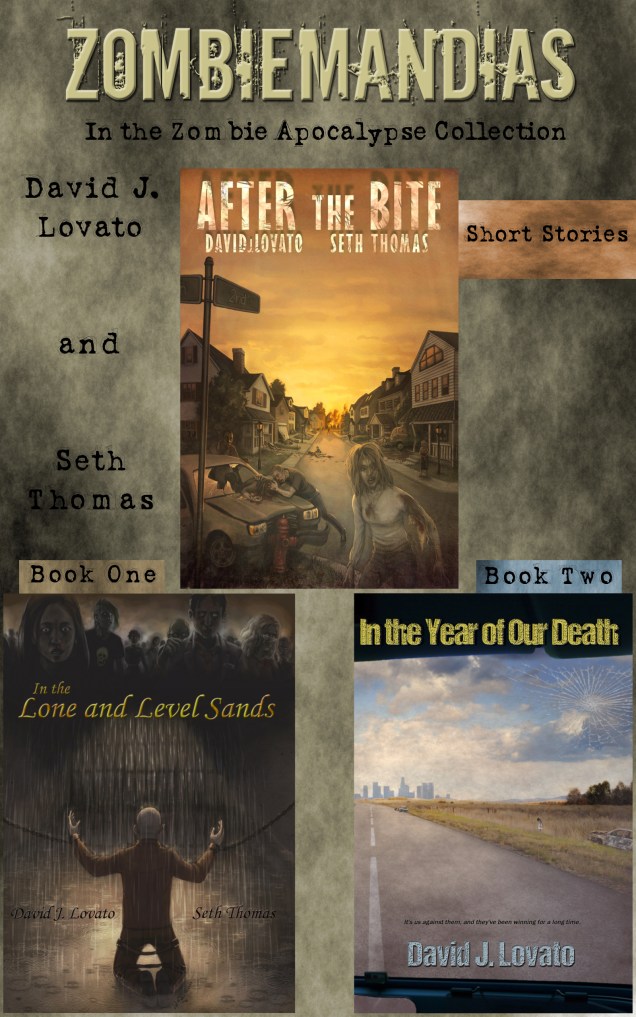
Zombiemandias: In the Zombie Apocalypse Collection

Buying the three of them together will end up being a little cheaper than buying them separately, but fair warning: This is going to be quite a long eBook.

Both books release on October 20th, 2015. Pre-orders will be live soon, I’ll update with links as they’re available. Also, in celebration, the eBook version of In the Lone and Level Sands will be available for free and/or at a deep discount at most retailers through the month of October.

So that’s that. Stay tuned here for release info, teasers, and other goodies.

Thanks always for reading.

What’s in a Name?

Big changes incoming!

Perhaps you’ve noticed this very site (as well as Twitter) list me as “David J. Lovato” while the name on all my covers and storefronts simply reads “David Lovato”. That’s going to change.

Big changes this far along can get messy, and I spent the better part of two days updating all of my book covers and websites to add one little “J”, but the end result will be worth it. Why the change? Well, “davidlovato” wasn’t available for use as a WordPress site, so I added the J way back when, and it’s always good to keep things streamlined. Another reason is that I’m not the only David Lovato in town, and I think it’s best to keep any potential confusion to a minimum. So, starting in the coming weeks, you should see “David J. Lovato” on all of my books and store fronts. Also, it turns out I really like the way it looks. It’s like a little hook cementing my name in place. At the risk of sounding full of myself, I think I’ve realized you can tell a great font by its J.

Anyway, It’s a lengthy process to change all of my links and descriptions and profiles, but I’m almost done, and hopefully I did it without breaking anything too badly.

So, while I’m busy writing a post about my writing, I guess I should give a general update.

I’m way behind on Camp NaNoWriMo, thanks in part to burnout and in part to a household emergency. I may or may not get caught up, but I do plan to finish this project someday, and hopefully not too far away.

I have another project, a big one, that I’m hoping to release by Halloween. More details on that when it’s a little more ready for the spotlight.

I’m kicking around ideas for another poetry book. Possibly two of them. I enjoyed writing and publishing Permanent Ink on Temporary Pages, but for these two, I’m thinking bigger. Maybe louder.

I’m sitting on some novellas! One is finished and polished and I’m working to get it published traditionally. Another one is finished but not edited, and the last is unfinished, but I hope to put the final touches on those two this summer. Not sure whether I’ll self-publish or try the traditional route with them; that will depend on how I feel about the finished products. I also have an almost-finished short story collection that will most likely be self-published; the stories are all set in the same world and follow a specific theme.

And, as always, I have plenty of projects always moving, some slower than others, but they’ll be revealed when the time is right.

In short, I promise I’m working on things, and I’m pretty sure at least one of them will see a release this year.

Speaking of Halloween (I know that was a few paragraphs ago but it’s my blog and I’ll do what I want), last year I started a second RPG Maker project in the spirit of Halloween. With any luck I’ll finish it and release it before Halloween this year. It’s just a short little adventure where I challenged myself to see how odd I could make things go in that game engine, but I don’t see the harm in getting it out there, supposing I finish it. My main project is still Let the Moonlight Give You Wings, but that one is a lot larger and less predictable, so I can’t give an ETA on it. If I do pick up my Halloween-ish game again, expect to see some previews around these parts.

That about does it as far as talking about what I’m working on. One last thing though:

My favorite band is back! I can hardly express how excited I am to see Brand New recording and putting out new material. My history with this band is a long one. I’ll probably write a whole post on it pretty soon. But for now let’s just say they have a new song called “Mene” and you should buy it because it’s awesome.

And that’s it for now. Until next time!

nowReading: The Dispossessed

The Dispossessed
The Dispossessed by Ursula K. Le Guin
My rating: 4 of 5 stars

It’s hard to assign a star rating to this one. On one hand, “it was amazing” is an understatement. On the other, “I liked it” is accurate.

The Dispossessed features sprawling moments of brilliance, pure genius word after word, big ideas delivered one after another. The book doesn’t preach; the characters and even some of the ideas are wrong or don’t pan out at times, it’s as critical of itself as everything it else it criticizes, which is quite a lot. It’s easy to say some of my favorite quotes going forward will have been discovered here. My mind was blown again and again.

It’s not a philosophy book but a work of fiction, and Le Guin has, as always, done a good job keeping the story in front of its moral. As far as her Hain books go, however, this one isn’t all that physically exciting. The page-turning comes from a yearning to take in all of the ideas happening, while the actions of the characters are sometimes downright boring. There are (in my copy at least) an unfortunate amount of typos, and certain areas where the writing itself feels like a rough draft. Some things read more as a summary of events than actual events, there are a lot of lists given, and the chapters are too long for their own good. The decision to split each chapter between past and present is smart, but the chapters are so long it can be difficult to remember where the last time frame left off. Shorter chapters would’ve been easily accomplished without breaking the pattern. Too often things are explained as soon as or even right after they’re relevant to a conversation or action; Chekhov’s gun kept firing before it was hung on the wall or, sometimes, even assembled. More things are placed exactly as they should be than not, but the ones that weren’t are noticeable.

It’s a long read, and sometimes a hard one. There’s a lot to take in. Lots of philosophy, lots of symbolism (the last line blew me away). Less physical action yet more lore than any other Ekumen book, it’s possibly the most important in the series, as well as being an important work of American literature.

It’s amazing. I love the book, even if I only like the story.

View all my reviews

nowReading: The Girl Who Fell Beneath Fairyland and Led the Revels There

The time has finally come. A journey of a few years, which began with me picking up a magazine lying around in the bathroom, has come to a close. Well, a rest stop, at least. I’ve finished reading The Girl Who Fell Beneath Fairyland and Led the Revels There.

(Those wondering what in the world I’m babbling about will find the answer here and here, but the short version is this book’s title caught me by surprise, roped me in, and forced me to sit down and read.)

As I do with most of my reviews, I want to get the bad out of the way before I focus on the good. What can I say? I like to end on a high note. To make a long story short, which is to do absolutely no justice to the complexity that comes from reading a novel, the book didn’t quite live up to the hype I created upon seeing its title. It reads almost like a first draft; lots of lists, lots of descriptions, things are a little sloppy. Characters will drop everything they’re doing and give their entire species’ life story, often times for no apparent reason. Other times, important things happening directly to our main character, September, are glossed over in a sentence or two. Everything is more or less there, but some things feel like they’re in the wrong order, or given the wrong priority. There were also a few typos, and things appearing out of nowhere that probably should’ve been mentioned sooner than they happen.

Another issue I had was in how convenient certain things were. It was like September was never in any sort of danger or peril—a magical person or item would always bail her out at the last second. The real danger of the story, and one that threatens all of Fairyland, isn’t made present until over halfway through the book. In the end it becomes clear why this was intentional, but I’m not convinced it was always justified.

This leads to the main issue I had with it: The first half to two-thirds of the story are a little boring. It reads like a history of Fairyland and Fairyland-Below, but not so much like a story about a girl who has just been spirited away to the underworld of a fantasy dreamscape.

When it does finally pick up, it’s relentless! I couldn’t put it down, I read the last third or so of the book in two sittings, stopping only to sleep. That last bit is as wonderful and magical and heartwrenching as the majority of the first book was.

This leads me to my last comment: It’s worth it, and not just for the third act. Even when giving off random lists or colorful descriptions of things that don’t really matter, there’s so much heart and spirit in the writing. Characters’ histories are interesting and wonderful, even if they’re not immediately important to the story. I wonder if this would have been better as a novella, and if it were accompanied by an actual history book regarding Fairyland, I would pick that up in a heartbeat. But again, to make a long story short: Even when it’s bad, it’s good.

I also found a lot of joy in reading the book’s two afterwords, and, if I might be so bold (and I might; this is my blog and I’ll do what I want!) I would say they are as important to aspiring writers as Stephen King’s On Writing and Strunk and White’s Elements of Style. They’re not as much about the how of writing but do a fantastic job detailing the why, and as far as I’m concerned, they’re required reading for anyone who takes writing seriously.

On the whole, it’s a good book, even if it could’ve used a little more polish.

On to the next one!

nowReading: Still Life With Woodpecker by Tom Robbins

Following is my review of Still Life With Woodpecker by Tom Robbins. You can read more of my book reviews on my Goodreads page.

Line after line is clever, funny, tragic, or some insane mixture of the three. I had no idea where the story would lead me next, but I’ve seldom been so excited to find out. It’s interesting how relevant the book is over thirty years after it was first published, yet so ahead of its time in other ways.

Still Life With Woodpecker transcends the boundaries of its pages in a fashion similar to House of Leaves, where the physical appearance of the book is itself a reflection of the themes found within. This, however, is more of a comedy (though both books boast a good deal of philosophy).

I was reminded of Wes Anderson’s movies and of Arrested Development; things seem ridiculous at first glance but are actually carefully-placed, often sparks lit to ignite later fires. The ones in Still Life With Woodpecker just happen to have dynamite at their ends.

The Ones Who Follow the Water Release

It feels strange posting a book release almost directly after posting said book’s announcement, but what can I say? My November has found me occupied with writing a new project, which I’m just about finished with the beginnings of.

My fantasy novel The Ones Who Follow the Water is available now, at the links below.

The Ones Who Follow the Water front cover

The town of Welby is surrounded by a high wall, erected in long-forgotten days when people remembered their magic and Immortals walked the earth.
Oren and Carah grew up together in Welby, but when Oren makes a mistake that could get Carah exiled, he has no choice but to climb over the wall and enter the unknown world beyond, following a river and looking for a necklace.
The world is full of creatures and people Oren never dreamed of, but friend and foe alike offer him the same advice: Don’t follow the water.
Oren’s journey leads him to an impossible castle, and inside, Oren finds the necklace, and a reason to never go back home.

Amazon • Apple iBooksGoogle Play • Barnes & Noble • Kobo •  Smashwords • Hardcover (Lulu)

Thanks for sticking with me, checking out my books, reading my reviews, and especially to those who leave reviews of your own.

For now, I’m going to get back to my NaNoWriMo project. After that… I have my eyes on the horizon, and I see some exciting things.

Book Announcement: The Ones Who Follow the Water

I figure it’s about time I share the main project I’ve been up to as of late, considering how overdue this is in the first place.

I’m just about finished with The Ones Who Follow the Water, a new adult fantasy novel.

The Ones Who Follow the Water front cover

This is a story that will always be dear to me. When I was in high school I wrote short stories, mostly for fun, and I didn’t have many ideas I could see taking up a full novel. That changed during a camping trip with my best friends, when I had a dream that inspired one.

I tried to write it as soon as I got home. Something like 300 words in, I realized I wasn’t ready to write it. I had about a page and a half, and it read like a summary of the dream I had, not actual storytelling. So I shelved it for years.

I wrote the first draft much later, during NaNoWriMo 2010. I could go on about the process behind the book, but to make a long story short, I edited the life right out of it. The final result was boring, stagnant, almost like that two-page summary I had written years before. I had told the story I wanted to tell, but that was all it was—a sterile recount of a story I could see so well in my head, but failed to get down on paper.

This year I decided to go back over it and breathe some actual life into the story. I re-wrote most of the novel with a better understanding of how to write, how to edit, what audience I was going for, and how to translate the story I saw in my head.

But enough about me. Here’s the synopsis for The Ones Who Follow the Water.

The town of Welby is surrounded by a high wall, erected in long-forgotten days when people remembered their magic and Immortals walked the earth.
Oren and Carah grew up together in Welby, but when Oren makes a mistake that could get Carah exiled, he has no choice but to climb over the wall and enter the unknown world beyond, following a river and looking for a necklace.
The world is full of creatures and people Oren never dreamed of, but friend and foe alike offer him the same advice: Don’t follow the water.
Oren’s journey leads him to an impossible castle, and inside, Oren finds the necklace, and a reason to never go back home.

The Ones Who Follow the Water will be available November 25th, 2014 in e-book, hardcover, and paperback editions. I’ll post store links (including pre-orders) on the book’s main page soon. The Smashwords page is already available, with others coming soon. In the meantime, here’s a trailer for the book:

Authorgraphs

I have a major announcement coming very soon (most likely tomorrow) but before that, I wanted to drop a quick message about Authorgraphs.

I’ve signed up with Authorgraph, so now you can request signatures for your ebooks! Don’t be afraid to send me a request and add my atrocious handwriting to your collection!

The link is here: http://www.authorgraph.com/authors/crackedthesky

It’s also on the sidebar of my blog. There’s supposed to be a widget, but it doesn’t seem to work at the moment, so for now the link will have to do.

Thanks for everything, and stay tuned for a post on something I’ve been teasing for a while now.

Permanent Ink on Temporary Pages Release

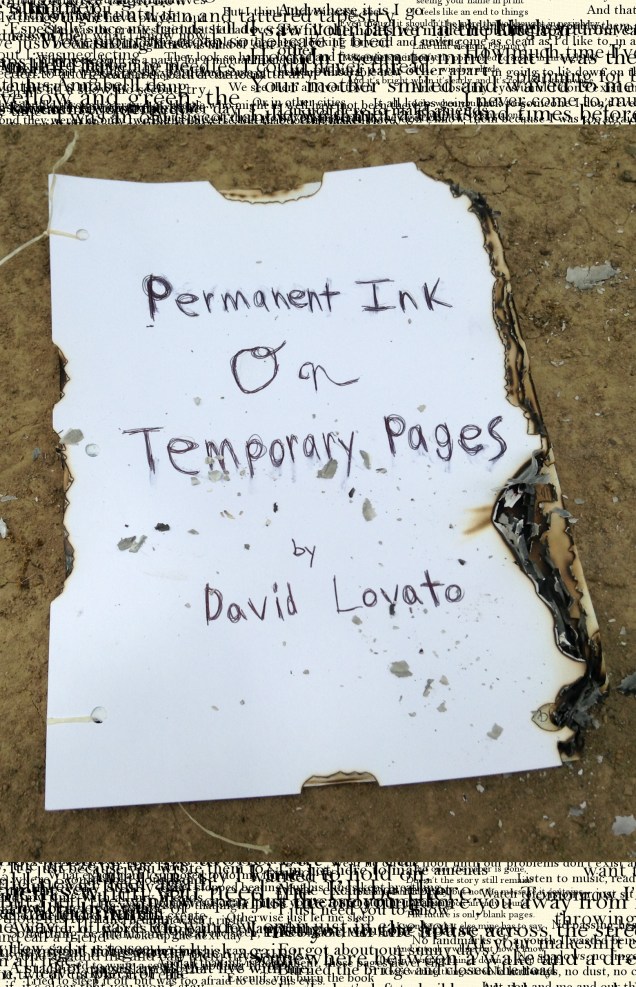
Permanent Ink on Temporary Pages is now available at most online book retailers.

Permanent Ink on Temporary Pages

Each of the 16 poems in Permanent Ink on Temporary Pages stands alone, but also serves as a piece of a larger narrative. From the death of poetry itself in “At Rest in the Sea” to the lifetime-spanning “The Back of the Room”, the stream-of-consciousness piece “Alone” to the song-turned-poem “Sunday Calls for Cloudy Skies”, and the thematically-related interludes “Letters”, “Pages”, and “Poetries”, Permanent Ink on Temporary Pages tells the story of a narrator struggling to find his place in the world, drifting between tangential universes, and replacing the people around him with fictional characters, all the while writing letters he doesn’t send, poetry scattered to the wind, and pages full of everything he can’t bear the thought of losing.

You can find the e-book through these links:

Amazon • Smashwords • Apple iBooks • Barnes & Noble • Kobo • Google Play

The paperback should be up on Amazon and Barnes & Noble soon, and is available through the CreateSpace store now.

Samples of the book can be found at all of its storefronts, but you can also read several poems under the Scenes section of my blog, under “Samples” in the menu bar.

nowReading: The Girl Who Circumnavigated Fairyland in a Ship of Her Own Making

I first mentioned this book in a post I wrote about good titles. To summarize the relevance: In the back of some magazine or another, I found a review for a book called The Girl Who Fell Beneath Fairyland and Led the Revels There. It’s not unusual for me to be captured by a good story, but just by the title? That was new to me. I learned this book was a sequel to a book with an equally captivating title: The Girl Who Circumnavigated Fairyland in a Ship of Her Own Making. The story could be about anything, it could take me anywhere. I had to pick it up.

I’m sure you’ve heard the saying “Don’t judge a book by its cover”, and I suppose the same should be said for its title, no matter how magical, captivating, awe-inspiring. Fortunately, from the first page, the story is as captivating as its title. Nearly every line is full of magic and wit, nearly every scene is crafted as a vehicle to propel the story forward. This is one of the most well-written books I’ve ever read.

It isn’t without its flaws. September, our twelve-year-old heroine, doesn’t sound like a twelve-year-old girl from World War II-era Nebraska. She sounds like a young woman from England, to be honest. Well-read or not, she seems much older than she actually is, except for her naivety. This is a small caveat, and one that is easily overlooked.

I was slightly disappointed by the near irrelevance of the title I fell head-over-heels for. After several chapters of pure magic and heart, it’s a little disappointing to find that the titular ship of her own making takes all of a paragraph to make, and isn’t really a ship at all. The circumnavigating also takes only a few pages, and compared to the events before and after it, comes across a little threadbare. However, this is also easily overlooked, as it almost seems like a joke played by the author; the same kind of trickery the inhabitants of Fairyland often pull on September.

I found the cast wonderful. September is likable without being overtly good, almost inhumanly flawless, as some heroes and heroines are. A-Through-L is a fantastic companion, and even meek Saturday, who is barely present, plays a large enough role to stand out. Some characters are also found where you wouldn’t expect them. Sometimes they’re inanimate objects, and not even magical ones. A certain green sweater plays a prominent role in the book, despite September’s inability to interact with it in any traditional way.

Perhaps my favorite character, though, is The Marquess. She’s this book’s Queen of Narnia, or Wonderland’s Queen of Hearts. The Marquess is, however, far more interesting. She’s frightening but oddly charming, and where Catherynne M. Valente could’ve given us a carbon-copy “pure evil” villain, she instead crafts a character who is human, tragic, and more deserving of this story.

At its heart, The Girl Who Circumnavigated Fairyland in a Ship of Her Own Making is a children’s story, and the kind we need more of. It’s important for children to grow up seeing the world not in black and white, but shades of gray; not as good and evil, but as different viewpoints. This isn’t to say that nobody is ever right or wrong, just that right and wrong sometimes take an adventure to come to. Valente treads a path set before her by the likes of Ursula Le Guin, Neil Gaiman, and Hayao Miyazaki, but still carves out her own place, her own reason for being in it. (While I’m here, I’ll mention that this book would make a fantastic Studio Ghibli film.)

I had so much fun reading this. Books like this are what made me want to write in the first place: A wonderful, magical story from the first page to the last, and beyond the back cover.