Camp NaNoWriMo Day 1

Yesterday was day 1 of the first session of Camp NaNoWriMo 2012. Here’s a brief summary of how the day went for me:

I kicked things off by downloading the 30-day trial of Scrivener for Windows. I had taken part in the beta testing and experienced a very unfortunate saving bug (to the tune of the program not saving anything at all) which was not a very good first impression. This trial version is singing a very different tune. I like the organization a lot. For this particular writing project I’ve been busy since last November, writing detailed character profiles and histories, the history of the world in which the story takes place, descriptions of various creatures that inhabit it, drawing maps of cities and regions etc. All of these are things which must exist in this world but not necessarily be written out in excruciating detail. Scrivener is the perfect software for this as it allows you to do all of the above outside of the actual manuscript. Before I was using three or four different apps and programs, but Scrivener keeps all of this info in one place. I’m not sure yet if this is a convenience worth the program’s $40 price tag, but I guess I’ll see in the coming days.

As for the manuscript itself, I wrote a little over 500 words. It’s a very modest start but I’m not too worried about it yet (for my first NaNo attempt I didn’t begin writing until November 5 and I wrote well under my daily limit until the last week, during which I wrote enough to catch up and finish on November 28th or so). I am hoping to write a little bit more than that from now on.

As for the finer details, my project is tentatively titled The Lament of the Land and it’s a fantasy story. I have a pretty good idea what I want out of it and where I think it’ll go, but I’m looking forward to any surprises it may have to offer me.

I’ve mentioned before that I like to listen to music while I work on first drafts. This project’s playlist consists of Yuki Kajiura’s soundtracks to .hack//SIGN and Tsubasa Chronicle and Joe Hisaishi’s soundtracks to various Studio Ghibli movies (Princess Mononoke and Spirited Away come to mind).

Are you participating in camp right now? How about the next session this August? What are you working on? Let me know your thoughts. If you want to keep up on my camp progress you can find my profile here: http://www.campnanowrimo.org/campers/crackedthesky

Tips for Camp NaNoWriMo

If you didn’t already know, the first session of Camp NaNoWriMo begins this Friday. Camp NaNoWriMo is about the same as regular NaNoWriMo, just in the summer, and there are two sessions (The other one being in August). The goal is to write a complete 50,000+ word manuscript in 30 days or less.

My second manuscript is a product of National Novel Writing Month, and I’ve attempted every session since. I’m going to give some advice to those new to or curious about the process.

NaNoWriMo is a prompt. Its main purpose is to prompt those who otherwise wouldn’t write into doing so, but if you’re already a writer (or even if you aren’t) NaNoWriMo can still come in handy. It’s a lot of fun and adds a little bit more to the writing experience.

Don’t take it too seriously. It’s not about winning or losing, and really there’s no way to lose. Say you pass the 50k word mark, but it took you two months to get there. Who cares? You wrote a book, didn’t you? How is that anything but winning?

Don’t be afraid to fail the deadlines or break the rules. For Camp last year I had an idea I was kicking around, and I decided to wait about a month and a half for Camp to start to begin work on it. It turned out the project didn’t go where I thought it would, and I ended up scrapping it and now I plan to start over. I love my idea, but because I waited so long to start I didn’t realize until it was too late that it wouldn’t go as planned, and because of the word count I tried to force it out anyway. I ended up with a huge mess. Needless to say, I didn’t “win” NaNoWriMo that time. I would have been far better off starting the project as soon as I felt ready and taking the time it needed me to take. I still would’ve failed NaNoWriMo, but I might have had something to show for it.

A friend of mine started a project last November and got a few thousand words in, and while he continues his project, he definitely didn’t meet the deadline. I told him about Camp and he expressed concern that it’s against the rules to continue an old project. I told him it would be better to participate anyway, despite being disqualified from the beginning. Again, it’s better to be disqualified and have a finished book than to not attempt it and have nothing.

Remember to have fun. If it stops being fun, if it feels like your project isn’t going the right way because you’re caught up in rules and deadlines, just take a step back and decide whether continuing with NaNoWriMo is the right way to go. After my Camp fiasco last year, I was able to identify when the same thing was happening to a different project in November. I didn’t hesitate to give up on NaNoWriMo, and come January I had a novella I was a lot happier with than I would have been if I had forced it out a few weeks prior.

With that all said, I’ll be participating in Camp NaNoWriMo this year. You can follow my progress via my page here, and I’ll also try to update my blog with how it’s going. What about you? Are you participating this year? Do you have any advice for NaNo newcomers and veterans? Care to share your Camp profile page? Leave a comment.

Update

It’s been a while since I posted a blog, sorry for that. I’ve been busy developing several projects, on the page and off, and working on revising my manuscripts (at least one of which is coming along quite smoothly).

I started this blog as a daily writing outlet and I sort of failed on that front (not that I don’t write almost every day elsewhere, I do). I’m hoping to focus a little bit more on my blog, so hopefully I’ll start posting more soon, probably beginning with a post on the upcoming Camp NaNoWriMo, including tips and thoughts on the process as a whole.

How have you been? Anything exciting going on in your lives?

How NOT to Write

Sorry for the lack of updates. I reached my Script Frenzy goal very early on but I’m nowhere near finished. I’m also working on several other projects, mostly in the editing phase.

I thought I’d write up a quick list of things to NOT do while writing. Sometimes not doing something is easier than doing something, right? Here’s my list:

1. Use as many big words as possible as often as possible.

2. Describe everything in excruciating detail.

3. Tell the reader how they should feel about something.

In other words, things that make the reader want to put your book down.

Words at the End of the World

Exciting news!

The Write Place at the Write Time hosted a flash fiction contest, and my short story “Words at the End of the World” tied for third place!

The contest had a Mayan calendar theme. I just read the winning entries and I’m happy to be among them. I particularly like the first place story, an emotional piece called “Goodnight” by a very talented young writer named Kendall Junger. I really hope you’ll check these out.

You can read the winning entries here: http://www.thewriteplaceatthewritetime.org/writerscontest.html

Script Frenzy

I’m in the mood for trying something new, so I signed up for this year’s Script Frenzy (http://www.scriptfrenzy.org/). I’ve never written a screenplay before but it seems like fun. I’ll be basing my script on one of my manuscripts as a way to approach the story from a different angle. I guess I have until April 1st to learn the basics of script writing.

A quick note: I recently passed the 10,000 word mark on my latest manuscript. I’m feeling good about this story.

On Big Words

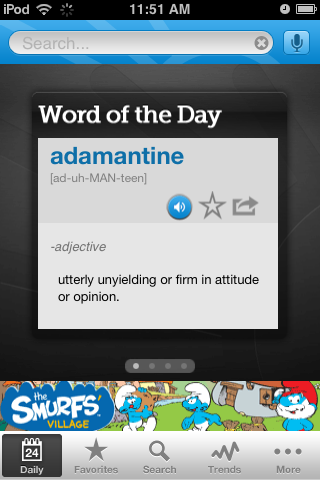
This is a screenshot I took from my iPod. The app is the official dictionary.com app, which I highly recommend. I love the word of the day section they do, and I have a list of favorites that I pulled from there.

However, I rarely get to use them. I tried once, and guess which word was the only one I had test readers complain they didn’t understand?

Sometimes you can say in one word something that might otherwise take more, but that isn’t a good trade off if nobody knows what your one word means. If your reader has to put down your book and pick up a dictionary in order to progress, you’re in trouble. I’m not saying “don’t ever use big or unconventional words” but if you can keep it simple, do so. Sometimes you can make a word clear from the context, and if you can that’s great, but keep in mind sometimes that just adds fluff. Consider:

She might have had a lot of friends had she not been so farouche.

What does “farouche” mean? Ugly? Stinky? Prone to being a big fat jerk? It’s not entirely clear from this sentence alone.

Well, “farouche” basically means “chronically shy”. This is the word that made my test readers raise an eyebrow. The page it was on talked a lot about a character being shy, but the particular paragraph in which it appeared didn’t (save for “farouche” itself). If you’re going to use context as a clue, it might be best to keep the context as close to the word in question as possible. Don’t, however, do something like this:

She might have had a lot of friends had she not been so farouche. She found it hard to talk to people because she was so shy.

The reason I say this is a no-no is because you now have two sentences that basically mean the exact same thing. This isn’t so much context as it is using a sentence to define another sentence, which I’d consider fluff. Incidentally, I’d probably change that sentence to:

She found it hard to talk to people, and she might have had a lot of friends otherwise.

I got rid of “shy” entirely because that’s pretty much what it means to find it hard to talk to people. This sentence doesn’t really show as much as it tells, but it does tell a lot in a few words. For example, since we’re told she might have friends otherwise, we can infer she’s probably a pretty cool person, she’s just shy. It does all of this without making the reader pick up a dictionary.

Don’t use big or unconventional words just for the sake of using them. If you’re a writer, words are the only thing you have to convey what you want to other people, and unless you’re writing only for yourself, it does you no good if those words aren’t understood by anybody.

On Inspiration

Here’s what I’m doing tonight:

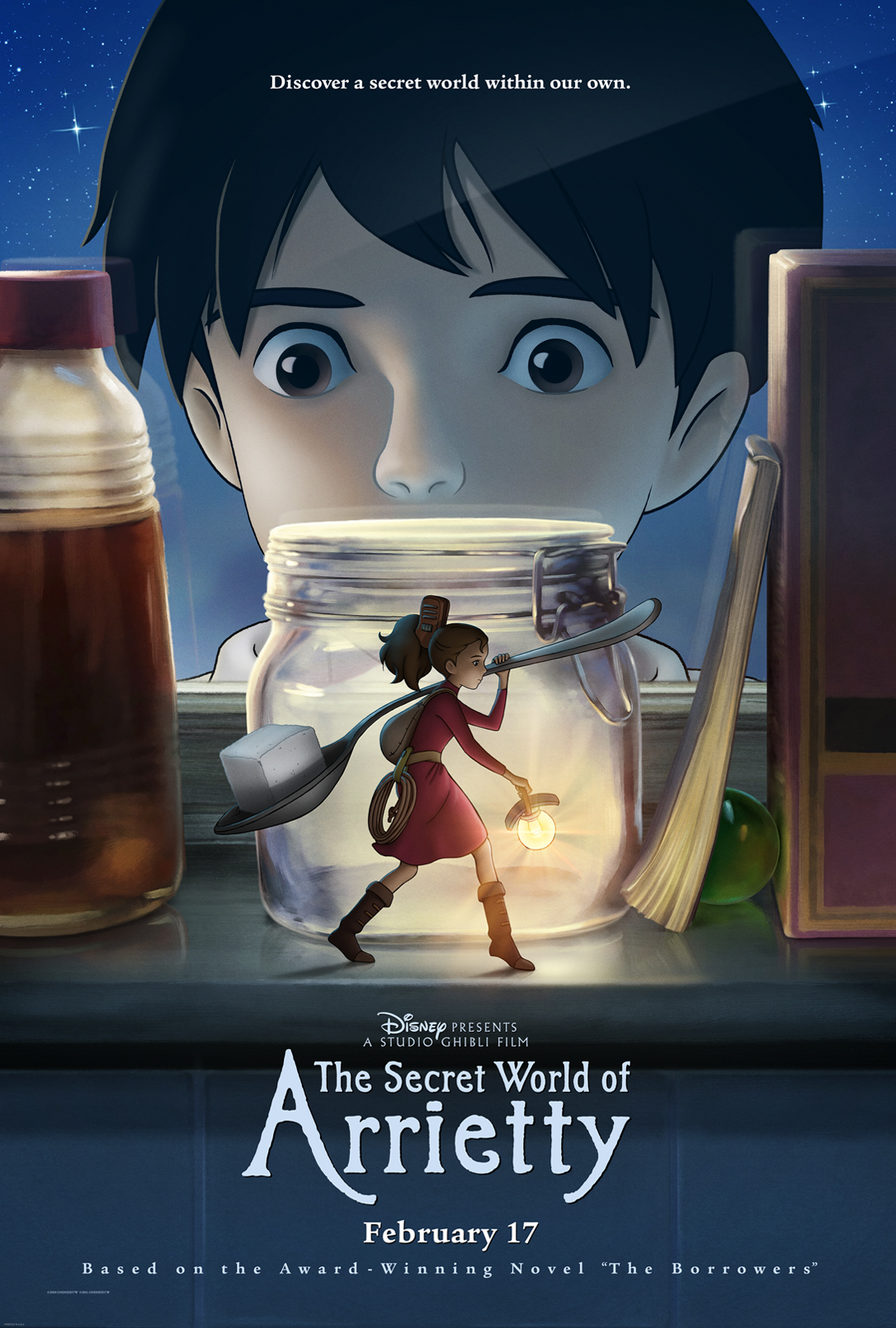
I’m a big fan of Studio Ghibli, and Hayao Miyazaki in particular (he wrote this one, but didn’t direct). Miyazaki is one of my biggest influences as a writer. That might sound strange, since he makes movies and I make books, but it’s the truth. Watching these movies is so inspiring. I can watch them over and over, and every time I’ll catch something new. Every frame has so much detail, every little background object or shot of scenery has a story to tell.

Books can be very inspiring, but inspiration can come from anywhere. Studio Ghibli movies consistently inspire me to write stories. I love them and I can hardly wait to see this one.

What inspires you?

Stumped!

I think all of us as writers have reached that dreaded brick wall. You’re writing your heart out, the story is rolling, everything is going fine, and suddenly you stop. You just can’t move.

What do you do?

Here are some ways I cope with being stumped.

Let’s talk about being stumped within a story. What happens when there’s a boulder in the path? A sandbar in the sea? A locked door in the haunted mansion?

Take a step back. Remember these two things:

1. At any given time, you’re probably only half as clever as you think you are.

What I mean by this is often that plot twist you just have to have might be what’s holding you back. That clever back-and-forth dialogue currently marking the end of your page, the wrong path your character took that suddenly doesn’t seem to lead anywhere, the evil twin from the shadowy past come back to rear his ugly head, sometimes that’s what’s blocking you. If you present a conflict and there’s just no resolution, get rid of that conflict. Focus on what you were writing originally. Chances are, if you introduced some spur-of-the-moment thing and can’t figure out where to go after, that’s why. Your clever little sidetrack might end up derailing your piece overall, and if so, what good is it? Cut it out. Yeah, it hurts, but not as much as not getting anywhere at all. Take a step back, assess what’s really important, cut what isn’t, and you might find your path is a little wider than it looked and you might just find the footing you need to keep going.

2. If you’re stuck, make that a part of your story.

I recall a time I was writing a certain story and I had no idea where to go. My characters had not resolved the main conflict (they hadn’t even discovered it yet) and they were safe and everything was just peachy. Boring, right? I felt like I was at a brick wall. And that was the solution. I literally had my characters reach a brick wall, forcing them to take a different path, one that led right into the main conflict of the story.

If you’re stumped, stump your characters. Just throw a wrench in their gears and see what they do. Sometimes your characters know more about where to go than you do.

This sounds like the opposite of what I said before, and in a way it is. The truth is, there’s no one-size-fits-all solution to problems in writing. The trick is to know which will work for you. If you throw your characters a curve and you write five pages and then get stuck, go back and get rid of the curve. Try a different path, make a different decision. Have them reach that brick wall and go right instead of left. Have them find a way to climb over it.

In other words, try different things. Don’t be so attached to your writing that you fear pressing the backspace key. The backspace key can be your best friend and sometimes your story’s savior. If you think so highly of your writing that you can’t delete a word you wrote, you probably shouldn’t be writing anyway.

Sometimes you don’t get stuck until after you’ve finished writing. This is the problem I’m currently having. My friend and I have a manuscript sitting at 230,000 words. It’s just too darn long for unpublished writers. It’s easy for us to sit there and justify it (two writers equals twice the length, right?) but that doesn’t do us any good. Our opinions on it don’t matter; an agent’s opinion does. Arguing about it won’t get the book published.

So we have a dilemma. Like I said, sometimes that road block comes after you’ve finished your manuscript. Maybe your publisher wants you to delete your favorite scene, maybe your agent thinks your book should be in first person when you wrote it in third. There’s a time for standing up for what you think is right, and there’s a time for discussion, but there’s also a time to concede you might be wrong. Again, take a step back, look at the big picture. Of course you love your manuscript the way it is. You wrote it. Yeah, it feels like someone is coming into your house and telling you how to dress your child (or, more accurately, how to re-arrange their limbs). But give it a shot. Sometimes you don’t know how wrong you are until you see how right someone else is.

That’s all well and good for people who have it from the horse’s mouth, but it’s more difficult when this problem is keeping you from getting an agent or a publisher in the first place. We’ve gone through about a dozen rejection letters, all form, except for one agent who helpfully let us know our manuscript was just too long.

It’s devastating to find out, it really is. We decided to cut our story in half. We had seven viewpoint characters, we cut it down to three and a half and tied off the loose ends. We have a good length going now, but a test reader informed us it doesn’t feel like a complete story anymore.

Back to square one.

I don’t have a solution yet, but I’m working on it. So I’d like to mention a few of the things I do to try to look at a situation from different angles. The answer is there, I just have to find it, and you won’t see anything different if you don’t look at it another way.

Often when I’m stumped (in either of the fashions mentioned) I’ll step away from the story. I’ll go for a walk, or perform some remedial task, like doing the dishes or vacuuming or rearranging my underwear drawer. There’s an episode of The Big Bang Theory where Sheldon takes on remedial tasks to occupy his mind while he searches for an answer to a theoretical problem, and it works for him. It works for me too, and it can work for you. Often when I have some impassible problem, I’ll have a solution within ten minutes of doing one of these tasks. If you’re like me and you live with your parents and writing is your job, you’ll probably be helping them out and keeping them from going crazy for another few days in the process.

Take a step back. Take a deep breath. Look at it from any and every point of view. Try something that sounds like it’ll never work. Try something you have a hunch will. There’s a solution, and it won’t always be easy, but it’s there. You might have to do a lot of searching, but it’s there.

Your turn. What do you do when you’re stumped?