I have another nowPlaying post in the works, but I thought I’d break those up with an update on what else I’ve been up to as of late. Before I get to that, I should say the nowPlaying posts will probably be rare from now on. I’m excited to announce I’ve been taken on as a writer over at Cubed3, where I’ll occasionally post news and reviews relating to video games.
nowReading
I’m about halfway through Still Life With Woodpecker by Tom Robbins. I’m enjoying it; its style reminds me a lot of Wes Anderson’s movies, as well as Arrested Development. Lots of humor, lots of irony.
I’m also reading Lost at Sea by Bryan Lee O’Malley. I found it annoying at first (for reasons I’ll detail when I write a full review), but it’s quickly growing on me.
nowWatching
The Leftovers on HBO. I love Damon Lindelof, I loved Lost, but I have to admit that the show lost focus at some point and never quite got it back. I fell in love with the trailer for The Leftovers and knew I’d give it a chance, but it looked like the kind of show that could go anywhere.
There’s a lot of mystery, but it’s a lot more self-contained than Lost was. Unlike the magical island, there are limits to what can and can’t happen, but that doesn’t stop the show from constantly pushing those limits a little further each episode. It’s riveting, it has an attention to detail comparable to that of Breaking Bad (but not quite the character development, not yet anyway). It’s one of few shows that keeps me on the edge of my seat, constantly wanting to know what comes next.
What I’m Working On
Things have been exciting for me on the writing front. I’m maybe 85% finished with a project I’ve been working on for a long time now. It’s a horror novel, and I can’t say much else about it, other than that I will most likely self-publish it sometime next year.
I’m also still working to get things published traditionally. There are certain projects that are better suited for self-publishing, and certain projects I’d rather do the traditional way.
I have a few other things lined up, one of which I’ll talk more about pretty soon here.
This all leads me to a major project I’ve been working on. I was hesitant to get this one out in the open because I’ve never done something like this, so keep in mind there’s a slight chance the following might never come to fruition. I’d like to introduce my project, tentatively titled Let the Moonlight Give You Wings.
That’s quite a mouthful! So what exactly is it?
First and foremost, it’s a game I’m making in RPG Maker VX Ace. I love games, and I’ve always had ideas for my own, but nothing ever really took off. I’ve worked with engines like Unreal Development Kit and Unity, but I’m not good at making models or scripting, so I always reached the limit of what I could do pretty quickly.
RPG Maker, however, is a little more suited to people like me who are more reliant on GUIs, and it’s also easier to make a game without a team of people working on it. RPG Maker also has an amazing community of people behind it for those moments when a single person runs into some trouble during development.
My sister bought me a copy of RPG Maker VX Ace during Steam’s summer sale. I started playing around with it, and eventually a story began to develop. It’s very loosely based on a fantasy novel I’ve had on the backburner for a while, but it’s different enough that I’m willing to consider it its own story.
Because of this, I’m planning on writing a novel based on the game. The current plan is to release the game for free or under a pay-what-you-want model (with a portion of each donation being forwarded to a few people whose scripts my game wouldn’t work without), and completing the game will give you a coupon to get the book at a discount.
Keep in mind, everything from here out is subject to change.
Let the Moonlight Give You Wings is the story of Emery, the oldest child at an orphanage. It’s a hard life for Emery, as she helps take care of the other kids between chores and school. Emery often daydreams about a fantasy world full of magic and mythical beings, and one night, Emery goes to sleep only to wake up in a world not unlike that of her dreams.
As currently planned, the game will transition between day and night, and character armor will change depending on what’s equipped.
All dreams must end, and when morning comes, Emery finds herself awake in her old life. Much to her surprise, however, when she goes to sleep that night, her dream picks up right where it left off.
Emery is caught between a world that desperately needs her and one that seems as though it doesn’t want her, and embarks on a journey to save them both from disaster.
The game itself will have a lighthearted, tongue-in-cheek tone, for the most part. I want to pay homage to all the games I grew up with, but bring something new to the table as well. There’ll be quests, side quests, puzzles, and a lot of backstory told only to those players who seek it out. I like being rewarded for exploration, and my game should reflect that.
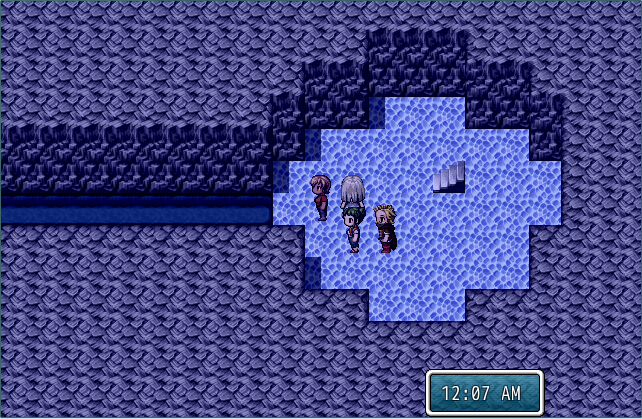
Four members of the party explore a cave.
A large emphasis will be put on the game’s characters. I currently have a system in place that randomizes most of the game’s conversations. Put simply, pressing the action button on certain objects, characters, signposts, etc. brings up dialogue and comments from the game’s characters, but it’s randomized. You might get a different conversation every time you play it. Having certain characters in the party will make different dungeons and puzzles easier or elicit different responses from NPCs.
There’s also an affinity system in place. Leveling up certain characters will unlock special conversations with them, and eventually allow them to tap into their full potential.
This is a lot of work. Writing out a single event can take all night, but so far, it’s been worth it. My main priority with this game is to tell a story that can only be fully realized in video game form, though I’m still going to try my hardest with the novelization as well.
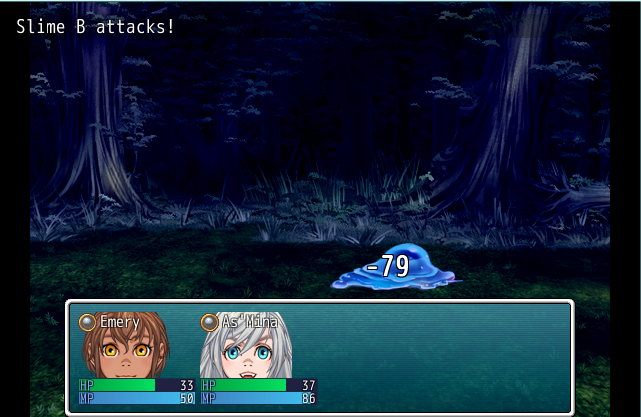
An in-battle screenshot.
I wish I could give a timeframe for release, but it’s way too early to tell. Certain things I think will take a while to finish end up taking a few hours, other things I think will take a few minutes end up taking days. There are a lot of variables involved (pun intended) and there’s just no way to say when this’ll be finished, and even then, I have to have people playtest it, look for bugs, etc. I do, however, think it’ll be a few months at the most (knock on wood!) before the bulk of the game is finished.
I’ll hopefully talk more about the game as it progresses. Certain things aren’t set in stone yet, but for the most part, the core of the game is. I’m hoping to eventually devote full posts to some of the game’s cooler features.
And that rounds out some of what I’ve been up to lately. It might not seem like it, but this is mostly backburner stuff. My current major project is coming along nicely, but I’m saving it for its own post, coming up pretty soon.
I try to make my reviews as spoiler-free as possible, but there is an aspect to this game that can’t be ignored, yet I don’t want to spoil. For that reason, I’ll include the spoilery parts under a “read more” link for those who aren’t aware of what P.T. really is.
All screenshots were taken by me using the Playstation 4’s share feature.
Last week, at Sony’s Gamescom conference, they debuted a trailer for a new horror game called P.T. The playable demo for P.T. launched immediately after, available for download on the Playstation 4 store.
As it turns out, P.T. was harboring a huge secret that only took the internet about an hour to figure out, after which news broke everywhere. I went into P.T. after reading the headlines, so I knew what I was working toward. I did not, however, have any idea what I’d be working through.
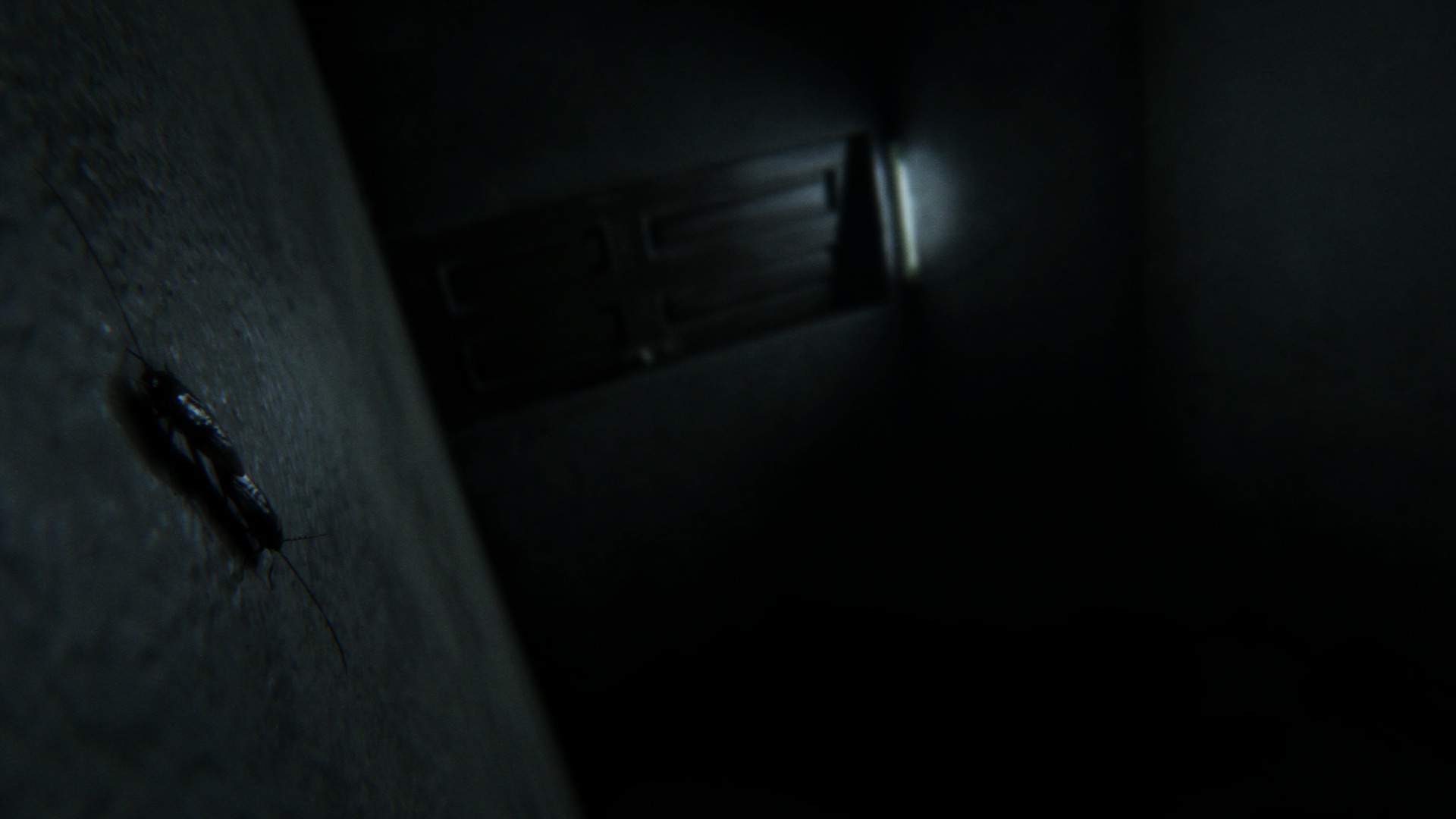
The opening shot of P.T.
P.T. is a horror game. You’ve probably seen my thoughts on the horror genre in video games on this blog before (if not, I touch on them in my Outlast review here). In short, all of the horror classics have either gone on hiatus, or have shifted genres until they’re not really horror games anymore. Many indie games have come forward to fill the gap, but a lot of them are too short for their own good (and let’s be honest, a lot of them are also ripoffs of Slender).
P.T. pays homage to recent works of indie horror. Played from a first-person perspective, you wake up in a grungy basement, complete with cokcroaches. The basement has only one exit, so you take it, and find yourself in a hallway.
Immediately noticeable are the game’s stunning graphics. While the anti-aliasing is almost nonexistent and screen tearing is present at times, the lighting sets the mood. Things are perfectly reflected in the hallway’s polished floor, the lights bounce shadows down the hall as they would in real life. It looks like a real hallway.
The first hallway you find yourself in. It won’t be the last time you see it.
Walking down the hallway reveals a messy house. Food and empty beer cans litter the floors and counters, cockroaches scurry across all surfaces. Rain hits the windows from outside, a rusty hanging light groans as it swings back and forth in the foyer.
There’s a radio near the front door that blasts a news report about a father who snapped and killed his family. He’s the latest in a rash of similar events. The report is staticky but audible. When it’s done, you try the front door and the hall door. Both are locked. There’s one more door, down a set of stairs, leading to the basement. Yes, the basement you just came from.
So you try that door. You swing it open, and beyond you find the same dirty hallway, the same lights and cockroaches and rain. It’s a sight you’ll want to get used to, because every trip through that door leads back into the same hallway.
From here, the ambiance takes over. Musical cues and sound effects become just as important as the lighting. Playing with headphones is a must, and this hallway comes to life.
P.T. is a psychological adventure, so I’m not going to spoil all of the fun things that happen along the way. There are many puzzles to solve, most of them extremely difficult. This is not an understatement; the game’s creator recently said he wanted this thing to take at least a week to solve, and require teamwork from people around the world. This is evident as flashes of text in multiple languages pop up on the screen, and the events that play out are randomized—how one person solves a puzzle can be completely different from how another person solves it. If you ever played video games before internet guides existed, you might remember your friends at school swearing that if you do some quirky thing or another, something special will happen. “Stand right here, spin around three times, press A-B-A-B-X-X-Y-Y and you get the ultimate weapon!”
P.T. conjures echoes of that, with people on the internet swearing by certain events that produce no results for others who try them. The psychological creepiness of this game extends far beyond the game itself.
There’s another aspect to the horror of this game. It doesn’t take many trips through the ever-looping hallway before your character begins to be followed, and then directly haunted by an ethereal being. This creature will persist through the rest of the demo, and can get you at any time. Sometimes she’s harmless, other times she kills you, sending you back to the basement (but with all of your progress intact). Oh, and don’t make the mistake of feeling safe on the pause screen.
When this clock strikes midnight, all bets are off.
Atmosphere is the main source of scares in P.T., which is exactly what the horror genre needs. It can be frightening to see a horde of creatures approaching you, it can impose a sense of impending doom that makes you sweat as you try to off the nearest ones or simply run away successfully, but I think it’s more frightening if a game manages to give you that sense of impending doom without any visible cues at all. “Something’s going to get me pretty soon” is always trumped by “Something’s going to get me and I have no idea what, how, or when.” P.T.‘s essence is the latter.
Keeping with its psychological undertones, P.T. is more than it seems. Beating the game unlocks a post-game trailer that reveals all. If you want to unlock it yourself (and have somehow avoided all of the news spoiling it), you should stop reading here. Otherwise, feel free to press on to the next page.
The following screenshots and impressions were created during the Destiny Alpha phase, and may not reflect final game decisions. The game enters its beta phase on July 17th, 2014.
I won’t go into detail about the way the Halo franchise changed video games. I’m assuming anyone reading this who has even a passing knowledge of video game history probably noticed it. Keeping it to a minimum, Halo redefined online multiplayer, paving the way for first-person-shooters for years to come. On the campaign front, it didn’t have the most original story (which isn’t to say it had the most unoriginal story either; the game was perfectly average in that department).
Behind the first three Halo games was a studio called Bungie. Bungie wasn’t new to the video game world, and while they saw moderate success in games like Marathon and Oni, it was Halo that established the studio as one of the most prominent developers in the industry. Bungie’s work on Halo would end with a game called Halo: Reach, a prequel to the series.
Some fans of the series found the changes to Halo: Reach’s multiplayer unwelcome. I don’t hate it, but it’s a different experience from Halo 3. With that said, Reach is my favorite game in the series for its campaign. Creating my own Spartan made the story a lot more personal, and the emotional impact of the game is present from the beginning: The first Halo game begins with the human race becoming nearly extinct. Halo: Reach takes place before that. You know from the gate it isn’t going to end well, yet every comrade who falls along the way takes its toll on you as a player, until that final moment when you provide cover fire so the humans, along with one Master Chief, can escape Reach. A post-credits scene puts you in control of your Spartan one last time, and ends only when your health is depleted and you’re overcome by enemy forces.
I found Halo: Reach impressive in terms of graphics and story, with a solid multiplayer component as its backbone. After Reach, Bungie could’ve done a lot of things. For a long time, fans of the studio waited to see what they would come up with next. After a few years of little to go on besides industry leaks, Bungie’s next game was revealed in 2013: Destiny.
For a lot of us, having Bungie behind the game is the only hype we need. Others aren’t so easily convinced, and early screenshots and videos showed what almost looks like a Halo skin for Borderlands. That in itself isn’t a terrible premise for a game, but compared to Halo, it was hard to see Destiny as an industry-changing juggernaut.
That changed during E3 2014, when Bungie unveiled a pre-release Alpha phase, inviting PS4 owners to play a small part of the game before the upcoming Beta phase. Anyone with a PS4 could sign up, and I made sure I was among them.
“It’s just a game,” I thought over and over again in the days before I received my invite via email. On the one hand, what if it sucked? If the game were terrible, it would easily become the biggest flop in video game history.
But what if Bungie really could pull another Halo?
Sometimes a work of art is more than its medium. Some movies are more than movies, some paintings are more than paintings, some songs are more than songs. The same can be said for video games: The Legend of Zelda: Ocarina of Time, Shadow of the Colossus, and Half-Life 2 come to mind. Halo was close; if not for the lackluster story that seemed tacked-on in comparison to the multiplayer element, it would be there. (Halo: Reach had the opposite problem: A fantastic campaign with a multiplayer element that wasn’t quite up to snuff compared to its predecessors.)
The pre-release information on Destiny sure made this seem possible. Bungie promised a world in which single-player and multi-player aren’t two incompatible selections on a main menu, but a perfectly blended media through which an epic work of science fiction would be told. But promises are wind; I was told I could step on a flower in Fable and it would butterfly-effect my entire game, I was told I could approach anyone in Skyrim and ask them to go on a quest with me. Neither ended up being true, and those things seem easy compared to what Bungie had promised with Destiny.
I signed in. I created a character. I wished there were more customization options; it seemed like I had a choice between five or six faces and maybe ten hairstyles I was willing to use. The only customizable part of your Guardian is their head. You can pick a gender and one of three species, and change those parts of the head I mentioned, but it’s all but in vain: Your character will almost always be wearing a helmet. Some customization in terms of body size and proportions would’ve added to the immersion. But this is all superficial, a tiny part of the game.
The Destiny Alpha threw me right into the story, on what I surmise is chapter 3. Out of how many, who knows. I was dropped into a map many times larger than the largest Halo map, my Ghost (a robotic companion voiced by Peter Dinklage) gave me a few clues on what to do, and then I was on my own.
The game’s layout and style will be immediately familiar to fans of Halo.
Well, not quite. Two other people were dropped into the world right next to me. The three of us set off, unfortunately in different directions. This is likely to become one of the biggest criticisms of the game, I think. Much of the game revolves around the idea of forming teams of three players, but unless you’re playing with friends or get matched with people willing to cooperate, you might as well be playing alone.
Not that playing alone detracts from the game. It certainly didn’t for me. It was always interesting to be exploring on my own and run across another person (or several) who were engaged in a fierce battle, drop what I was doing and help out, and then go on my way. It’s also nice when you’re in a pinch, expecting to be taken out any second, and then three or four Guardians show up out of nowhere and turn the tide of battle.
Exploration was fun. There are always things to do, whether it’s fight enemies, collect items from the environment (there was only one type of collectible I noticed, I’m hoping there are more in the final build of the game), or just summon your vehicle (which could use a more specific name, in my opinion) and ride around the terrain.
This story mission offers only a peek into what’s going on: There are two factions of aliens fighting each other and you. As a Guardian, your job is to defend the last living humans.
The story has a lot of potential, and Bungie appears to have circumvented one of the biggest problems you’ll find in gaming. When a game mixes single-player and multi-player elements, it’s difficult for any player to feel special. There are games like those from Bethesda, where your character is special and no other human-controlled player ever enters your game. There are others like Pokemon, where your character is special and you can play with others only in a select mode in which they’re little more than passing strangers, a step above NPCs. Then there are games where you play with as many people as you want and nobody is special, or NPCs refer to you as though you are when you’re really not; there are a thousand other “chosen ones” running around next to you.
In Destiny, there isn’t just one Guardian. There are many of them, so the presence of other players makes sense. When you enter an area that would make your character unique, the game un-loads other players. They see cinemas and events on their screen, but they don’t see you, and vice versa. This makes you feel like you’re not alone in the world, but that your character is actually a person experiencing things other people aren’t. It’s very interesting, and I’m excited to see just how crazy the story gets.
The game itself is immediately familiar to anyone who has played Halo. That “Borderlands with a Halo skin” analogy works to an extent, but only insomuch as the game’s controls. I never felt like I was playing Halo or Borderlands; it was clear I was playing something new.
Something else stood out from the beginning, this one negative. It’s almost hard for me to type this, but Peter Dinklage’s voice acting is… sub-par. It’s actually shocking. I love the guy on Game of Thrones, and I know he can voice act, so I don’t know what’s going on. I keep hoping there’s some logical reason behind how bored he sounds (he is, after all, playing a robot; but there’s monotone robotic voice, and then there’s actor-is-half-asleep voice, and Destiny very abrasively has the latter). There are a few possibilities. I was dropped into the game on chapter three, so maybe the beginning offers some kind of explanation for the droning, unexcited tones Ghost speaks in. It’s also the Alpha build, and the playable part of the game was shown over a year ago, so it could also be a sort of rough draft. There is also the possibility that Dinklage, his voice director, or some combination of people involved just plain dropped the ball. In the end it’s no dealbreaker, but I was very excited to play through an entire game with Dinklage’s inimitable voice accompanying me, and the Alpha defeated much of that excitement.
UPDATE: After playing the Beta, it’s clear that the Alpha included a very rough version of Ghost’s voice. The Beta includes re-recorded and enhanced vocal effects to give ghost a more mechanical sound. The flat audio from the Alpha appears to have been a deliberate choice after all, and the end result is much better. I’ve left my original complaints in the article to reflect my reaction to the Alpha, but the Beta has very much cleared all of my doubts about this part of the game. Props to Bungie and Peter Dinklage; I love the character already.
Once the story mission was finished, I was taken to an overworld menu. Here it’s clear what Bungie is doing in terms of gameplay. You select a planet, then a part of a planet, and then you’re given three choices in missions: Story, Explore, and Strike. Story missions progress the main story behind the game. Exploration drops you into the area and lets you roam, but it’s also full of little blinking boxes that, when found and activated, give you sub-missions, such as defeating a certain type of enemy, scouting an area, or finding supplies. Strike missions are sort of a mix between the two, and require teams of three to complete a more linear series of goals.
Aside from those three modes is The Crucible, which is the player-vs-player mode. This will again be familiar to fans of Halo: Two teams compete in deathmatch, capture-the-flag, or various other modes.
The Crucible loading screen. Each ship represents a different player on the same team, and while they all appear the same in this screenshot, your ship is customizable and will appear so on such screens.
Where it differs from Halo (and just about every other FPS) is that it doesn’t take your things away. You aren’t given a carbon-copied mannequin to play as; you get your Guardian, complete with their armor, weapons, special abilities, everything.
This is a concept I’m sure every FPS player has thought about, and one that usually looks better on paper. After all, when you have a game as customizable as Destiny, where each player has different weapons, armor, and abilities, how do you create a fair fight?
I can’t answer that, but somehow, Bungie pulled it off. I never felt like I was being overpowered or that I was dominating; almost every match came down to the wire. Neither team was ever far ahead of the other, victory was never squarely in my grasp. The matches were fast-paced and fun. Since I was never sure I was going to win or lose, I found myself not even caring, and just playing the game. I don’t know of any other game that does that for me. And this is just one PVP mode; there are a handful, but only one was available during the Alpha.
A standard PVP results screen.
There’s also the Tower, which is the hub of humanity. To my surprise, when you enter the Tower, the game switches to third-person mode. This is the only area (in the Alpha, at least) in which your character doesn’t wear their helmet.
The tower, with my character sans helmet in the foreground.
The Tower is full of NPCs that run shops, give missions, manage items, and deliver mail. It’s an interesting area, though the third-person controls are a little rusty (think Fallout 3 as compared to Skyrim), and I couldn’t shake the feeling that the Tower is, essentially, a main menu that makes you walk to each selection.
On the flip side of that, other players popped in and out of the Tower, and a few emotions were available, such as waving and dancing. This led to a lot of humorous shenanigans between players, and makes the Tower a worthy addition to the game. At one point I found a guy sitting on the edge of a skyscraper looking out at the Traveler, that iconic gigantic white orb at the core of Destiny’s story. I sat my character next to him, and a third guy joined us. After a little sightseeing, the three of us stood and danced for a while, after which the two of them jumped to their in-game deaths. I don’t think I’ve ever laughed so hard at something in a video game.
Enjoying a night at the Tower.
Also, dancing.
It’s that inter-personal connectivity that makes Destiny what it is. You’re playing alone and with others at the same time. It’s easy to see why the game took so long to complete; everything just works. Playing the Alpha was everything I thought it would be: It’s like when you’re younger and you have all of these awesome ideas for a video game, and as you get older you realize how impossible it all was, how so many different nuances and elements couldn’t possibly work together. Destiny has the potential to be that game you always wanted to make, and Bungie made it work together. I don’t know how, I don’t want to know. I’ve never played a game like this, and I can’t wait to see the finished product, and what the projected sequels have to offer.
The Destiny beta begins on July 17th for Sony consoles. I play on PS4, where my username is crackedthesky. Feel free to add me and play along in the beta.
All screenshots were taken by me from the Playstation 4 version of Outlast, and may contain graphic imagery.
I have a long history with the horror genre. Nearly all of the short stories I wrote as a teenager were horror stories. I loved horror films as well, and it’s no surprise that my fondness for the genre eventually extended to video games.
It started with Resident Evil, as it probably should have. I bought Resident Evil and Resident Evil Zero for the GameCube, in time to play through them before the then-impending release of Resident Evil 4 (which I still consider one of the greatest video games ever made). Eventually I’d move on to other genre classics like the Silent Hill series, Dead Space, Left 4 Dead, you name it.
I think the horror genre works particularly well in the world of video games. The added layer of interactivity video games provide gives you a sense of peril not possible in film or literature. It’s not impossible for a book to be frightening (I can easily refer you to House of Leaves by Mark Z. Danielewski and the short story “Vaster Than Empires and More Slow” by Ursula K. Le Guin) and you’re even more likely to find a frightening film, but video games have an innate ability to hit the fear sweet spot.
I grew up on survival horror video games, but the last few years have yielded a drought for the genre. Resident Evil is more about action now (and I liked Resident Evil 5 and I liked Resident Evil 6 even more, but the horror element is barely present). Silent Hill sees few releases these days, but the series has gone more or less the same way, and while Dead Space 3 tried to strike a balance between action and horror, it mostly abandons all attempts at fear after the first third of the game.
I must not be alone in my yearning for the survival horror classics of the past, because indie developers have stepped up to fill the void most major publishers seem to be ignoring. Games like Slender, Underhell, and Amnesia bring a lot to the table and prove survival horror is alive and well, but my favorite slice of this indie survival horror pie has to be Outlast.
The Blair Witch Project didn’t invent the found footage genre, but it did propel it into the mainstream. A few attempts have been made to translate it into video games, but Outlast does it the best. You play as Miles Upshur, a reporter who receives an anonymous tip about atrocities being committed at Mount Massive Asylum. Armed only with his video camera, Miles breaks into the asylum. The video camera plays an integral role in Outlast, being Miles’s only ally within the walls of Mount Massive.
The anonymous tipster wasn’t joking, and Miles immediately becomes trapped in Mount Massive, wandering the dark and bloodied hallways, using the camera’s night vision mode to navigate dark corridors and sneak around pursuing enemies. Night vision isn’t unlimited, and Miles must keep a stock of batteries to power it as he tries to record the events unfolding in the asylum, or just find a way out.
A few survival horror games put you in the role of a defenseless protagonist, relying on stealth and running away rather than confronting enemies head-on. Outlast is interesting in that not everyone in the asylum is trying to kill you–some of the inmates will actually aid you, some will ignore you, and some will aid, ignore, or attack you depending on their mood.
Outlast features no playable combat, forcing you to rely on stealth and hiding to avoid enemies.
There are no ghosts or monsters in Mount Massive, only mentally disturbed people. While some have an inherent propensity for violence, others only mistake Miles for another “doctor” arriving to further torment them. This human aspect permeates the game, and even extends to Outlast’s primary antagonist, Chris Walker.
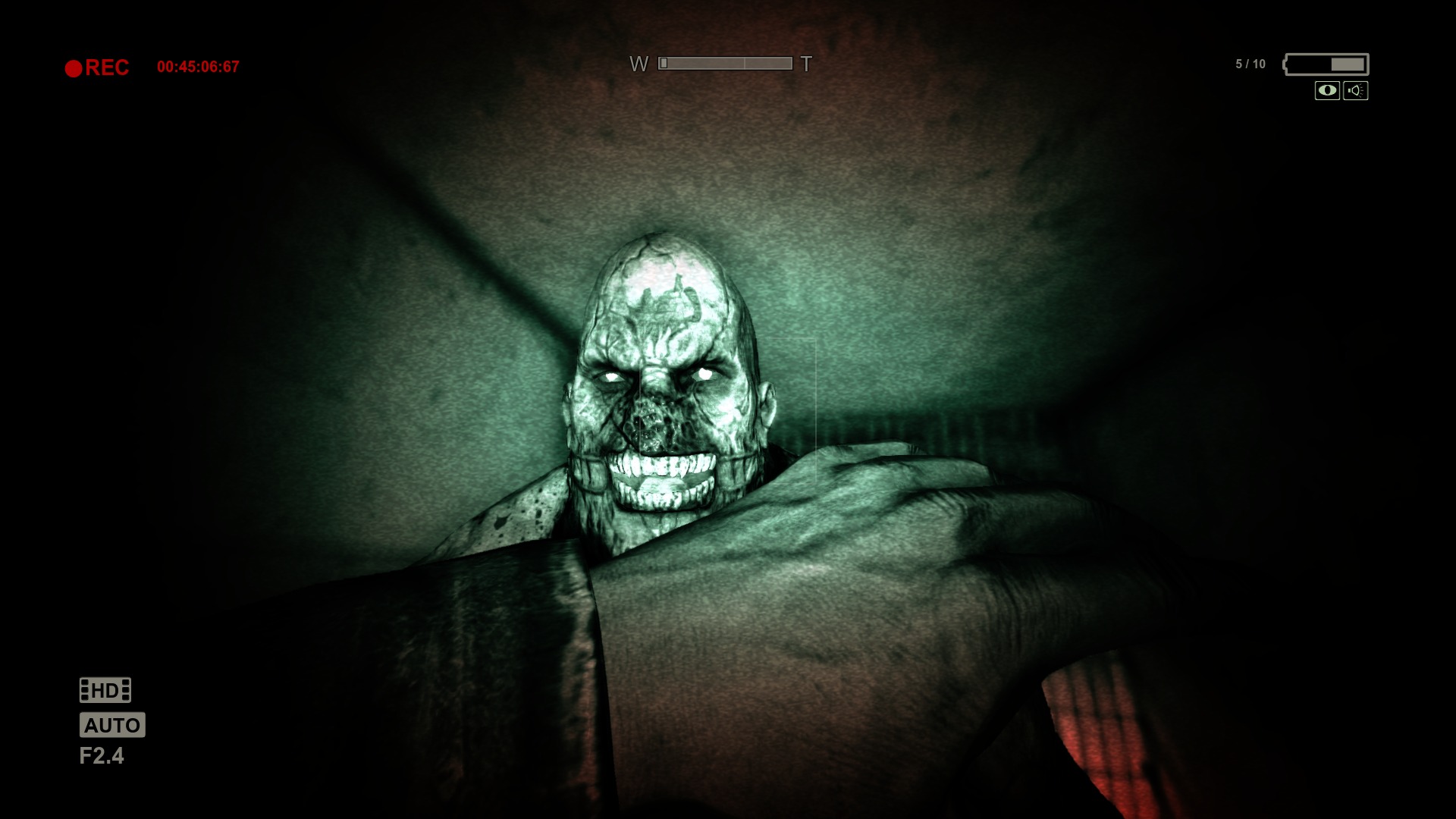
Walker is an ex-marine committed to the asylum long before Miles’s arrival. Easily the largest inmate, Chris stalks the halls grunting about completing his mission, rattling his chains, breaking down doors, and occasionally ripping off people’s heads. He has a particular interest in Miles Upshur, and if he catches you with low enough health, it’s an immediate game over.
Protagonist Miles Upshur tries in vain to defend himself against Chris Walker.
Other characters (like Father Martin, Doctor Trager, and the twins) give the game a sense of personality. They’re well-written, oddly charming, and create lingering presences that keep you on your toes throughout your stay at Mount Massive.
The story behind the events at the asylum unfold through documents and in-game dialogue and graffiti, all pointing Miles toward one thing: The Walrider. I won’t spoil what the Walrider is, other than it’s the one inhuman thing in Mount Massive, and Miles will eventually come face-to-face with it.
A lot of the game’s events are scripted, and the layout and level design are genius. While you’re rarely not in control of the protagonist, the building is designed to make sure you’re looking at the right places at the right times to see exactly what you need to to progress the story, or just to frighten you.
Outlast had me on the edge of my seat, but the game’s ending left a lot to be desired. My largest gripe with the horror genre is the way many works end. Often they’re predictable, ambiguously grim, and usually avoidable scenarios that feel more like the writing team checked out early than actually sat down to wrap up the story they created. Outlast was no exception to this rule. At least, not until Whistleblower.
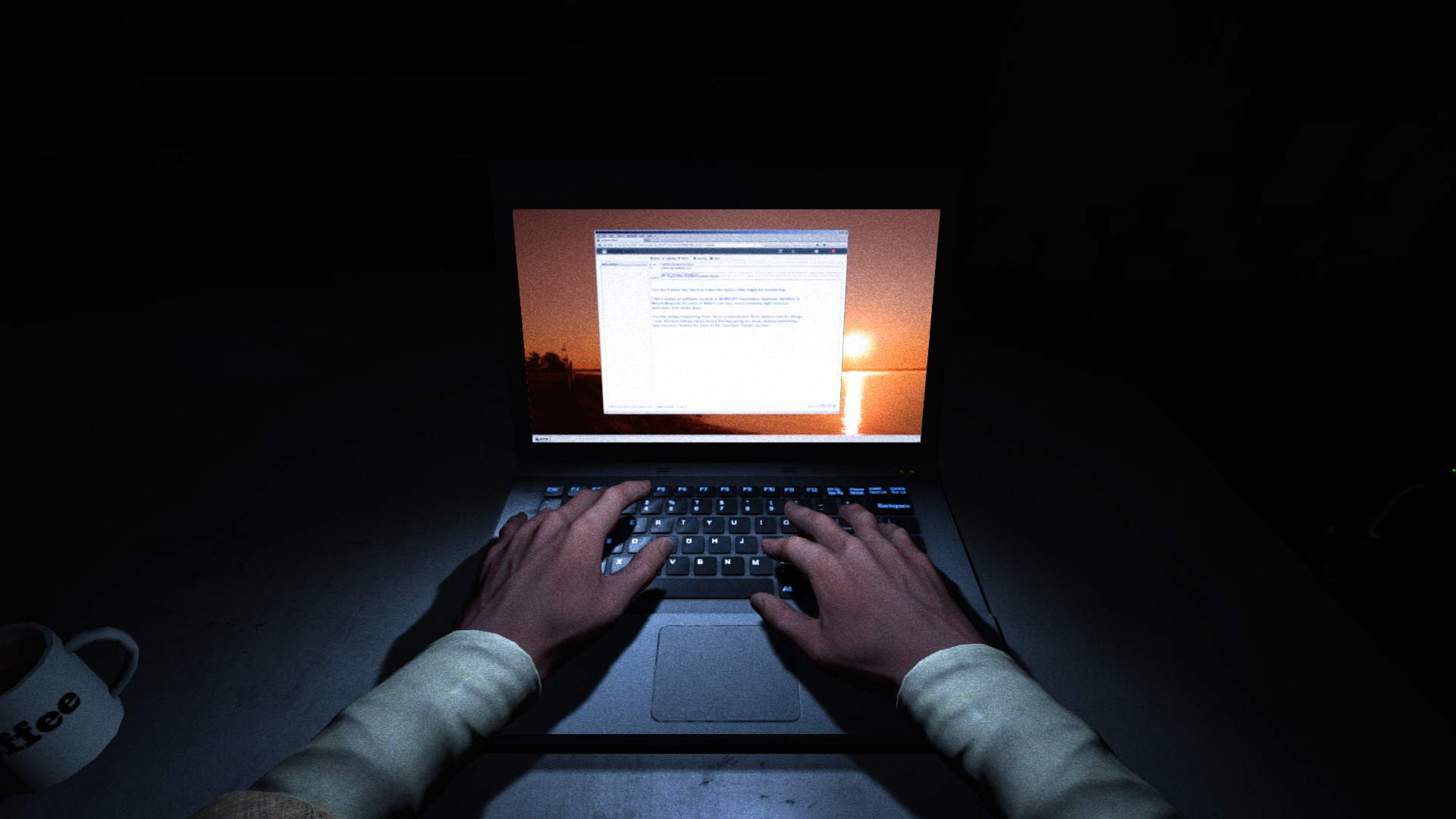
Outlast: Whistleblower is a DLC prequel/interquel/sequel to the main game. In it you play as Waylon Park, the anonymous tipster who first alerted Miles Upshur to the events at Mount Massive. The two stories heavily intertwine, which is apparent from the beginning: Your first objective as Waylon Park is to send the email Miles Upshur receives in the main game.
While it starts earlier than Outlast, Whistleblower is meant to be played after. As Waylon Park, you’ll experience echoes of Miles Upshur’s actions throughout the game, which leads to several Easter eggs and clever encounters with old enemies and allies.
Waylon Park prepares to send an email that will change his life—and Miles Upshur’s—forever.
Whistleblower doesn’t rely entirely on the old, however. The DLC introduces new characters equally as creative and frightening as the ones found in Outlast. Dennis, Frank Manera, and Eddie Gluskin almost make you wish you were being hunted by the twins or Doctor Trager again.
Outlast and Whisteblower touch on the “body horror” subgenre made popular by works such as Alien, The Thing, and Dead Space. As far as subgenres go, body horror is one of my favorites. When you can all but feel what’s happening on the screen, the horror becomes more visceral, more effective. Again, I don’t want to ruin the fun, but neither Miles Upshur nor Waylon Park will emerge from their time at Mount Massive entirely intact.
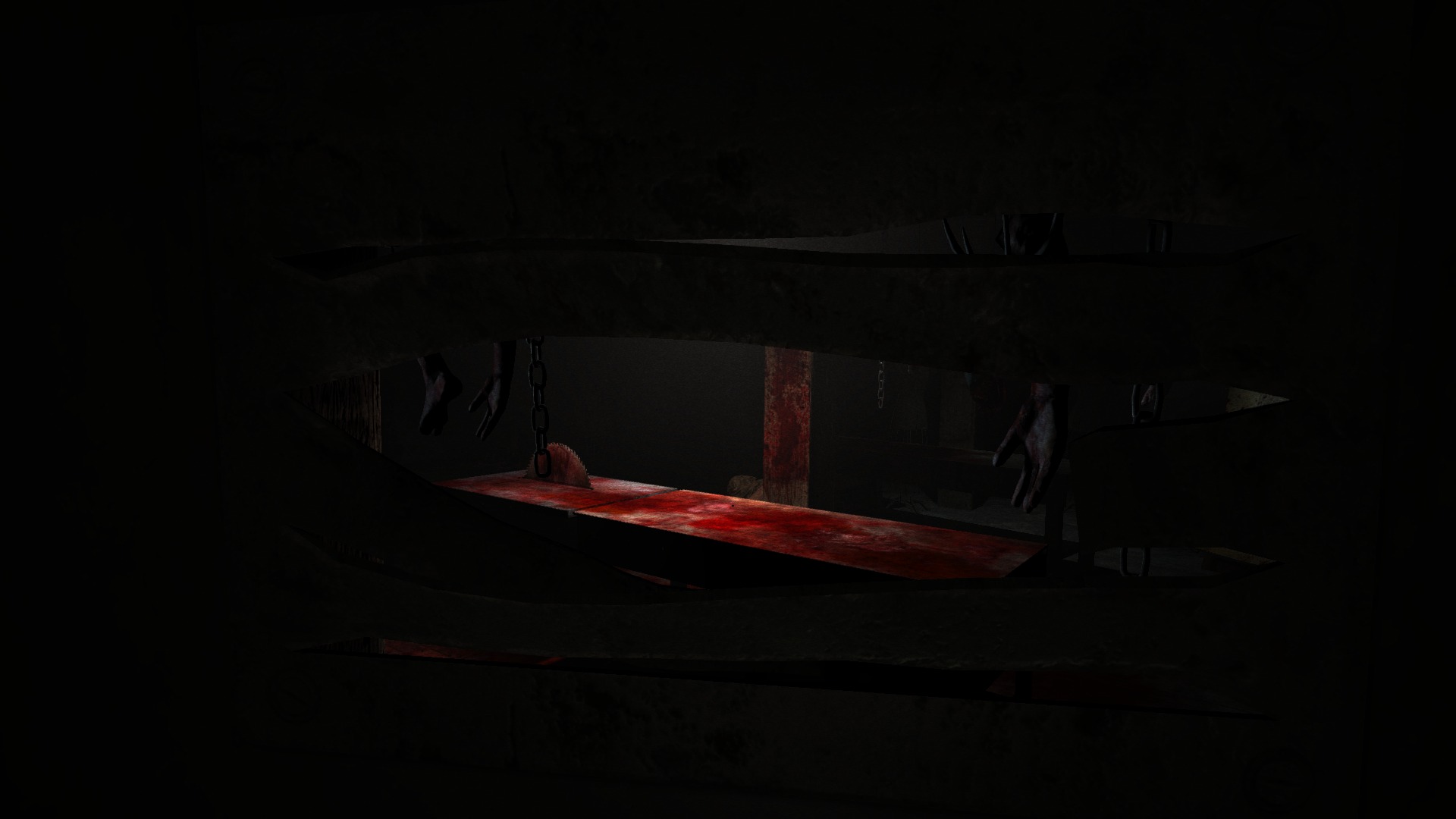
Inmate Eddie Gluskin’s operating table.
Whistleblower is a much shorter experience than Outlast (my first playthrough of the main game took almost seven hours, while Whistleblower hovered around two) but it remedies all of my qualms with the game’s ending.
Both Outlast and Whistleblower come with a layer of social commentary (the former on mental health and treatment of those suffering from disorders, the latter on the titular concept of whistleblowing) but it never gets in the way of the game’s main intention: Telling a story. A very disturbing, frightening, and totally fun story.
The team at Red Barrels consists mostly of former employees of Ubisoft and Naughty Dog, and proves that a game doesn’t need a huge budget or a large studio to be as good as the $60 discs you’ll find on store shelves. Outlast is a lot of fun and one of the best survival horror experiences I’m aware of. I’m excited to see what else the studio has to offer, not to mention any future entries they might have in the Outlast vein.
The halls of Mount Massive are difficult to escape, but I can’t help but hope Red Barrels will one day let us back in.
Bioshock was one of the first Xbox 360 games I ever played. I bought the console from a friend, along with a few games, and that was the only one that looked interesting to me. (I had yet to go pick up my copy of Fallout 3, which was my reason for buying the console in the first place.) I remember being surprised at how much fun it was: Not your average first-person shooter, the game implements the use of biological powers called plasmids, which ultimately led to the fall of the game’s utopian underwater city, Rapture. The game introduced the Big Daddy, one of the most iconic video game characters to appear in recent time, and the story’s twist ending was something I hadn’t seen much in the world of video games.
I remember playing Bioshock 2 and finding it to be a little too familiar. It’s a solid game, but it didn’t offer much that the first game didn’t. Perhaps this is to be expected; the game is made by a different team.
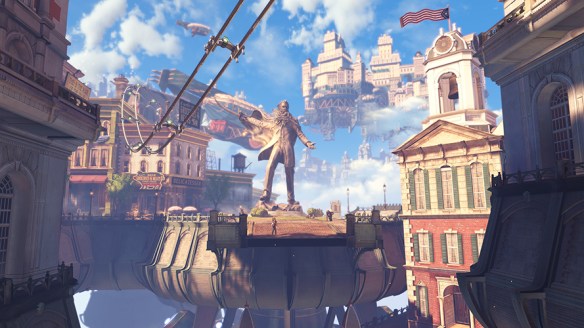
The team behind the first Bioshock would later go on to make the third entry in the series, Bioshock Infinite. This one leaves the underwater city of Rapture in favor of the floating city of Columbia. It’s clear from the beginning that this isn’t going to be more of the same.
Welcome to Columbia.
The protagonist of Bioshock Infinite, Booker Dewitt, is much more present than in past games. In recent years, there’s been an influx of silent protagonists. This is something that isn’t always successful in terms of storytelling; when done correctly, the player will feel like they’re in the game, but if not, it tends to feel more like you’re playing as a wall that other characters keep asking to do things. It’s refreshing to see the concept of the pre-made, vocal protagonist is still around and can still be successful.
While you don’t control what Booker Dewitt says, several decisions are left up to you, the player. These range from trivial to very difficult, but great care has been taken to make sure they aren’t out of place. This is the downside to playing as a pre-made protagonist: Sometimes you, the player, make them do things that character would never do. Bioshock Infinite treads this line perfectly. Nothing Booker does is out of place, and he reacts to things the way you’d expect him to react.
Strong storytelling isn’t limited to Booker Dewitt. Bioshock Infinite is one of the strongest games I’ve seen in a long time, in terms of story. Booker’s journey begins on a boat trip to a lighthouse, and takes him into a floating city. His mission: Bring us the girl and wipe away the debt. “Whatever that means” will likely be your first thought, and this is intentional: Booker is the kind of guy who does things he needs to do and doesn’t ask questions. At least, that’s how he starts out.
Things in Columbia quickly take a dark turn, and Booker finds himself fighting for his life, trying to reach a distant statue so he might “find the girl”. It seems Booker is Columbia’s prophesied antichrist figure, recognizable by the “AD” carved into the back of his right hand. Columbia’s prophet, Zachary Comstock, has seen Booker coming, and wants him stopped at all costs.
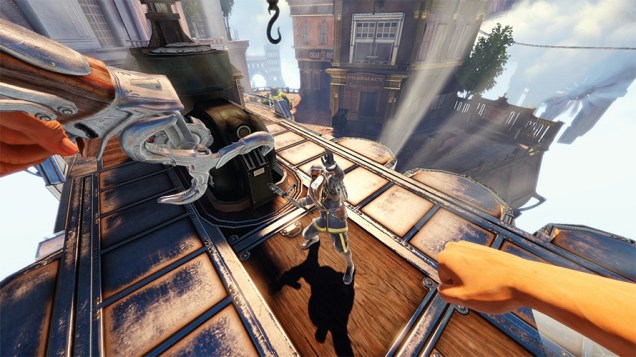
Columbia is made up of floating islands, and to traverse them, Booker will use a device called the Sky-Hook to latch on to rails connecting the islands. This makes for an interesting mechanic: While sliding along these rails, called Sky-Lines, combat is still possible, and sometimes even required.
The Sky-Hook also makes for a powerful melee weapon.
While interesting, the Sky-Line and Sky-Hook system never realize their full potential. Whatever you do the first time you use them is probably going to be all you do with them throughout the game. Shooting from the Sky-Line is difficult, and you’ll most likely miss most of your targets. There also isn’t much complexity to be found: Most of the Sky-Lines in combat areas just take you in a circle around a platform your enemies will be shooting at you from. I couldn’t help but feel like a lot more could’ve been done with this system.
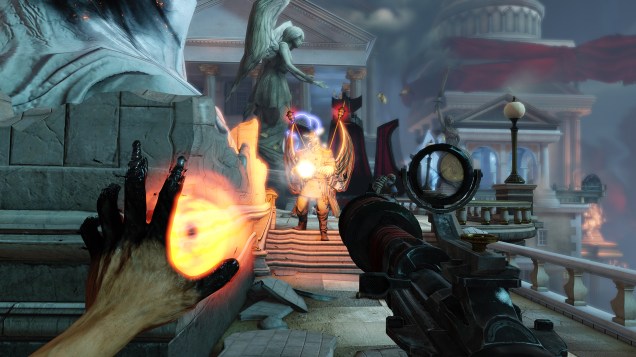
This brings me to my other main complaints about the game. Instead of the plasmids found in earlier games, Booker will use Vigors. The concept is the same: Your DNA is altered, allowing you to use biological attacks. If I had to summarize the game’s use of these, it would be “too much shock and not enough bio”. In most cases, you’ll just end up pulling the trigger of your regular old rifle until everyone else stops shooting at you. I found the Vigors to be mostly useless; one of them, called Devil’s Hand, was just about the only one I used, and it wasn’t particularly creative: Throw a ball of fire and it explodes. As far as first-person shooters go, they may as well have given you grenades.
The exception to the rule is a Vigor you acquire later in the game called Return to Sender. This one is easily my favorite, and the only one I found creative or even fun to use: Booker summons a ball of energy into his hand that allows him to catch incoming bullets and then throw them back at enemies. Doing this requires the use of Booker’s shield, so it isn’t unlimited, and timing is everything.
Return to Sender is particularly useful against Patriots, robotic renditions of the Founding Fathers equipped with machine guns.
Return to Sender aside, Bisohock Infinite is a pretty basic first-person shooter. There isn’t much variety in the enemies (the iconic Big Daddies are nowhere to be found, instead replaced with Handymen, which are far more annoying than frightening or formidable). Where the game surpasses your run-of-the-mill FPS is in its art direction. You’ll be using the same guns to fight the same enemies you’ll find in any FPS, but they’re going to look a lot more beautiful.
It takes more than looks to make a great game (which Bioshock Infinite is). With breathtaking visuals but standard gameplay and game time (a playthrough will take about 8-10 hours), where Infinite succeeds is its story, and this really takes off when you meet “the girl”, Elizabeth.
It’s difficult to meet Elizabeth and not be immediately reminded of a Disney character (Belle from Beauty and the Beast comes to mind). She’s a young, naive girl who’s spent her life alone in a tower with her books (and a certain guardian I won’t spoil for you). Sounds easy, right? Find the girl, protect the girl, get her to New York, wipe away the debt. Looks can be deceiving; Elizabeth is no sucker, and she’s not going to obey Booker as easily as Booker obeys the man who hired him. She has a mind of her own, and this lends to what is perhaps the game’s biggest charm.
The first time Booker meets Elizabeth, she attacks him with a book on quantum physics. and thus, a legend was born.
Elizabeth makes for an interesting character in so many ways. I said she has a mind of her own, and this extends to the gameplay itself: Elizabeth will be with you for most of the game. She’ll stay out of the way during combat, searching for ammo and health for Booker, sometimes finding money, lockpicks, and other useful items. The game’s AI is often mentioned, and with good reason. She’ll walk ahead of you toward your goal, sit down, chat with strangers, lean against walls, look through shelves; Elizabeth acts like a human being. She’ll talk with Booker about everything from his mission to her missing pinky finger. Her personality and programming make her one of the most likable video game characters I’ve ever met.
It’s hard to talk about the game’s story without ruining it. From the point you meet Elizabeth onward, Bioshock Infinite carries one of the strongest stories in video gaming. You’ll meet a lot of characters and factions with their own reasons and purposes, and the story carries what would otherwise be a decent game into greatness. Enemies become friends, motives change. Something as small as the tip of a pinky finger can have life-altering ramifications.
When the screen finally cut to black and the credits began to roll, my first thought was “That’s it?” This quickly gave rise to “What in the world did I just witness?” which was then followed by me sitting in silence for about a half hour playing back everything I’d just experienced in my head. What seems at first like a tangled, nonsensical web of plot holes becomes a complex, intricate, purposeful and meaningful series of events the more you pick at it, the further you unravel it, and I’m not convinced it’s possible to straighten everything out. There’s a reason the title contains the word “Infinite”.
Look up any list of the most mind-blowing endings in video game history, and you’ll probably see the first Bioshock on it. Bioshock Infinite puts it to shame. If I hadn’t rented the game, I would have popped it right back into my Xbox and played through it again to see what else I could see. I look forward to my next playthrough (but I’m aiming for PC next time; the Xbox 360 version suffers from an unfortunate amount of lag, especially during the last battle).
The game’s developer, Irrational Games, recently announced a massive scaling-down, as well as an intent to make no further Bioshock games. I have no doubt their publisher, 2K Games, will assign another team to make sequels, but it’ll be hard to see them as true Bioshock games. Bioshock ends with Infinite; you can’t take a story this well planned and executed and simply add on to it. It’s rare in the world of video games to see a complete story with a beginning, middle, and end. Bioshock and Bioshock Infinite create one of the exceptions to this rule, and I think I’d be happier if they remained that way.
All images taken from the official website and not owned by me.
You might remember how, for a few months, I was a staff writer for a Nintendo fan site. The site is gone now and the admin vanished, but my love for writing, video games, and writing about video games is stronger than ever, so I’m happy to continue doing it on my blog. I’ve also decided to extend my reviews/analyses outside of the gaming world (with music and films in mind), but for now, here’s the first in my nowPlaying series: Xenoblade Chronicles, developed by Monolith Soft, for the Nintendo Wii.
All images taken from the official site, not owned by me.
When you ask people about the greatest video games ever made, there are a few titles that’ll come up on almost every list: The Legend of Zelda: Ocarina of Time. Half-Life 2. Resident Evil 4. In a perfect world, Xenoblade Chronicles would be one of them. It’s near the top of mine.
Released for the Wii in 2010, this one took a while to leave Japan. It didn’t reach America for nearly two years, coming out shortly before the Wii’s successor, the Wii U. The game received a limited printing, so a copy is going to cost you anywhere between $60 and $80, but it’s worth it.
The word “epic” is overused these days, but it fits this game perfectly. The story opens with two titans fighting each other in an otherwise empty ocean. They strike fatal blows at the same time, but their lifeless bodies remain standing, and from these spring forth all living things.
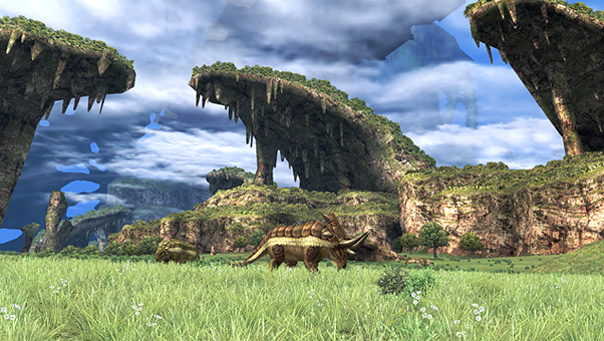
You play as Shulk, a young boy who grew up on one of the titan’s knees. Did I mention the game is epic? The whole world consists of the bodies of the titans. At any point you can look into the sky and see their arms, their heads, you can look across the ocean and see most of the other titan—all but the part that extends beyond the clouds.
An example of the view from one of the legs, complete with the torso of the titan in the distance, and its extended sword hovering above.
This game is huge. Everything about it is massive: Open-world areas in the same vein as Bethesda’s latest games, seamless combat (nearly all of the game’s loading screens are just there to load cinemas, only a few places require a loading screen transition), character customization; everything you’d expect from an action RPG, but bigger. My final play time, for example, was 75 hours. There were still dozens of side quests I hadn’t done, and I could have sunk another few hours in to level up and have an easier time with the final bosses (because a game this big can’t have just one).
The graphics are good, for the Wii. You can find screenshots, but they don’t do it much justice. The wind blowing through the grass, the people and creatures going about their lives, the ever-looming titans, you have to see it for yourself. It’s a Wii game, so by today’s standards it’s dated, but even as such it looks good.
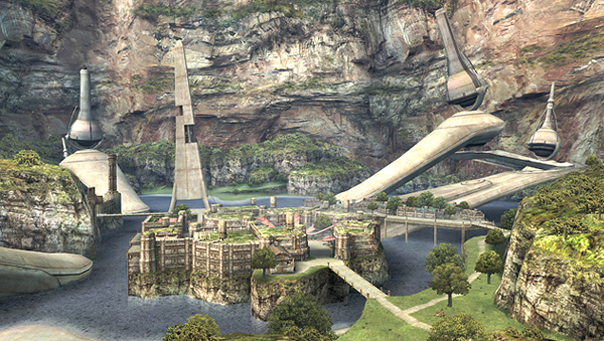
Colony 6, where the main characters grew up. From this viewpoint, you can travel all the way into the town and along its streets without loading screens.
The characters you face are, for the most part, lovable. Off the top of my head, only one enemy character comes to mind who I could describe as one-dimensional, and she’s not a major character. Everyone else is a well-acted, well-designed being, complete with their own motives and reasons, and this adds to one of the game’s running themes: Existentialism.
Your run-of-the-mill game can be pared down to “Find the bad guy and kill him”. You’ll be doing a lot of finding in this game, and you’ll be doing your fair share of killing, but you won’t want to. Instead of faceless “baddies” that only stand in your path, the game presents your adversaries as people who happen to be on the other side of the coin. Shulk, the main character, begins as a naive kid with a desire for vengeance, but transforms into a strong, noble man, one who tries to reason before ever lifting his sword, and who understands his enemies. I have a feeling the game’s director, Tetsuya Takahashi, might have been influenced by the works of Orson Scott Card and Ursula K. Le Guin: Before Shulk defeats his enemies, he has to know and love them, and he feels every loss along his path.
The game’s story goes on to tackle the idea of what it means to be part of a Universe in which you aren’t the only inhabitant. I don’t think I’ve ever seen a game do this before. There are often moments of depth, often strong characters that you feel for, but Xenoblade takes it to a new level. As big as the game is, it must also be described as “deep”.
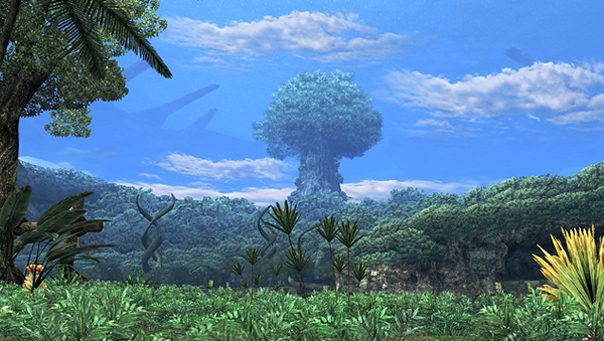
The tree in the background is just a texture from this distance, but you will eventually reach the top of it in-game.
Some of the plot points are trite, but most are unpredictable. The game threw a lot of curveballs. In most cases I had no idea what was coming until the second it happened. It does suffer from some overly-descriptive and repetitive dialogue (sometimes the characters just plain talk too much), but it’s nothing you won’t find in the average video game.
The gameplay itself is fun, but a lot of people seem to have trouble with the battle system. Unlike most games, you won’t be mashing the A button to obliterate everything in your path. Characters (there are several in your party, and you get 3 on-screen at a time and may play as any of them) auto-attack. Your job as the player is to choose where they go. Some attacks are more powerful from behind, some from the side, etc. You also have special attacks called “Arts” that you choose from, giving combat a layer of strategy comparable to that of a turn-based RPG, but the battles won’t wait for you, and timing is everything.
Another word I might use to describe the game is “exhausting”. The last ten hours or so started to wear me down. I did get a little tired of running around fighting random creatures and fetching items for NPCs. The game’s design is relentless, every new place you find is as large and as full of things to explore and do as the last, but by the time I reached the last handful of areas, I just wanted to skip them and go straight into the main quests. I never really wanted to stop playing, but if there had been another ten hours of main story, I might have.
The upsides far outweigh the downsides, and in the end I’m so glad to have played through this game. It’s one of the most original and unique stories I’ve ever encountered, especially in the world of video games.
In January 2013, Nintendo revealed a trailer for a game by the same company, Monolith Soft, that is very heavily implied to be a sequel to Xenoblade Chronicles. I can’t wait to see what’s in store this time around. The possibilities are limitless, and I’m looking forward to what will surely be one of the richest gaming experiences offered this generation.
E3 is coming up in just a few days (June 5-7) and I’m excited for some things, curious about some things, and a little worried about others. Here are my thoughts on the expo.
Sony
I’ve owned every current generation console but the PS3 is the only one I subsequently sold. To be fair, when I had it there were few games available. I played Resistance, which was fun but very short (took maybe 5 hours to beat) and had little replay value. I played Folklore, though I use the term “played” loosely because in the two hours I had the disc spinning in my system I think I played for maybe fifteen minutes, and the rest of that time was spent watching cutscenes and scrolling through text. I rented Uncharted which was a lot of fun but wasn’t a good enough reason for me to keep the console.
There are a lot more and a lot better games out now, but nothing I’d be willing to buy the system again for, especially now that I have an Xbox 360. That said, some games come close. What I’m looking for from Sony is a lineup that finally crosses that threshold. The Last Guardian might have been the game to do it, but the likelihood that we’ll see anything from it is pretty low. I don’t want to use the term “vaporware” but things are not looking great for this game. The Last of Us also looks very promising, and I think if any developer is going to bring me back to the Playstation, it’ll likely be Naughty Dog. I’m a sucker for Studio Ghibli, so Ni No Kuni is high on my radar. Then there’s Playstation All-Stars Battle Royale, Sony’s inevitable ripoff of answer to Nintendo’s Super Smash Bros. franchise. I’ll keep my eye on this one, but Sony doesn’t have anything remotely close to the franchise-specific fanbase Nintendo has, and most likely at least one character in this game will have appeared in SSB already (Solid Snake). Besides that, Masahiro Sakurai (the man behind Super Smash) is a gaming genius, and I don’t think Sony will reach the same level of creativity we’ll find in his series.
Overall, I’m mildly interested in what Sony has to offer.
Microsoft
I have some interest in what Microsoft is doing with Halo 4, but beyond that the company will have to pull some surprises to catch my attention. The Fable series never reached its potential with me, and releasing a Kinect-exclusive title is not going to fix that. I’m far more excited to see some third-party games for the Xbox. What I expect to see is two days of people talking about how great the Kinect is and why I should buy one, which in my view is two days of wasted time. Back to Halo 4, Bungie isn’t developing this one, but I like to remain optimistic, so I’ll keep my eye on it. Overall I’m uninterested in what Microsoft has to offer, but factor in third-party games and we have an entirely different story.
Nintendo
Nintendo is probably going to have the most of my attention. They should be announcing final details on the Wii U. Unfortunately, I expect the Wii U to be about the same as the Wii: It’ll be great for a year or maybe two. After that, Nintendo’s competitors will release systems twice as powerful, causing Nintendo to hemorrhage third-party support. The tablet controller will hopefully move the industry away from the motion control pit it has fallen into, but basically we’re replacing one gimmick with another. Sure, some games used the Wii’s motion control the right way, but nearly all were by Nintendo itself, and the mass amount of games left over primarily consisted of shovelware. The Wii U’s tablet controller might do the same, though it seems like the touch screen is being viewed more as an accessory than a tenant (considering it can be entirely disabled while using the tablet screen as the console’s main screen). Something else I’m concerned about is the system’s 1-2 controller limit. Yes, I know you can connect up to 4 Wii Remotes, but what’s the point? It hasn’t worked so far; you can use any controller for Super Smash Bros. Brawl but the game is still nearly unplayable with anything but the Gamecube controller. Using the 3DS as a controller seems feasible, but only if the 1-2 controller limit doesn’t still apply (as in I can use a Wii U tablet, my brother can use a Wii U tablet, and my sister can use a 3DS all at once). I would also like to see DVD support. I feel like I’m really not asking for much here. I know it’s a video game system, but being able to watch movies without switching out my HDMI device would be awesome. I really want to know for sure Nintendo is going to do the right things when it comes to online play. I’m sick of friend codes, and I’m sick of having one profile per system. We were promised these things would be fixed with the 3DS. They were not. I still need friend codes, I still can’t talk to people I’m playing with despite the system having a microphone built into it, and there are only a handful of games that can even be played online. I don’t play online often, but it would be nice if I didn’t have to jump hurdles those times I do.
Nintendo’s game lineup will surely be promising. There’s a new Animal Crossing, which I’m mildly excited for. A new Fire Emblem will definitely have my attention. Rumor has it we’ll hear about a new Pikmin, which I can’t wait for. I’m not expecting any news on new Zelda or Super Smash games, but either would be a very welcome surprise.
Overall, I’m most excited for Nintendo’s conference.
Third Party
There will be a plethora of other games announced, demoed, and detailed at E3, so I won’t talk about them all. I’d like to touch on some of my favorites so far, though. Bethesda’s Skyrim will be getting its first big DLC, Dawnguard. I’ve seen the trailer and it looks awesome. Elder Scrolls Online has my interest as well, but if Bethesda really wanted to blow me away they’d give us some info on Fallout 4. Fallout 3 is the reason I bought an Xbox, it’s probably my favorite video game of all time. However, Skyrim just came out last year, so I’m not expecting anything on a new Fallout for a while.
Capcom definitely has my attention with Resident Evil 6. RE4 is another of my all-time favorites, and a predictable and sometimes plain stupid story didn’t hinder RE5 from being ridiculously fun at all. RE6 looks very promising, bringing back zombies (and mass amounts of them) as well as the meeting of Chris Redfield and Leon Kennedy fans have been waiting for for over a decade. Revelations for the 3DS saw a return to form for the series, keeping the over-the-shoulder perspective but bringing back the claustrophobic, atmospheric terror earlier games had. The game also kept many moments of all-out action, bringing the best merger of the series’ two forms yet. Hopefully RE6 will continue this (I can see Leon’s story being fear-oriented and Chris’s leaning closer to action) as both formats work very well for the series.
EA’s Dead Space 3 is a game I’ll keep my eye on. Dead Space is probably the most frightening video game I’ve ever played. The game mastered atmosphere, reminding us that a quiet, echoing knock can be leagues more terrifying than a big squishy baddy running toward you, or that a giant mutated creature can be scary but sometimes you can be more scared by what turns out to be nothing at all. Dead Space 2, while a lot of fun, was an epic failure on that front. The atmosphere and suspense were all but gone, replaced by increasingly tough bad guys running at you from the shadows. It was a bit of a letdown, but the creative enemies and weapons (javelin gun hehehe) and the more character-driven story almost made up for it. Almost. I hope Dead Space 3 can reconcile the two.
Square Enix will hopefully drop some info on Kingdom Hearts. Dream Drop Distance looks fun, and rumors are circulating about a collection which would feature all of the games thus far, all leading up to Kingdom Hearts 3. Besides the numbered titles, the rest of the series seems to have tremendously lost track. Where KH1 and to a lesser extent KH2 were designed to be a seamless blending of the worlds of Final Fantasy and Disney, the handheld entries have turned it into the go-to series for those of us who thought The Matrix needed a little more Winnie the Pooh. The games remain fun, which is arguably the most important thing for a video game, but the story has become convoluted to say the least. I’m hoping for a Kingdom Hearts 3 to get the series back on track.
What I’d like to see less of:
Motion control. When the Wii was announced I saw limitless potential. Maybe 5% of that was ever realized. Sony and Microsoft then took it further, and all three of the companies got it all wrong. Nintendo seemed to be on the right path for a while, but things went south fast, culminating in The Legend of Zelda: Skyward Sword. MotionPlus was supposed to save motion control, but instead it over-corrected it. When Skyward Sword works, it works beautifully. Unfortunately, this is marred by instances of the Wii Remote being utterly unable to respond to what I’m actually doing. What could have been the best Zelda ever turned into a frustrating, sometimes unworkable monument to the failure of motion-controlled gaming.
I can’t remember how many times I’ve lost a game because I sneezed or a dog walked in front of the motion sensor bar. I have no interest in the Kinect at all, which is good because the room my Xbox 360 is in is both too dark and too small to even use one. Sony’s Move is a cheap Wii-mote ripoff and doesn’t even pretend not to be, and while the consensus is that it functions a little better, it isn’t really useful in any way.
Motion control was meant to bring a layer of depth to video games that hadn’t been achieved yet. Instead it brought a gimmick of epic proportions and legions of useless shovelware. These days, Sony and Microsoft lifting off whatever new “feature” Nintendo comes up with is basically a staple of the gaming industry. I very much hope that with the Wii U, Nintendo gets this controller thing right. When a video game company leads the market with an innovation that is actually useful (see: shoulder buttons, analog control, rumble support) things are better for all of us. The motion-control plague inflicted upon us by the Wii is nigh unforgiveable. Luckily, the touch-screen-as-companion is an innovation already tested and proven true by the DS and 3DS, and again I see that potential I saw when the Wii was first announced (if I can’t play Fallout 4 with the Wii U tablet as my own personal Pip-Boy 3000, what good are either of them?) but only time will tell.
I don’t want to hear about how cool Reggie Fils-Aime is, nor do I want to hear about how cool Kevin Butler is (which is decidedly worse considering he doesn’t even exist). I don’t want to hear about how the Kinect is the future of everything and the best thing ever invented and I should buy one. I certainly don’t ever want to see a 3DS-launch-like sexism parade, and announcing a system without actually revealing anything but the controller is kind of like announcing a new car by showing pictures of its steering wheel. E3 shouldn’t be about a company’s beefed-up accomplishments. It needs to be about video games. The big three console makers should take a page from third party developers and just show us the games.





 Faded Pages