I recently received my proof copies of the hardcover editions of After the Bite and In the Lone and Level Sands. I’m pretty happy with the way they turned out, and now I’m making them available to purchase through Lulu.
I wish I could make these available elsewhere, but I can’t justify the cost to do so. For now, Lulu is the only place to get hardcovers of these books. Paperbacks and ebooks will remain available everywhere they currently are.
After the Bite comes in black satin with gold spine text, while In the Lone and Level Sands comes in tan satin with black spine text. Both books feature glossy dust jackets and black-and-white interiors.
I’ve been going over my poetry collection, and on the whole I’m happy with it. It’s looking very unlikely that I’ll scrap it at this point, so I’m probably going to share a few more poems in the coming weeks. I still want to give it another round of editing, then there’s assembling it for publishing, finding a cover, hopefully getting some external feedback, etc. Hopefully I’ll have more concrete information about it next time I mention it on here.
In the meantime, this poem is called “On the Mend” and it almost didn’t make the cut. It’s one of the shortest poems in the collection, but it fits the theme well, and I’m happy with how it turned out.
On the Mend
I’ve been throwing bricks
From atop this house of sticks
And I’ve been casting stones
Across a lake as dry as bones
I hope you never know
How much time I’ve spent planning for bridges
I never come to, much less have to cross
And I’ve been planting seeds
In a yard not fit for weeds
I’ve been writing words
That leave the page like little birds
I was pretty sure
I’ve spent most of my life burning bridges
I couldn’t sleep beneath, much less try to cross
I wrote you down so you would always stay
But a heart like yours won’t be contained
So I put quotation marks around your name, like wings
So you could fly away from me
I hope you never see
I’ve spent every hour since then building a bridge
And I can barely walk, much less bear a cross
Tonight I’ll try to sleep
Beside the secrets I don’t want to keep
Tomorrow I’ll start throwing bricks
At your makeshift crucifix
And hope you do believe
You won’t find any answers jumping off of bridges
Come down from there. You’ve suffered enough.
I’ve already posted this on my facebook page, but I’ve cleaned it up since then, and I’m really hoping to get some input from blog followers as well as strangers.
I’m just about finished with the first draft of my poetry book, which I’m calling Permanent Ink on Temporary Pages. The whole thing has been a new experience for me, one I’ll detail in a later post, but for now I can summarize: I’m somewhat new to the world of poetry. Not writing it, but sharing it.
Over the course of a few weeks, I had a burst in creativity, during which I wrote a few poems. I noticed recurring themes throughout them, so I decided to keep them together. With a sort of narrative in mind, I wrote a few more, and even dusted off some old ones that fit the theme, which has led me to a collection of roughly 16 poems. At first that strikes me as too few, but then again, most of them are longer than the poems I’m used to reading.
I’m going to let the collection sit for a while before I come back to it and edit it, but I want to get outside input on some of it as well, especially if this is going to be an actual book I put together and decide to sell. (Not sure if I can justify the cost of a physical edition of this one, so I might go ebook-only, but again, that’s all for down the road.)
So here’s one of my poems. It’s called “Shadows and Fingerprints”. I’d be very grateful to hear any thoughts on it, good or bad.
Shadows and Fingerprints
There are fingerprints in the dust on the underside of the cabinet
And fingerprints in the thoughts on the underside of my mind
There are shadows on the ceiling
Out in the hallway where I sat on the stairs
And shadows in my memories
Cast by someone who isn’t there
I’ve never been as awake as I am right now
I want someone to talk to, but everyone’s asleep
And that’s okay.
I shouldn’t want to trouble them anyway
I never come as clean as I’d like to, in any case
I’m going to lie down on the floor
And close my eyes until I don’t exist anymore.
It all keeps going back to someone I don’t even know
Or the fact that I don’t know them because I was too afraid to live
So I walk through this city
Trying to find myself out there
Find only passing headlights
And landmarks of my youth,
Like where we’d sit where the sidewalk ends
Walk up the hill and around the bend
Cut through the woods to the circle of stones where we’d sit
Contemplating the world around us and our places in it
It’s not quite the same as it used to be.
Without Ian, it feels a little bit empty.
We’ll get away for a while
Let’s go to Michael’s house, visit Loren in Ohio
Sip vodka and turn off the tv screen
Talk about life and death and philosophy
Get everyone together and go down to the lake
The sun goes down, the stars come out, but we’re wide awake
Let’s sit around a campfire,
Bring a bag of things to burn
Like journal entries
Written by someone who isn’t me
(not anymore)
Old letters
Torn photographs
Clothes that don’t fit,
And some that never really did
That cherub figurine
Unfinished poetry
And all my thoughts of her and me,
So maybe I could get some sleep
Get in the water
Float on your back
Let the wind in the waves wash away your every heart attack
Pitch up the tent
Get into bed
Stay up talking ‘til the morning brings the sun up again
Then go back home
Get on with our lives
Maybe never see each other again,
But that’s all right.
I’ll walk these city streets,
Try to find someone out there who feels like me
We’ll lie on the floor until our problems don’t exist anymore
We’ll listen to music, read poetry
Watch television or just sit quietly
No passing headlights
No landmarks of a youth I wasted being alone
No shadows, no fingerprints
No hallways, no dust, no cabinets
Just you and me and our thoughts.
Just you and me,
Or me and my thoughts.
It’s always me and my thoughts.
When we die, do we turn into stardust?
Can it wait until I’ve made something beautiful first?
Because so far I’ve made nothing but shadows.
So far I’ve left nothing but fingerprints.
I’ve mentioned my little project I’m calling “Scenes” before. The basic idea is I take pictures (some new, most of them old ones lying around my hard drive) and put somewhat-related excerpts of my writing over them. It’s mostly for fun: Picking a photo, picking an excerpt, choosing a font, arranging it, applying effects to it, etc.
I mostly post these on the facebook page for In the Lone and Level Sands, since so far all of the scenes I’ve made are from that book. I do plan on making some for my other writing, but the zombie apocalypse epic was the most inspiring, so that’s where I started.
I’ve also been posting the project on my tumblr page, and today I finally got it up and running on this site as well. It turned out to be a lot easier than I thought, since WordPress has a built in “gallery” feature, and it even adds some nice effects (like randomly arranging the photos in a grid, which I like). You can find it under “Samples” in the navigation bar, or through this URL: https://davidjlovato.wordpress.com/samples/scenes-from-in-the-lone-and-level-sands/
The idea is to have a separate page for scenes from each of my books, when I finally get around to doing some from the others. I might do a few of my poems, as well.
Speaking of which, I’m almost finished with my poetry book. A few poems need cleaning up, even fewer need finishing, and then it’s mostly a matter of waiting a while before going back and editing the whole thing. I’m kicking a few titles around; I have yet to find one I’m in love with.
My favorite band is Brand New. I have a list of reasons far too long for this blog post, but one of them is their tendency to introduce me to other great bands, through covers, tours, or the occasional “This song is called ‘Go See Explosions in the Sky.'”
One of Brand New’s most famous tours was a series of shows they played with Manchester Orchestra and Kevin Devine. You can find some high-quality videos from this tour on YouTube, and I recommend doing so. All three artists and their opening acts gave fantastic performances.
Kevin Devine and members of Brand New and Manchester Orchestra covering “Holland, 1945” by Neutral Milk Hotel, another of my favorite bands.
That’s how Manchester Orchestra appeared on my radar. Eventually I would hear their song “Wolves at Night” on the radio. I thought it was okay, but my second radio experience with Manchester Orchestra fared much better: It was the song “Shake it Out”, and from then I was hooked. Fast-paced guitars and explosive vocals culminate in a noisy but still melodic refrain, before the song suddenly drops into a quasi-acoustic, quiet interlude:
I felt the Lord begin
To peel off all my skin.
And I felt the weight within,
Reveal the bigger mess
That you can’t fix.
—Manchester Orchestra, “Shake it Out”
The loud-quiet-loud structure of the song reminded me of something off of Brand New’s The Devil and God Are Raging Inside Me, and not long after, the band released the title track of their then-upcoming album Simple Math for free. It was another quiet-loud-quiet introspective song, so I picked up a copy of Simple Math (and went back and bought Mean Everything to Nothing and I’m Like a Virgin Losing a Child as well).
The three albums (four if you count the unreleased Nobody Sings Anymore, which I do, since “Slow to Learn” and “Girl With Broken Wings” are some of my favorite songs) were enough to cement Manchester Orchestra as one of my favorite bands. Between Andy Hull’s angelic voice (and legendary beard; you have to mention the beard), drums that aren’t afraid to leave the hi-hat and snare, bass you can actually hear, guitars that get noisy but never reduce themselves to noise, and Chris Freeman playing like a dozen instruments at the same time, the band has everything I love about music.
The wait for new material after Simple Math was a long one. Now and then a new song came up during a live performance, and the band released a handful of singles, but after two years, Manchester Orchestra played a set featuring several new songs. For a few months nothing else happened release-wise, and during a show Andy Hull even joked that their new album was “apparently never coming out.”
Thankfully, their new album did eventually come out, incidentally enough, on April 1st.
The first thing I noticed about the album was that I wasn’t fond of its artwork. While I’ve since come to accept it, at first it struck me as bland, almost lazy. That’s a superficial part of what makes an album, though, and didn’t deter me from pre-ordering the album, much less listening to it as soon as it arrived.
I was already familiar with the opening track, “Top Notch”, as the band released it on the internet months before the album’s release. The song sets the tone for the album to follow: Loud and angry. Where Simple Math gave way to orchestral instruments like strings and horns, “Top Notch”, like many of the songs on Cope, instead offers flavoring with sporadic guitar shreds. Lyrically, the song is classic Manchester Orchestra, blending storytelling and metaphor into a message that is cryptic but oddly relatable.
So the first kid says in his temporal tone,
“I don’t think there’s a way to resolve it.
We should wrap up these towels around our blistering palms,
And wait it out in the closet.”
His brother looks him up and down and prophesies how all of it should end,
He says, “We’re buried underneath the yard, and no one ever listens.
Or visits.”
—Manchester Orchestra, “Top Notch”
Before “Top Notch” has a chance to exit the stage, “Choose You” comes in with feedback leading to a fast-paced chorus of guitars, eventually giving way to one of my favorite opening lines on the record: “The invention of the ship was the invention of the shipwreck. I tried to find out who I was by jumping off the deck.” This song is more upbeat than “Top Notch”, but just as loud and angry, and many of the songs on Cope will follow its example.
The third track, “Girl Harbor”, quickly became one of my favorite Manchester Orchestra songs. One of the band’s signatures is their ability to be loud without sacrificing melody. I’ve touched on this already, but “Girl Harbor” is one of the best examples of this talent. Andy Hull’s brutal but somehow not unkind honesty shines in the song’s lyrics.
You always talk so loud,
And you never notice.
I don’t mind the sound, but you
Have re-arranged the pieces of your life
So many times, you’ve burned out the parts.
I don’t want to believe, but I want to believe you.
I don’t mean what I say, but I say what I mean to.
—Manchester Orchestra, “Girl Harbor”
Following this is “The Mansion”. One of Manchester Orchestra’s greatest influences is Built to Spill, and this song makes it easy to tell. I’m a sucker for songs with palm-muted verses that explode when they get to the chorus, and the trippy lead guitar and catchy chorus made this the first song from the album to get stuck in my head.
“The Ocean” is another great example of the angry-but-upbeat tone embedded in Cope, and the following track, “Every Stone”, is almost like the other side of the same coin. I don’t know what it is, but the two songs strike me as being related to each other. Where “The Ocean” is more flat and angry, “Every Stone” is calmer and more melodic, and both songs touch on the subject of letting things go.
That boat will not float,
It’s the last in its class, I’m the first one to know.
That bed is never made,
I’m the last of my kind, fucking tricked by my training.
I, I’ll give it to the ocean.
—Manchester Orchestra, “The Ocean”
You might just miss the mark
If you’re keeping everyone away
You didn’t mean to, you didn’t want to.
Well it might just leave a mark
If you don’t give anyone a say
You never want to, you never mean to.
Every stone I’ve thrown has gone away, it’s gone away,
It’s gone away.
—Manchester Orchestra, “Every Stone”
“All That I Really Wanted” is another showcase of that brutal honesty I mentioned before, while “Trees” almost feels like an epilogue to it. “Trees” has some cool moments, but I don’t love either song. I feel bad writing that, because Manchester Orchestra’s songs have a habit of creeping up on me and becoming favorites out of nowhere, so I can’t exactly set an opinion in stone, but for now I find the two underwhelming.
“Indentions” offers a welcome change of pace. It’s another fast favorite of mine. The bass and keyboards stand out on this one, the second verse has a really cool pre-echo effect on the vocals, and the last chorus is followed by a brief but very cool electric guitar riff. The chorus is simple but powerful: “I won’t leave indentions of me. I won’t leave intentionally.”
“See it Again” is probably the most unique track on the album. It starts off dark, with a faint vocal chorus to accompany heavy drums and a palm-muted guitar track, and the lyrics offer another storytelling session. This one isn’t so cryptic; the song deals with the narrator losing someone he cares about. The verses take us from the narrator’s front door before his loss, to uncertainty in a hospital waiting room, to deciding what does and doesn’t matter in life once he gets to the morgue.
Every Manchester Orchestra record contains at least one song that conjures a vivid depiction of some stage of death and grief. “See it Again” takes on this task for Cope, and it does a fantastic job.
The album closes with the title track, “Cope”. It’s another of those loud-quiet-loud songs I like. “Cope” is one of Manchester Orchestra’s shortest closers (“Colly Strings” and “The River” clock in at almost 6 minutes each, and “Leaky Breaks” ends up over 7) but it’s one of their strongest, in my opinion.
If I do echo, I hope you never see
There is no one there who’s waiting after me.
And I hope if there is one thing I let go,
It is the way that we cope.
—Manchester Orchestra, “Cope”
All of Manchester Orchestra’s albums have a unique sound, but Cope exists on an entirely separate plane. Sometimes, the album reminds me of the cover: Plain in black and white. There isn’t a lot of color here, but somehow, the band made it work, and with a few exceptions, each song becomes its own entity and stands out. Cope isn’t the album I asked for and it certainly isn’t the album I expected, but it’s one I welcome gladly.
All lyrics and the album artwork belong to Manchester Orchestra, not me.
I’ve mentioned before that I don’t want my blog to focus mainly on reviews, yet I have one ready to post at any time, and another one in progress. As it turns out, I greatly enjoy talking about the things I enjoy.
Before I get around to posting those, I thought I’d give an update on the other things this site was intended to focus on.
Writing
My main focus right now is on a coming-of-age / magic realism novella. I’m a little over 15,000 words in. I’m not sure what I’ll do with it once I finish it (and in this case, “finish” means finish writing, shelve it for a few months, then edit it and decide if it’s worth existing anywhere but my own hard drive). For now, I’m going to focus on writing it. Its tentative (and likely final) title is “The Afterglow”.
I have a few other projects on the backburner, one of which I’d like to talk a lot more about, but probably shouldn’t, since it won’t be finished anytime soon, let alone releasable. The reason I mention it is that I’m pretty sure I’ll break that silence in the coming weeks, depending on how well it comes along.
Publishing
Search around the internet, and you’ll find a very unfortunate battle raging over traditional- vs. self-publishing. I think (and hope) the squabble is coming to an end, with both methods coming out of it as valid routes to the same goal, and both methods existing as alternatives balancing each other out. With that said, I don’t prefer or dislike either method. I’m still eager to have certain works traditionally published, but I have turned to self-publishing before. One reason for it is that I enjoy doing it. My first love will always be writing, but putting the finished product together as one package is a lot of fun. It’s hard work, sometimes it’s frustrating (no one can ever know how long I’ve languished over where to place the title on the cover, what size to print a book in, what font to use, etc.), but in the end I enjoy doing it.
It’s always exciting to see new options pop up on the publishing side of things. In my case, these options aren’t necessarily new, but old ones I’ve seen in a new light.
There isn’t a lot to say about either route, at the moment. On the traditional side, I’m submitting short stories and novelettes to publishers for their consideration. There’s a lot of waiting involved, which I understand and don’t mind, but it doesn’t make for an exciting blog post.
On the self-publishing side, I’m putting together hardcover editions of After the Bite and In the Lone and Level Sands. My co-author Seth and I have had a few people ask us about hardcovers, and it’s always a bummer to have to tell them it’s not in the cards. However, I’ve found a happy enough medium to work with. If I get these finished and approve of the quality, hardcovers will be available through Lulu’s store only. (I can’t bring myself to use their expanded distribution options; I would have to charge in the realm of $40-$60 for the books, and part of my self-publishing philosophy is that my books need to be affordable. I paid $40 for the entire A Song of Ice and Fire series, I can’t see myself charging the same for one short story collection by some random not-George R. R. Martin.)
Finally, and this one falls somewhere between “writing” and “publishing,” I’m considering a book of poetry. I had a random burst of creativity a few weeks ago, and the result was over a dozen strongly related poems. I’ve considered submitting them for publishing elsewhere, but these follow a theme and almost form a story, and I think they belong together. I could submit the entire book for publishing, but I’m not sure anyone would want to represent or publish a poetry book by someone who hasn’t published poetry before, so for now I’m leaning toward self-publishing it.
Reading
I’ve finally made decent progress with Neil Gaiman’s Neverwhere. I started reading it a long time ago, but I found the beginning to be slow, even boring. It’s finally picking up, and it was worth getting through; I’m enjoying the story.
I also recently began The Girl Who Circumnavigated Fairyland in a Ship of Her Own Making. The writing is delightful; I find myself smiling almost nonstop through it. The story is magical, although the parallels to previous works like Alice in Wonderland and other writers like Diana Wynne Jones and Ursula K. Le Guin are very strong, and I’m not sure the book will end up accomplishing anything those others haven’t already. But I’m not very far in yet, and anyway, a book doesn’t have to change the world or even change literature to be great. In any case, I’m surprised Studio Ghibli hasn’t made a film out of this one. It would fit right in.
Blog Upkeep
I’ve been doing a lot of behind-the-scenes stuff around here. For example, the “Published Works” link at the top is now a drop-down menu that contains a page for every work listed in there (which it should have from the start, but I hadn’t thought to do it yet). Clicking “published works” will still go to the old page, where everything is on one page.
I’ve also been using the tumblr version of my blog a lot more than I thought I would. It’s great for posting pictures, and I’ve recently begun a project I’m calling “Scenes”, where I put excerpts of my writing over pictures I’ve taken over the years. I do plan to get that project going on here as well, but it’s a little more involved on WordPress, and I’m not sure yet how I want the page to appear. In the meantime, you’ll find the pictures on my facebook, the page for my zombie series, and my tumblr.
So that’s what I’ve been up to, more or less. Now I’ll get back to finishing those review posts, and hopefully, by the time those are up, I’ll have something a little more substantial to share on the writing side of this blog.
All songs and lyrics belong to La Dispute, not me. I’m just here to share my own interpretation of and experience with them.
This isn’t meant to be a review per se, it’s meant to be an analysis. It gets personal at the end. I’m not trying to bum anyone out or make anyone worry about me; I’m generally a happy person. My intention is to share why this album is so close to me, especially in those moments when I’m not.
The more avid readers of my blog will recall I recently wrote a post about La Dispute’s 2011 album Wildlife. At the end of that post, I linked to the band’s YouTube, where they had posted the first single from their newest album. I had listened to it once or twice, but only casually. I prefer to take my La Dispute albums in their entirety.
Rooms of the House hasn’t been out long, but I’ve given it enough thorough listens to write my thoughts on it. Sometimes these came in the middle of sleepless nights, sitting awake and listening to the album. Sometimes it was on the band’s YouTube page, where they’ve provided every song, complete with lyrics, in a seamless playlist. Once, I lay on my back during a panic attack and listened as I felt my heart rate increase and my breaths fall short for no readily apparent reason. And, of course, I gave it several listens while walking, either on the treadmill or around town.
The first thing I noticed about the album is that it’s shorter than their previous releases. Somewhere at the Bottom of the River Between Vega and Altair consists of 13 tracks totaling 52 minutes. Wildlife upped the number of tracks to 14 and clocks in at 58 minutes. Rooms of the House, on the other hand, contains only 11 tracks, and rests at 42 minutes.
At first I was worried that I might not be in for the same kind of intense roller coaster ride of a narrative the band usually puts out, but I pushed these thoughts aside. It’s not the length of a work that matters, but the impact it has on you. I wanted to be free of any preconceived notions when I listened to the album as a whole.
It’s immediately clear why this record is shorter than their past LPs. From the first second of the opening track, “HUDSONVILLE, MI 1956”, you can tell the band is much more focused, almost more frantic, like they’re dying to get their sound out and do it now.
“HUDSONVILLE, MI 1956”, the opening track of La Dispute’s Rooms of the House.
The opening track tells the story of a couple who are temporarily split up. A woman takes her son to her parents’ house in Terre Haute, Indiana, while her husband stays in Hudsonville, Michigan, until his week-long shift at the furniture mill ends and he can join them. Instead, a storm rocks both cities, knocking out the phone lines and leaving both parties unable to contact each other.
The song intensifies as its thematic storm does, sounding more frantic and chaotic as the narrative progresses. One of my favorite moments on the whole album comes when the storm has passed and the couple finally get into contact with each other, yet the song doesn’t calm down, instead escalating to new heights, and we catch a glimpse of a much more dangerous, internal storm our characters are weathering:
I remember those nights I couldn’t get through to you when
Quiet storms came, rattled the window panes
I couldn’t keep a thing the same way
When the storm blew in, and the furniture rearranged
I could see lightning there,
And a funnel cloud.
And your mother said,
“I swear I saw lightning in your eyes
When that call got through to the other side.”
—La Dispute, “HUDSONVILLE, MI 1956”
After this, we reach the calm after the storm. The song drops in volume and tempo, slowing to a crawl while vocalist Jordan Dreyer reads off the lyrics more like a list than a song, reflecting tattered thoughts, both profound and inconsequential things that cross one’s mind after an internal conflict, like leaves and branches scattered after a heavy storm: “Wires snap. Metal gets twisted. There’s the rattle of the window glass bending in. Take the kids down. Terre Haute. Coffee. Thanksgiving. Stay calm. Keep down…” While the music and the vocals drift apart and settle into discordant remnants of the song, we’re given the final line: “There are moments of collapse.”
These moments of collapse, that internal storm and separation itself serve as repeating themes on the record. I’m not sure if Rooms of the House is meant to be a concept album in the strictest sense, but there is a heavy theme: These songs all serve as rooms of a house, they all serve as pieces of a whole that can be something or nothing, depending on how they’re filled.
The next track is called “First Reactions After Falling Through the Ice” and tells the story of two people who go for a walk on a frozen lake. Our narrator is distracted by his everyday problems (“Had I cut my hair short? Had I grown my beard out long? … There’s a leak in the basement, stupid permanent estrangement, casement windows need glazing, hinges and arms need to be replaced.”). These problems disappear for a moment when the ice collapses below him, resulting in a brush with death.
“Don’t panic” I could hear you
Saying as I fell through
Blackness complete down,
Waiting until my feet touched ground.
At the bottom, they finally did
First reaction was “This is it.”
Next thought was “Just stay calm,
Kick up and save your phone.”
—La Dispute, “First Reactions After Falling Through the Ice”
Despite being one of the band’s shortest songs, “First Reactions” is one of their more vivid pieces. Imagery doesn’t always work in songs, but here it becomes personal; we hear first-hand the narrator’s plight, the everyday things still eating at him even at the bottom of a lake, the panic and the bargaining that accompany a moment of fright.
After this comes a change in pace. “Woman (in mirror)” is a quiet, slow tune, and one of the support beams that holds this metaphoric house together. The narrator begins by explaining the house: “Where a bookshelf goes, or a throw rug, how you shape any common space, and the language you make out of looks and names, all the motions of ordinary love.” The bookshelf mentioned here is a prominent symbol on the record. It’s as the first track says: “There is history in the rooms of the house.” Objects like this make up part of the history currently being laid out by our main characters.
In this song, our narrator watches his wife get dressed for a dinner party. It seems like a simple action, but the band expands it into an entire song, and not without reason. There are hints of trouble for the characters involved, but on the whole the song represents one moment.
And I watch you, your reversal
It’s an honest thing when there’s no one there.
Some days, they feel like dress rehearsals,
Some days I watch, and you don’t care.
There’s a dinner, Thanksgiving
Dress up nice, make a dish to bring
There are moments here, only yours and mine,
Tiny dots on an endless timeline.
—La Dispute, “Woman (in mirror)”
One of the song’s final lines is perhaps the most important to its narrative: “The smallest sounds leave the clearest echoes.” The song fades away soon after this, but later on in Rooms of the House, we’ll find out what it means.
“SCENES FROM HIGHWAYS 1981-2009” is a song about people driving away from their problems. This isn’t a new topic in the world of music (this song even mentions a few classics like “Born to Run” and “Running on Empty”). La Dispute takes the song down a different path than some of their predecessors; what we’re given is the story of people trying to drive away, but always returning home in the end.
“For Mayor in Splitsville” follows this by setting up jokes about how much of a pain marriage can be. Our narrator is reflecting on this while he considers his own marriage. He and his wife have just returned from their road trip, unable to drive away from their problems and ending up back home. They make promises to change their lives and their living space, but this does little to help: “But I guess in the end, we just moved furniture around.”
After this is the song “35”. Our narrator is sitting up late one night when the news comes on the television. A bridge has collapsed, cars have fallen into the river, and a rescue is underway. Our narrator enters a dreamlike state; he feels sorrow for the people involved in the accident, and by the next morning, he feels like his life is a bridge that collapsed under him, and wonders if he can still kick out the window and swim to safety.
This is followed by “Stay Happy There”. Here our narrator imagines parallel universes in which he ended up happy. He sees images of a world in which the bridge in “35” didn’t collapse, visions of him and his wife talking through their problems, living on a coast instead of the Midwest. He also imagines other, less hopeful ones: “Somewhere I’m up past dawn, until / Somewhere you live here still / Somewhere you’re already gone.” Meanwhile, all the things he and his wife have filled their house with, all of the things that carry history weigh heavily on him: “Doesn’t it seem a bit wasteful to you, to throw away all of the time we spent perfecting our love in close quarters and confines?”
Following this is another of these objects that carry history. “THE CHILD WE LOST 1963” begins and ends with a lamp, and the story in between is one of a group of young girls who come home from school one day to find their parents sitting at a table, with a shoebox full of things that would have belonged to their youngest sister, had she survived her birth. The girls are perhaps too young to understand exactly what happened, but they understand very well the weight and sadness their parents are experiencing, so heavy that both parents refuse to ever say the child’s name.
You watched while Father held her,
Said, “Some things come, but can’t stay here.”
You saw a brightness,
Like a light through your eyes closed tight,
Then she tumbled away.
From here, someplace
To remain in the nighttime shadows she made
To be an absence in Mom, a sadness hanging over her
Like some Pentecostal flame
Drifting on and off.
She was “sister,”
Only whispered.
Sometimes “her”
Or “the child we lost.”
—La Dispute, “THE CHILD WE LOST 1963”
Next is “Woman (reading)”. The title hearkens back to “Woman (in mirror)”, and this is no coincidence. In the latter, our narrator was watching his wife put makeup on in her mirror. “Woman (reading)” is set later, when the end of their marriage is all but imminent, and our narrator sits in his office struggling to write, instead watching his wife reading in the other room.
“Woman (reading)” by La Dispute.
I could probably write a blog post the entire length of this one just about this song. From the first listen, it became one of my favorite songs. I’ll only go into detail on a few of the reasons.
There’s a clear contrast between both “Woman” songs. In “(in mirror)” the titular woman is putting makeup on. She’s getting dressed up to leave. She and her husband are going to a dinner party. They appear content, but it’s only an appearance. The cracks are present, but the characters have put makeup over it. In “(reading)”, there’s no more illusion. Things didn’t work. But we’re given another tiny dot on this endless timeline, and our narrator gets a final look at his wife, not dressing up or putting makeup on, but sitting and reading. This is who she really is, and he’s trying to figure her out, knowing it’s too late. She’s aware he’s watching, and that’s where our moment ends. Everything is out in the open: No makeup, just a woman reading, and a man unable to read her.
From here the song proceeds into the future, after they part ways.
And I pause where I am for a second when I hear your name
Sometimes I think I see your face in improbable places
Do those moments replay for you?
When I’m suddenly there, and then won’t go away
When you’re sitting in your living room
Reading for the afternoon
Do you put your book down, look and try to find me there?
—La Dispute, “Woman (reading)”
Our narrator reflects on how, together, they turned the house into a home. He goes over local landmarks, like a wine stain on the couch and scratches in the floor, sometimes not remembering whether he and his wife created them, or they were already there, and seeing history in them regardless.
Earlier we were presented with the line “The smallest sounds leave the clearest echoes.” It’s possible to see “Woman (in mirror)” as the smallest sound, and “Woman (reading)” as the echo it leaves.
“Extraordinary Dinner Party” moves forward in time. It’s the morning after a snowstorm, and our narrator digs his car out of the snow and goes to work. Throughout the day he sees images of all the stories told so far, reminders of the dinner party, the bookshelf, a man driving away from his problems. History has repeated itself, and our narrator has done nothing to stop it, as he says: “Because I was afraid to change. But that’s not an excuse to stay.”
The last few seconds of the track break the fourth wall. You can hear the band begin to practice the next track, mess up, and laugh it off before starting again. It provides a small bit of respite from the otherwise heavy record, a break from the weight of the previous songs, and the next one.
“Objects in Space” closes the album. Music accompanies a spoken-word poem; there’s no singing here, only speaking. Somewhere, at some time, our narrator gathers all of these things from around his house. He spends hours looking them over, thinking of their stories, and then trying to find something to do with them, somewhere to put them. Melancholy guitars guide us through the track, providing a chord progression to serve as the chorus, while the bass and the drums keep the song nailed down, serving as a structure for the narrator to weave through. This is one of the saddest songs I’ve ever heard. Defeat is audible in Jordan Dreyer’s voice, the guitars drip with resignation.
Somewhere at the Bottom of the River Between Vega and Altair begins with silence, an amp being turned on, and then a slow guitar progression. It ends with a similar song fading away. Wildlife begins with a distant, twangy guitar playing a tune for a while until the rest of the instruments come in, and ends with vocals fading away while the guitar drones on a few more times.
In contrast, Rooms of the House began with guitars and vocals in the first second of the record. I mentioned before that it’s shorter and more focused, and “Objects in Space” is no exception. We’re given our story, and then the record ends as promptly as it began. In terms of sound, there’s no lingering, no echo; just a tiny dot on an endless timeline.
My head is another story. The music bounces back and forth across my mind, the lyrics echo in the everyday things I see that remind me of my own tiny dots: My guitar on the wall, still missing its A string. The hat I made and never leave home without. Tickets to a concert I never went to. A letter someone wrote me (and I never wrote back). Figurines line every shelf of my desk, some of them found, some bought, some given as gifts, some I don’t like looking at. I have shelves full of books I’ve read, and boxes full of books I’ve written.
I’ve never lost someone to a stillbirth or a bridge collapse. I’ve never sat and watched a woman I love put makeup on, or sit and read. I’ve never driven down the highway to forget my problems, only to find them waiting on the porch when I get back. These are things I’ve experienced only vicariously through Rooms of the House, but there’s something cathartic about that. I wouldn’t know for sure, but maybe the guys in La Dispute have never walked home at four in the morning with a panic attack after telling someone you don’t love them. Maybe they’ve never stayed in a hotel after losing a house, then heard someone die in the next room over. Maybe they’ve never had nerve damage that calls into question whether they’ll ever write another word, let alone a song or a story or a book. I haven’t experienced what they have, and maybe they haven’t experienced what I have, but we all have our echoes to live with, and sometimes it’s nice to share them, to create a mutual understanding with another person. Sometimes it’s nice to listen to someone else’s echoes, and let them drown out your own for a while.
The last few weeks have been pretty crazy for me. Not crazy good, or crazy bad, just crazy. Good and bad. Most things are.
I finished editing a novelette, and I’m trying to find it a home. I’m trying to find homes for a short story or two as well. And I have other projects I’m working on, both writing-related and entirely not.
In the meantime, you can expect a few of my nowDoing posts. Three of my favorite bands have albums coming out in the next few weeks, and I’m excited for them.
I wrote a song last night. I will probably never record it, but I might finish writing it, and I might share it. I haven’t decided yet. But I enjoyed writing it; that has to count for something.
You there, the one with my blog open on your screen, with your eyes right here? Thanks for that. I probably don’t know you, and maybe I never will, but you’re here reading what I’ve written. Thank you.
I hope the more avid fans of Miyazaki and anime will forgive me for using the English titles in this blog post; they come more naturally to me and, I assume, most of my readers.
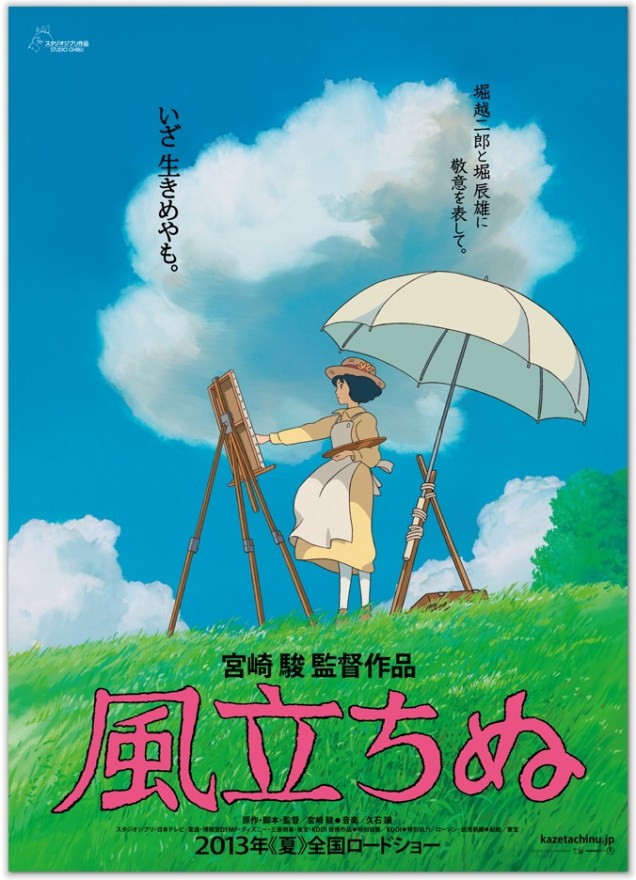
The image that appears later in this post was taken from the Ghibli wiki at nausicaa.net.
Hayao Miyazaki is one of my favorite filmmakers and one of my biggest influences, not just in my writing, but in my philosophy. From the first time I watched Princess Mononoke, I was in love with the animation and storytelling. I’d never seen anything like it before. I still haven’t. Even the other Studio Ghibli films (all of which consist of unparalleled quality, and all of which I thoroughly enjoy) aren’t quite on the same plane as Miyazaki’s personally-directed projects. (Credit must be given to Isao Takahata, whose films come close, and special mention to Hiromasa Yonebayashi, whose film The Secret World of Arrietty is wonderful; as well as Gorō Miyazaki, who directed Tales From Earthsea, one of my least-favorite Ghibli films, then went on to direct From Up on Poppy Hill, one of my favorites.)
I don’t know that I had ever cared for fictional characters as much as I cared for the ones in Princess Mononoke. It was particularly interesting to me that I was not presented with a “bad guy”, but with a large cast of characters who happened to have conflicting agendas, and sometimes do bad things. Even one of the central characters, Ashitaka, has a momentary lapse in his otherwise peaceful, nonviolent nature: “If it would lift the curse, I’d let it tear you apart.” The film’s characters are more than believable, they are alive.
Spirited Away made a big splash in America, winning the Oscar for Best Animated Feature. This film is probably the best example of one of the things that makes Miyazaki’s films so enjoyable. Taking place in a bathhouse for spirits, you can watch the movie a hundred times, and every time, you’ll notice something new, some minuscule detail placed in the background or hiding within a few frames. Hundreds of spirits go about their daily lives, and when you watch the film you can piece together countless untold stories. The film is a snapshot of characters that, while fictional, never cease to be real.
Howl’s Moving Castle is one of my favorite Miyazaki films, and I bought Ponyo the day it came out on DVD. Despite all of this, I had never seen one of his movies in the theater until last night. I’m glad to have had the experience; The Wind Rises is currently slated to be his last.
I’m not going to say a lot about the movie. One reason for this is that it just came out in America last night, and not a lot of people have had the opportunity to see it yet. The other reason is that I don’t believe I can adequately convey my experience in watching the film. For every time I laughed, every glint of light across an airplane’s wings, every flake of snow drifting into a young woman’s sleeping bag, every puff of smoke blown from a character’s cigarette, one thought kept coming back into my mind: This is the last one he’ll make.
Almost every film Hayao Miyazaki has directed features a scene where characters take flight. It’s only fitting that his last film carry the wind as a theme. More than this, the wind is an ever-present character in the movie. It appears in almost every scene, drifting smoke or curtains in the background, or carrying a parasol and changing a character’s life forever. I think this speaks to Miyazaki’s talent: The wind is invisible, but that couldn’t stop him from making an animated movie about it.
I would like to see the film in its original Japanese someday, but I’m thankful for the care and talent put in by the English cast. Joseph Gordon-Levitt is one of my favorite actors, and I couldn’t have hoped for a better person to carry the film. John Krasinski, Emily Blunt, Stanley Tucci, Martin Short, Werner Herzog, William H. Macy, and Mae Whitman round out the supporting cast, and each does a fantastic job giving a voice to Miyazaki’s wonderful characters. Sound designer Gary Rydstrom has done a fantastic job on the English adaptations of many Studio Ghibli films, and I’m thankful that such care is taken to bring the movies into a new language while keeping the story and interactions between characters intact.
I can’t describe the joy I would feel if Miyazaki were to again come out of retirement and announce a new film. It wouldn’t surprise me; some people never quit. They slow down, they take breaks, but they’re always working on something, there’s always another thing calling to them, begging to be shared with the world. Hayao Miyazaki strikes me as that type of person. But if it never happens, if The Wind Rises really is his last film, I can accept that. With a heavy heart but a smile on my face, I would understand and accept it.
All lyrics and songs belong to The Republic of Wolves, not me.
When I first heard The Republic of Wolves, I hated them.
To be clear, I didn’t have anything against their sound. I guess a slice of history is in order: The Republic of Wolves made the scene when several of their demos appeared on YouTube disguised as Brand New demos. Brand New is my favorite band, and when I found out it wasn’t them, I was disappointed in how shady the whole thing was. When the band came out and claimed the demos, they said it was a friend of theirs who posted them, without the band’s knowledge. That didn’t alleviate my disappointment.
I think deep down I was mostly upset that I wasn’t hearing new music by my favorite band. (I probably knew this anyway; the demos sounded very similar to Brand New, but “similar” is as close as it got.)
Despite my mostly forced aversion to the band, every now and then, echoes of the song “Cardinals” played in my head: “I think I found a better way to live, and I think I found a better way to die.” The lyrics were so simple, but said so much. I found myself returning to the song to see what else it had to offer. I found more to like: “I’ve been fitting myself into that small space, that you set out for the screaming of the wind, ’cause that is all I’ve ever been.”
“Cardinals”, by The Republic of Wolves, uploaded to YouTube by a fan.
The immature compulsion I felt to avoid the band eventually broke down, and one day, I used the last of an iTunes gift card to buy the band’s EP His Old Branches. I would come to love the songs “Cardinals”, “For His Old Branches”, and “The Clouds”, and eventually I picked up the rest of the band’s releases.
The band’s first full-length album, Varuna, solidified them as one of my favorite bands. From the haunting, selling-your-soul-themed “Sea Smoke” to the energetic “Oarsman”, the seven-minute-long epic “Monologues” to the lethargic, melody-driven “Pitch and Resin” and “Grounded, I Am Traveling Light”, some of my favorite songs come from this album. I hadn’t felt particularly moved by music in a long time, and Varuna helped change that. It’s impact on me is probably clear; in my novel In the Lone and Level Sands, two characters meet up in the middle of the zombie apocalypse and travel across the country listening to music, and “Pitch and Resin” becomes their anthem. (I didn’t reprint any lyrics as that would infringe upon copyright, but it was and still is my hope that mentioning the song will inspire people to find it.)
The Republic of Wolves next released an EP called The Cartogropher, full of oceanic songs primarily sung by the band’s backing vocalist, which provided a fresh and interesting perspective on their music. Next came their second full-length, No Matter How Narrow, in which the band nails down a very new, more unique sound.
From the opening track “Frozen Feet”, it’s clear that No Matter How Narrow sounds radically different from the band’s previous material. The introspective, cleverly crafted lyrics remain, but the vocal melodies and the music that accompanies them are much brighter and lighthearted compared to the often dark, serious tones carried in the band’s past work.
There’s a cold that I must catch,
Living well in all that I’ve said
And I feel it coming on,
Unless it’s all in my head.
But you were up at two A.M.
Figuring out what it meant:
That all those sins were really sicknesses,
And nobody’s to blame.
—The Republic of Wolves, “Frozen Feet”
“Stray(s)” comes in quieter and darker, with verses reminiscent of Coldplay. The chorus is much louder and led by backing vocalist Gregg Andrew Dellarocca (something I wish happened more often on the album; in past releases, he handled lead vocals on at least one song, but not this time around). After this is “Spare Key”, a more upbeat song with lyrics hearkening back to “Cardinals”.
The official video for “Spare Key”, from the band’s YouTube channel.
“Greenville, MO” is perhaps the most akin to the band’s former sound, with distant guitars accompanying a prominent bass and slow, droning vocals. This isn’t to say this song would belong on one of the band’s other works; two bridges heartily shouted by vocalist Mason Maggio sound like nothing the band has produced before.
“Pioneers” introduces itself with a loud, catchy chorus, then calms down long enough to deliver the precisely placed, cleverly woven lyrics I first fell in love with this band for.
Enough with the coronations,
There’s no one left who isn’t king of something arbitrary
That’s why I’m looking for a crown to pick apart,
We’re just collecting flies in jars, a reconquista in our yard
A war I never had to start.
—The Republic of Wolves, “Pioneers”
After this is one of my favorite songs on the album and from this band, “Keep Clean”. The song contains the energy and enthusiasm of past tunes like “Oarsman” and “The Dead Men Stood Together”, but is possibly the most upbeat track they’ve ever recorded. The talented Will Noon of Straylight Run and fun. fills in on drums for this song.
So we’re all ordaining ministers
Because we can’t keep, no we can’t keep clean.
We’ve been deferring to a hypocrite,
With a kind voice and a loud idea
He divided up the races with a pencil and the Book of Genesis
And sorted us into companies and colonies all pitted up against each other
No matter how, no matter how common is our cause.
—The Republic of Wolves, “Keep Clean”
Following this is “Arithmetic on the Frontier”, an experimental track with a lot of effects, which sounds like something that could easily go wrong, but is perfectly executed. At just over two minutes long, the tune doesn’t wear out its welcome, and culminates in one of my favorite moments on the album, a loud, multi-layered chorus that reminds me of some of my favorite songs from The Cartographer. This leads into “Turning Lane”, another fast-paced track that contains some of my favorite lead guitar work on the album.
Next is the moody, quasi-acoustic “Vinedresser”. This is another of my favorites, with lyrics drenched in metaphor, stopping only once to deliver a moment of clear, undisguised sincerity:
But I was a victim like you,
My shoplifted grace in hand.
How could you know me so well,
When I couldn’t know myself?
—The Republic of Wolves, “Vinedresser”
“Orange Empire” is probably the heaviest song on the album. With lyrics like “Now I’m barely blood and flesh, just an anatomic sketch, coming to find this may be as solid as we get”, the song is contemplative, if not angry, which makes for a very solid penultimate track.
The album closes with “Through Empty Vessels”, a melodic and honest reflection on two people who have had a falling out. This one hits close to home for me; the subject isn’t new to the world of music, but the stance it takes is a little more original. When two people fight, it’s almost never one person’s fault. Sometimes things just don’t work. I’ve tried to capture this in song before, but I don’t think I’ll ever do as good a job as this song does.
And I was intertwined, for the first time, with my own lies
As we both crossed a devastating line
In the flood tide, it never mattered why
When we chose sides, we were both right.
—The Republic of Wolves, “Through Empty Vessels”
The title is possibly a reference to the band’s first EP, whose last song was called “Through Windows”. It wouldn’t be the only reference on No Matter How Narrow to the band’s previous work, and it’s obvious that The Republic of Wolves have come a long way in their musical journey. I can’t wait to see where they go next.


 I’m not going to say a lot about the movie. One reason for this is that it just came out in America last night, and not a lot of people have had the opportunity to see it yet. The other reason is that I don’t believe I can adequately convey my experience in watching the film. For every time I laughed, every glint of light across an airplane’s wings, every flake of snow drifting into a young woman’s sleeping bag, every puff of smoke blown from a character’s cigarette, one thought kept coming back into my mind: This is the last one he’ll make.
 Faded Pages