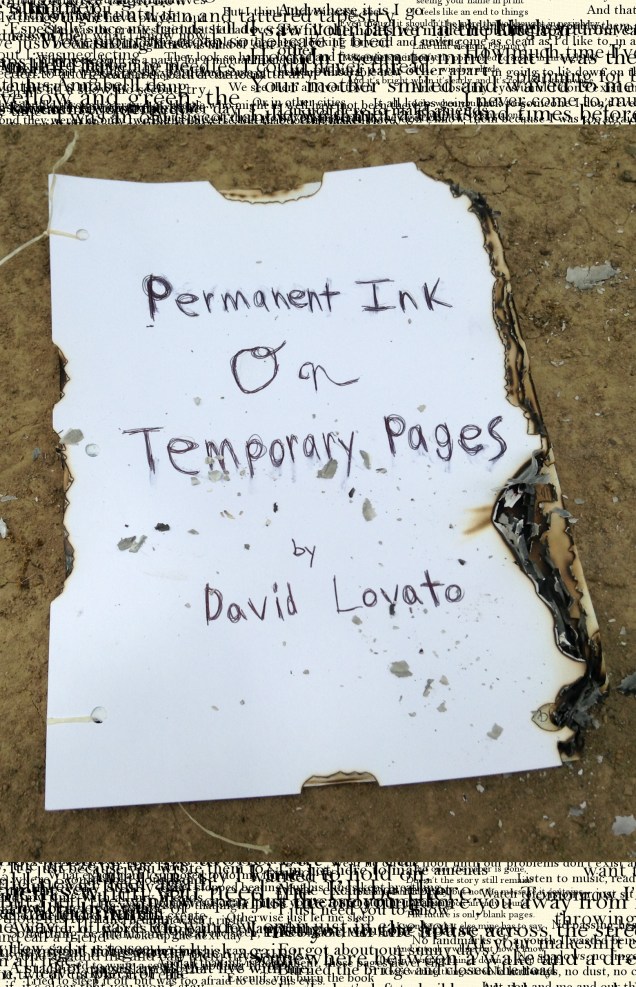
My poetry collection, Permanent Ink on Temporary Pages, will be released next month in ebook and paperback formats.
Each of the 16 poems in Permanent Ink on Temporary Pages stands alone, but also serves as a piece of a larger narrative. From the death of poetry itself in “At Rest in the Sea” to the lifetime-spanning “The Back of the Room”, the stream-of-consciousness piece “Alone” to the song-turned-poem “Sunday Calls for Cloudy Skies”, and the thematically-related interludes “Letters”, “Pages”, and “Poetries”, Permanent Ink on Temporary Pages tells the story of a narrator struggling to find his place in the world, drifting between tangential universes, and replacing the people around him with fictional characters, all the while writing letters he doesn’t send, poetry scattered to the wind, and pages full of everything he can’t bear the thought of losing.
My plan is to release all formats of the book on June 24th, 2014.
The ebook will be up for pre-order on most major retailers soon. In the meantime, here is the table of contents. A few of the poems available for reading now, which you’ll find through their links:
At Rest in the Sea
Letters
Faded.
Sunday Calls for Cloudy Skies
Alone Shadows and Fingerprints
The Back of the Room
Yearbook
Pages
Be There
In the House Across the Street On the Mend
I Could Have Shined
Love on a Page
Contronym
Poetries
I recently received my proof copies of the hardcover editions of After the Bite and In the Lone and Level Sands. I’m pretty happy with the way they turned out, and now I’m making them available to purchase through Lulu.
I wish I could make these available elsewhere, but I can’t justify the cost to do so. For now, Lulu is the only place to get hardcovers of these books. Paperbacks and ebooks will remain available everywhere they currently are.
After the Bite comes in black satin with gold spine text, while In the Lone and Level Sands comes in tan satin with black spine text. Both books feature glossy dust jackets and black-and-white interiors.
I’ve been going over my poetry collection, and on the whole I’m happy with it. It’s looking very unlikely that I’ll scrap it at this point, so I’m probably going to share a few more poems in the coming weeks. I still want to give it another round of editing, then there’s assembling it for publishing, finding a cover, hopefully getting some external feedback, etc. Hopefully I’ll have more concrete information about it next time I mention it on here.
In the meantime, this poem is called “On the Mend” and it almost didn’t make the cut. It’s one of the shortest poems in the collection, but it fits the theme well, and I’m happy with how it turned out.
On the Mend
I’ve been throwing bricks
From atop this house of sticks
And I’ve been casting stones
Across a lake as dry as bones
I hope you never know
How much time I’ve spent planning for bridges
I never come to, much less have to cross
And I’ve been planting seeds
In a yard not fit for weeds
I’ve been writing words
That leave the page like little birds
I was pretty sure
I’ve spent most of my life burning bridges
I couldn’t sleep beneath, much less try to cross
I wrote you down so you would always stay
But a heart like yours won’t be contained
So I put quotation marks around your name, like wings
So you could fly away from me
I hope you never see
I’ve spent every hour since then building a bridge
And I can barely walk, much less bear a cross
Tonight I’ll try to sleep
Beside the secrets I don’t want to keep
Tomorrow I’ll start throwing bricks
At your makeshift crucifix
And hope you do believe
You won’t find any answers jumping off of bridges
Come down from there. You’ve suffered enough.
I’ve already posted this on my facebook page, but I’ve cleaned it up since then, and I’m really hoping to get some input from blog followers as well as strangers.
I’m just about finished with the first draft of my poetry book, which I’m calling Permanent Ink on Temporary Pages. The whole thing has been a new experience for me, one I’ll detail in a later post, but for now I can summarize: I’m somewhat new to the world of poetry. Not writing it, but sharing it.
Over the course of a few weeks, I had a burst in creativity, during which I wrote a few poems. I noticed recurring themes throughout them, so I decided to keep them together. With a sort of narrative in mind, I wrote a few more, and even dusted off some old ones that fit the theme, which has led me to a collection of roughly 16 poems. At first that strikes me as too few, but then again, most of them are longer than the poems I’m used to reading.
I’m going to let the collection sit for a while before I come back to it and edit it, but I want to get outside input on some of it as well, especially if this is going to be an actual book I put together and decide to sell. (Not sure if I can justify the cost of a physical edition of this one, so I might go ebook-only, but again, that’s all for down the road.)
So here’s one of my poems. It’s called “Shadows and Fingerprints”. I’d be very grateful to hear any thoughts on it, good or bad.
Shadows and Fingerprints
There are fingerprints in the dust on the underside of the cabinet
And fingerprints in the thoughts on the underside of my mind
There are shadows on the ceiling
Out in the hallway where I sat on the stairs
And shadows in my memories
Cast by someone who isn’t there
I’ve never been as awake as I am right now
I want someone to talk to, but everyone’s asleep
And that’s okay.
I shouldn’t want to trouble them anyway
I never come as clean as I’d like to, in any case
I’m going to lie down on the floor
And close my eyes until I don’t exist anymore.
It all keeps going back to someone I don’t even know
Or the fact that I don’t know them because I was too afraid to live
So I walk through this city
Trying to find myself out there
Find only passing headlights
And landmarks of my youth,
Like where we’d sit where the sidewalk ends
Walk up the hill and around the bend
Cut through the woods to the circle of stones where we’d sit
Contemplating the world around us and our places in it
It’s not quite the same as it used to be.
Without Ian, it feels a little bit empty.
We’ll get away for a while
Let’s go to Michael’s house, visit Loren in Ohio
Sip vodka and turn off the tv screen
Talk about life and death and philosophy
Get everyone together and go down to the lake
The sun goes down, the stars come out, but we’re wide awake
Let’s sit around a campfire,
Bring a bag of things to burn
Like journal entries
Written by someone who isn’t me
(not anymore)
Old letters
Torn photographs
Clothes that don’t fit,
And some that never really did
That cherub figurine
Unfinished poetry
And all my thoughts of her and me,
So maybe I could get some sleep
Get in the water
Float on your back
Let the wind in the waves wash away your every heart attack
Pitch up the tent
Get into bed
Stay up talking ‘til the morning brings the sun up again
Then go back home
Get on with our lives
Maybe never see each other again,
But that’s all right.
I’ll walk these city streets,
Try to find someone out there who feels like me
We’ll lie on the floor until our problems don’t exist anymore
We’ll listen to music, read poetry
Watch television or just sit quietly
No passing headlights
No landmarks of a youth I wasted being alone
No shadows, no fingerprints
No hallways, no dust, no cabinets
Just you and me and our thoughts.
Just you and me,
Or me and my thoughts.
It’s always me and my thoughts.
When we die, do we turn into stardust?
Can it wait until I’ve made something beautiful first?
Because so far I’ve made nothing but shadows.
So far I’ve left nothing but fingerprints.
I’ve mentioned before that I don’t want my blog to focus mainly on reviews, yet I have one ready to post at any time, and another one in progress. As it turns out, I greatly enjoy talking about the things I enjoy.
Before I get around to posting those, I thought I’d give an update on the other things this site was intended to focus on.
Writing
My main focus right now is on a coming-of-age / magic realism novella. I’m a little over 15,000 words in. I’m not sure what I’ll do with it once I finish it (and in this case, “finish” means finish writing, shelve it for a few months, then edit it and decide if it’s worth existing anywhere but my own hard drive). For now, I’m going to focus on writing it. Its tentative (and likely final) title is “The Afterglow”.
I have a few other projects on the backburner, one of which I’d like to talk a lot more about, but probably shouldn’t, since it won’t be finished anytime soon, let alone releasable. The reason I mention it is that I’m pretty sure I’ll break that silence in the coming weeks, depending on how well it comes along.
Publishing
Search around the internet, and you’ll find a very unfortunate battle raging over traditional- vs. self-publishing. I think (and hope) the squabble is coming to an end, with both methods coming out of it as valid routes to the same goal, and both methods existing as alternatives balancing each other out. With that said, I don’t prefer or dislike either method. I’m still eager to have certain works traditionally published, but I have turned to self-publishing before. One reason for it is that I enjoy doing it. My first love will always be writing, but putting the finished product together as one package is a lot of fun. It’s hard work, sometimes it’s frustrating (no one can ever know how long I’ve languished over where to place the title on the cover, what size to print a book in, what font to use, etc.), but in the end I enjoy doing it.
It’s always exciting to see new options pop up on the publishing side of things. In my case, these options aren’t necessarily new, but old ones I’ve seen in a new light.
There isn’t a lot to say about either route, at the moment. On the traditional side, I’m submitting short stories and novelettes to publishers for their consideration. There’s a lot of waiting involved, which I understand and don’t mind, but it doesn’t make for an exciting blog post.
On the self-publishing side, I’m putting together hardcover editions of After the Bite and In the Lone and Level Sands. My co-author Seth and I have had a few people ask us about hardcovers, and it’s always a bummer to have to tell them it’s not in the cards. However, I’ve found a happy enough medium to work with. If I get these finished and approve of the quality, hardcovers will be available through Lulu’s store only. (I can’t bring myself to use their expanded distribution options; I would have to charge in the realm of $40-$60 for the books, and part of my self-publishing philosophy is that my books need to be affordable. I paid $40 for the entire A Song of Ice and Fire series, I can’t see myself charging the same for one short story collection by some random not-George R. R. Martin.)
Finally, and this one falls somewhere between “writing” and “publishing,” I’m considering a book of poetry. I had a random burst of creativity a few weeks ago, and the result was over a dozen strongly related poems. I’ve considered submitting them for publishing elsewhere, but these follow a theme and almost form a story, and I think they belong together. I could submit the entire book for publishing, but I’m not sure anyone would want to represent or publish a poetry book by someone who hasn’t published poetry before, so for now I’m leaning toward self-publishing it.
Reading
I’ve finally made decent progress with Neil Gaiman’s Neverwhere. I started reading it a long time ago, but I found the beginning to be slow, even boring. It’s finally picking up, and it was worth getting through; I’m enjoying the story.
I also recently began The Girl Who Circumnavigated Fairyland in a Ship of Her Own Making. The writing is delightful; I find myself smiling almost nonstop through it. The story is magical, although the parallels to previous works like Alice in Wonderland and other writers like Diana Wynne Jones and Ursula K. Le Guin are very strong, and I’m not sure the book will end up accomplishing anything those others haven’t already. But I’m not very far in yet, and anyway, a book doesn’t have to change the world or even change literature to be great. In any case, I’m surprised Studio Ghibli hasn’t made a film out of this one. It would fit right in.
Blog Upkeep
I’ve been doing a lot of behind-the-scenes stuff around here. For example, the “Published Works” link at the top is now a drop-down menu that contains a page for every work listed in there (which it should have from the start, but I hadn’t thought to do it yet). Clicking “published works” will still go to the old page, where everything is on one page.
I’ve also been using the tumblr version of my blog a lot more than I thought I would. It’s great for posting pictures, and I’ve recently begun a project I’m calling “Scenes”, where I put excerpts of my writing over pictures I’ve taken over the years. I do plan to get that project going on here as well, but it’s a little more involved on WordPress, and I’m not sure yet how I want the page to appear. In the meantime, you’ll find the pictures on my facebook, the page for my zombie series, and my tumblr.
So that’s what I’ve been up to, more or less. Now I’ll get back to finishing those review posts, and hopefully, by the time those are up, I’ll have something a little more substantial to share on the writing side of this blog.
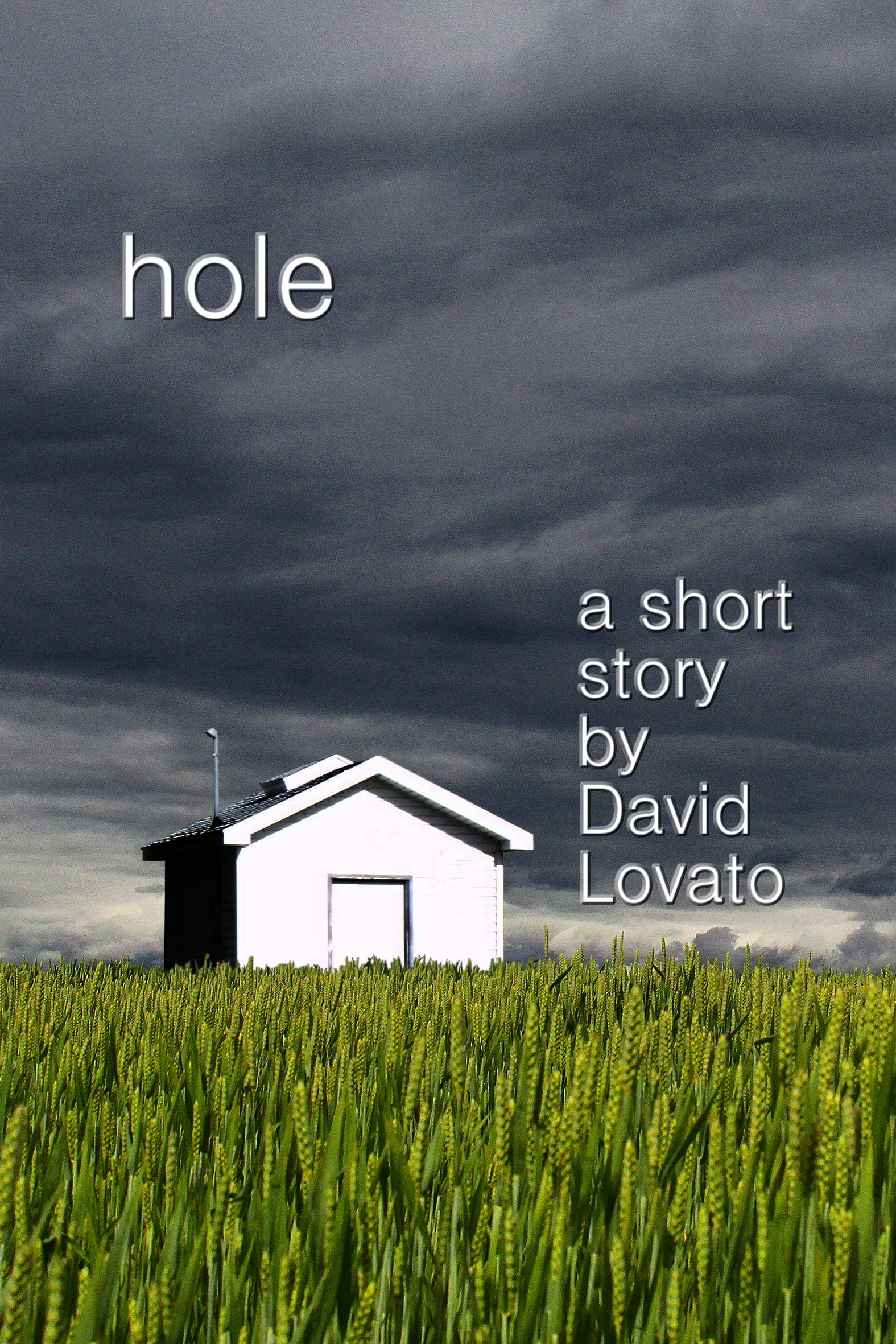
My first venture into self-publishing was through a free short story called “Hole“. For a long time the story appeared almost exactly as I’d written it. Sure, I’d edited it after first writing it, but beyond that, I didn’t do much to it.
I happened to catch a glimpse of the story recently, and realized that was something that needed to change. So, over the last few days, I prepared a new cover image for it (thanks in part to the contributors at Pixabay) and set to work editing the text itself. I’m a lot happier with the newer versions of both.
As I mention in the story’s new afterword, I’m considering making a side-by-side comparison of the 2010 version of the story and the 2014 version of it, to show a little bit of my editing process, and the thoughts that go into each change. Maybe it’ll help someone out there with their own editing. This probably won’t come until later; I’m pretty busy working on new, never-before-seen projects.
“Hole” is available for free from just about every ebook retailer, except for Amazon. (They tend to not allow permanently free ebooks.) You’ll find links to “Hole” at various ebook retailers here: https://davidjlovato.wordpress.com/works-2/#hole
Recently I re-visited one of my favorite albums, Wildlife by La Dispute. Normally I walk on the treadmill for 20-30 minutes a day, but Wildlife clocks in at almost an hour. I had planned to stop at my normal time, but couldn’t bring myself to do it, and went the whole hour. This isn’t one you listen to just part of, it’s an album you commit to.
All lyrics and songs by La Dispute, not me. Obviously.
The interpretation of these songs as presented in this post, however, is mine. At no point should you feel like it’s the correct or only one; that’s the beauty of music.
I first heard of La Dispute in the summer of 2011, when the band released their entire discography for free on the internet. I happened to be browsing a post over at AbsolutePunk, and one of my friends on that site couldn’t recommend the band enough.
I downloaded their discography and gave a few of the releases (one LP and about seven EPs ranging from two to eight tracks) a try. I was at first put off by the vocals; at first listen, Jordan Dreyer’s voice can be intimidating, if not raw.
Even then, there were a few songs I could really get into. I think “The Surgeon and the Scientist” was first among them. One day, with my iPod on shuffle, a little tune called “Such Small Hands” came up. The first thing to catch my hear was the haunting, disembodied guitar intro. Then the vocals come in, and what hooked me were the lyrics.
I thought I heard the door open, oh
No, thought I heard the door open but I only heard it close
I thought I heard a plane crashing
Now I think it was your passion snapping
—La Dispute, “Such Small Hands”
As it turns out, “Such Small Hands” is the first track on their first album, exhaustively titled Somewhere at the Bottom of the River Between Vega and Altair. That provided the foot in the door for the rest of the record. One listen to the following track, “Said the King to the River”, and I was sold on La Dispute.
La Dispute is a writer’s band. Vocalist Jordan Dreyer had reportedly never participated in music before being asked to join; he wrote short stories and poems instead. Literature is prominent in all of the band’s music. Two of their EPs (Hear, Hear. and Hear, Hear II) consist entirely of the band playing along to Dreyer reading, singing, and screaming famous poems, such as Poe’s “Annabel Lee”.
A fan-made lyric video for the song “Andria”, showcasing a few of the band’s common styles: A blend of spoken-word poetry and fast-paced punk vocals, Jordan Dreyer’s raw, honest-to-God voice and absolute control over his range, the bass coming in to foreshadow the intensity the song is about to escalate to, the lead guitar part forming a sort of “dueling guitars” melody to compliment the lead vocals. While it appears on their first release, this song is referenced many times on the album Wildlife.
For a lot of bands, you can hear the bands that influenced them in their music. With La Dispute, the keen listener will hear all of the writers that influenced the band instead.
It didn’t take long for La Dispute to cement themselves as one of my favorite bands. In October of 2011, they released a new album called Wildlife. I bought it immediately, and took my iPod out to the back deck to listen to it on the porch swing. It seemed fitting: That’s where I go to read books, and Wildlife is audible literature.
Still, I wasn’t prepared for what I was about to hear.
Wildlife is a concept album. Each song has a clear and complete narrative, but also fits into a larger one (think chapters in a book). The album opens with one of four letters the narrator is writing. The song is called “a Departure” and sets the stage for the story about to unfold.
Night fell on me writing this, and I ran out of paper
So I crossed the name out at the top of the page
Not sure why I’m even writing this, but I guess it feels right,
It sort of feels like I have to, like an exorcism.
I guess that makes me sound crazy, but that’s all right.
Lately I feel like I might be, not that I’ve heard any voices or anything
Just like that everyday kind, where you forget things you shouldn’t,
And you think too much about death.
—La Dispute, “a Departure”
The album can be broken down into parts: A letter, three songs, the next letter, three songs, etc. Following “a Departure” is the fast-paced “Harder Harmonies”, which tells the story of an extraordinary piano player whose music is overtaken by the tones of the nearby city.
In all of the songs, it’s difficult to tell how much is literal vs. metaphorical, and how many of the stories are true. I’ve heard that most of them are things experienced by the band members or people they know. Part of me wants to never find out; not knowing contributes to the magnitude Wildlife carries. I can only hope these things didn’t all happen to the same person, but in terms of the story, I’ll say they do.
“Harder Harmonies” escalates into a sense of frustration conveyed not just by the lyrics, but by the music. The song ends on a message anybody could sympathize with: “There’s a melody in everything, I’m trying to find a harmony, but nothing seems to work, nothing seems to fit.” This is a recurring theme: Nothing seems to fit, and I think that’s where the story really picks up.
“St. Paul Missionary Baptist Church Blues” comes next. It tells the story of a church our narrator passes by every day, the once-beloved church now abandoned and falling apart, and the narrator thinks the same thing of some kind of relationship in his life, possibly the loss of his own faith.
Ten years now standing vacant
Ten years on empty, maybe more.
Once held the faith of hundreds,
Soon one more cell phone store.
For years they gathered here
Inside the building, sound and true
To sing their praises to a God that gave them hope
To carry on, to carry through.
—La Dispute, “St. Paul Missionary Baptist Church Blues”
After this comes “Edit Your Hometown”, which sounds like a link you’d click on facebook, and that’s probably the point. The song tells the story of a young man who claimed his city with his friends, spending nights together and having fun, but as the years went on, his friends all moved away and carried on with their lives, leaving the narrator feeling alone with an empty city.
After this is our next letter, this one titled “a Letter”. The narrator looks at all of his anger and frustration and begins to wonder if it comes from within, and that maybe things aren’t working because he isn’t really trying to make them work.
Next up is a song in two parts: “Safer in the Forest/Love Song for Poor Michigan”. Both songs occupy the same track and are loosely related, but you can tell where one ends and one begins. “Safer in the Forest” is a relatively quiet, droning tune carried by guitars that never stop but don’t quite repeat themselves, moving up and down in tune with the vocals, until the song explodes into “Love Song for Poor Michigan”, a song about how a bad economy can break people down. In these you can hear references to previous songs; “Safer in the Forest” mentions the city’s song first suggested in “Harder Harmonies” as well as the desire to leave found in “Edit Your Hometown”, while “Love Song for Poor Michigan” hearkens all the way back to the song “Andria” off the band’s previous album, with the line “I will hold these old streets safely in my head, like her”. If you choose to interpret it as such, Wildlife can be seen as a sort of sequel concept to Somewhere at the Bottom… as this isn’t the only reference you’ll find to the band’s previous work.
“The Most Beautiful Bitter Fruit” carries tones of trying to forget pain through things like drugs and sex, but reflecting on how these releases are only temporary.
After this we get our third letter, titled “a Poem”. The narrator reflects on how the writing isn’t helping: “I had a reason for the writing, but trying to exorcise my demons didn’t work.” The narrator instead writes a poem to summarize his feelings and actions. This is reflected in the song as it slows to a crawl and transitions into a spoken-word poem.
The worry, the wonder, the shortness of days
The replacement for purpose
The things swept away
By the worry, the wonder, my slightness of frame
The replacements for feeling,
The casual lay.
And the worst of the wildlife wears clothes and can pray
And they worry and wonder for three meals a day.
Only death unimpeded, not slowing its pace
Brings that petty old worry and wonder away.
—La Dispute, “a Poem”
After this comes a suite of three songs that I find hard to listen to, but I mean that in the best possible way. The next three songs are, without contest, the most emotionally exhausting suite of music I can think of. By the time I was through the first of them, “King Park”, I had stopped swinging on my porch swing, my shaking hands were pressed against my mouth. If you can think of a movie that brought you to the edge of your seat in anticipation, not in the exaggerated, metaphorical sense, but one of those moments that actually made you drop everything and just sit down and pay attention, this song is the audible equivalent of that. If you listen to nothing else from this record, listen to these three songs, in order, please. Something like this doesn’t come along often in any medium.
I don’t want to spoil the effect for you, so I’ll try not to go into too much detail about these three. Just grab a pair of headphones, sit down in a dark room, and listen. You might want to bring a box of tissues and find some ear bleach for when it’s over. These aren’t songs you just listen to; you’re probably going to want something to help you calm down afterward. I guess this all comes off as pretentious or exaggerated, but that’s not my intention. I’m serious, things are going to get intense.
“King Park” opens with a shooting: “Another shooting on the southeast side, this a drive-by, mid-day…Not far from the park, about a block from where the other shooting was last month. Or was it last week?”
The first two stanzas of the song are told in an omniscient, procedural tone, just the basic facts. There’s been a shooting, not far from where another one was recently. At the end of the second stanza, we hit the human element: “The target: a rival, but they didn’t hit the target this time. They hit a kid we think had nothing to do with it.”
From there, our narrator becomes a spectre, a spirit transcending time and space in an attempt to find a reason for the violence. His journey takes him “High and high up over King Park”, back through time, where he can visit the victims before they died, just “playing games and doing homework”, and visit their families, see their lives.
I want to write it all down, so I can always remember
If you could see it up close, how could you ever forget?
How senseless death, how precious life,
I want to be there when the bullet hit.
—La Dispute, “King Park”
After this, our narrator moves forward in time to find the shooter, and from there an already dark and heavy song becomes almost too much to bear. I won’t even say anything about it. Just go listen for yourself.
After this is a song called “Edward Benz, 27 Times”. This one starts off on a much lighter tone than where “King Park” ends, and for that I’m grateful. We open with an old man, the titular Edward Benz, entering the narrator’s store and asking him to repair a window on a door.
Things take a drastic tone throughout the song as Ed tells our narrator his story. The song bounces back and forth between the narrator in the past, standing on Ed’s porch and listening to his story, and our narrator as he is currently, feeling alone and desperate and in pain. Slowly, our narrator realizes he’s writing a parallel to Ed’s story, so he revisits it in his head for comparison.
The underlying tone seems to be that the narrator finds the two situations incomparable: What the narrator is going through (suggested to be a breakup) is shallow compared to what Ed experienced, but that fact brings our narrator no solace; his pain is still pain.
And I sit in my apartment,
I’m getting no answers.
I’m finding no peace, no release from the anger.
I’ll leave it at arms length,
I’m keeping my distance
From hotels and Jesus and blood on the carpet.
I’m stomaching nothing,
I’m reaching for no one,
I’m leaving this city and I’m headed out to nowhere.
—La Dispute, “Edward Benz, 27 Times”
Our trio rounds out with the song “I See Everything”. In this one, our narrator recalls a day in his junior year of high school, when he walks into the classroom a little late and finds a heavy atmosphere in the room. He takes his seat and finds his teacher handing out photocopies of a journal she kept in the 80’s, shortly after her seven-year-old son was diagnosed with cancer. Following the introduction, the middle of the song is presented directly as these journal entries, and the end finds our narrator alone many years later, reflecting on the teacher and her son, as well as his own life.
July 9
There’s a suffering when I look in his eyes
He’s been through so much.
We’ve all been through so much, but
What incredible resolve our little boy shows
Only seven, standing face-to-face with death
He said it’s easy to find people who have suffered worse than him
“Like Jesus suffered worse than anyone,”
He told me last night, when God abandoned him.
—La Dispute, “I See Everything”
Once this suite ends, we’re given our last letter, “a Broken Jar”. Our narrator has grown tired of writing down these stories in attempt to cope, they aren’t helping. In his frustration he turns over a table and a breaks a jar, which he then attempts to repair, but reflects that no matter what he does, the cracks will still be visible, and some things can’t be fully repaired.
After this letter, we’re presented with two songs to serve as falling action. The first is “all our bruised bodies and the whole heart shrinks”. Maybe I look too much into it, but I think the fact that the title is improperly formatted (using all lowercase letters) is a reflection of how the writer has become tired and apathetic, but he hasn’t given up, hence the title being so long.
In this song, our writer comes to a realization. He’s been writing down the suffering of other people to cope with his own, and rather than comparing them, he begins to collect them, to realize that other people have made it through their pain, so it’s possible that he will, too.
Tell me what your worst fears are
I bet they look a lot like mine
Tell me what you think about when you can’t fall asleep at night.
Tell me that you’re struggling, tell me that you’re scared
No, tell me that you’re terrified of life
Tell me that it’s difficult to not think of death sometimes.
Tell me how you lost, tell me how he left, tell me how she left
Tell me how you lost everything that you had,
Tell me it ain’t ever coming back.
Tell me about God, tell me about love,
Tell me that it’s all of the above.
Say you think of everything in fear,
I bet you’re not the only one who does.
—La Dispute, “all our bruised bodies and the whole heart shrinks”
The album’s final track is “You and I in Unison”. In this song, the writer finally tells his own story, adding his own pain to the pages he’s been writing, and leaves them with the feeling that even if we suffer, we all suffer together. Our narrator isn’t alone and never has been—he has a stack of pages that prove it.
There’s a certain feeling you get when you finish reading a good book, and Wildlife is probably the only album that’s ever given me that feeling. It’s painful but hopeful, it’s heavy but beautiful.
La Dispute is releasing their third album in March 2014, called Rooms of the House. I’m looking forward to it, and I hope I love it half as much as I love Wildlife.
If you enjoy the music, please consider supporting the band. Pre-orders of their upcoming album Rooms of the House support various charities. More information can be found on the album’s pre-order pages here: http://hellomerch.com/collections/la-dispute
Writing a book can be frightening. There are times I wonder if I’m capable of doing the story justice; there are places and characters and plots in my head, but what if I can’t translate those onto the page? What if I end up sharing a bastardized version of them with the world?
Then there’s the fear of losing someone. I think a lot of people who read can relate; even though a story or character is fictional, you’re devoting part of your life to spend time with them, and sometimes losing them hurts. I think it’s just as hard on the writer, especially if we didn’t see it coming, but we have to do what’s right for the story.
For me, possibly the most frightening part is releasing the book into the world, and not knowing how people will react. It’s like I’ve raised a bird since it was an egg, and now it’s time to set it free to fly, and I really hope someone doesn’t shoot it out of the sky as soon as it leaves my hands.
Obviously, not everyone is going to like my writing, and every writer gets negative reviews. That’s part of the process. People have different tastes, and you can’t expect a book to sit well with everyone. There’s so much I love about writing, I’d keep doing it if nobody liked my work. Still, that anxiety that accompanies releasing a book exists. I’m pretty sure by now it’s inescapable. I could release 99 books that each get a hundred five-star reviews, and I’ll still feel it just before I release book 100.
I’m not trying to complain. That anxiety is also accompanied by a sense of excitement, especially if I’m proud of the book I’ve written. It’s a double-sided coin, and I think if I wasn’t anxious, I might not be excited, either.
So far my books are being well-received. I’m thrilled to see the reviews come in, most of them very positive, and I can’t thank you enough. I have a few one- and two-star ratings, and I can’t complain. Theoretically, every rating is followed by a reading. Someone took time out of their life to read something I wrote. That is its own reward; someone twice my age, someone half my age, someone sitting in a country I’ll probably never see with my own eyes has read something I’ve created.
If you’re that someone, thank you. There are millions of books out there, billions of characters you could’ve spent your time with, and you chose mine. That’s an incredible honor. We’re on this earth for a limited time, and to have anyone spend theirs on me is a humbling experience.
I hope you enjoyed it. I’m sorry if you didn’t. Either way, I’m thankful you gave it a chance.
There’s something about the spring that makes me want to visit other worlds.
I aim to always be reading something. Sometimes I’ll take a week or two off from reading, especially if I’m editing my writing; I need to give my eyes a break, after all. I’m editing something right now, but I’m not taking a break from reading (instead I’m reading a graphic novel, which is a little lighter on the eyes than a book is).
The other morning I stepped outside to let my dogs out, and for once it wasn’t freezing. It was actually nice; it was warm in the sunlight, and the wind was cold, but soft. It reminded me that spring is on the way, but more than that it reminded me of past springs and summers, when I’d sit on the porch swing reading books, only taking breaks to dream up my own.
Spring is almost like a refresh. Let’s reboot the planet, all the plants and the sun and the air. It gives me a feeling I can only describe as “new”. New year, new world. Maybe that’s what makes me want to visit other worlds, in reading and in writing, and it often continues through the summer.
We’re coming up on that time, and I’m excited. I’m not sure what I’ll be reading two months from now (probably either The Dispossessed or The Girl Who Circumnavigated Fairyland in a Ship of Her Own Making), and perhaps more importantly, I’m not sure what I’ll be writing two months from now. All I know is that I’m excited to get there.
It snowed last night, reminding me spring isn’t here yet. But oh, is it coming, and I can’t wait to meet you in another world.
Over a year ago, I was browsing a magazine (I don’t remember which), and near the back was a review of a book I’d never heard of. The book is called The Girl Who Fell Beneath Fairyland and Led the Revels There. I didn’t read the review (I think they gave it five stars, I don’t recall), but I did add the book to my mental “to read” list immediately.
The title hit me like a freight train. It captured my attention, held it, and demanded I pick the book up.
I looked into it and discovered the book is a sequel to one with a title that’s almost as good: The Girl Who Circumnavigated Fairyland in a Ship of Her Own Making. It should be noted that I haven’t read either book yet (a misfortune I plan to remedy very, very soon), but regardless of how that goes for me, I think these are two of the best book titles I’ve ever seen in my life. (The author is Catherynne M. Valente, for those interested in looking these books up.)
When it comes to titles, I don’t know that I’d consider them among the most important parts of the writing process. A bad title probably won’t turn anyone away, but a good title can certainly turn a reader toward your book. For example, let’s look at two of my favorite books: The Silence of the Lambs by Thomas Harris is one. It’s a great title for several reasons. To start, it has a sort of mystical feel to it. You don’t immediately know what it’s about. There are two key words in the title: “silence”, which makes me think of darkness, death, suspense, and fear. The other is “lambs”, which conjures the idea of “innocence”. So now I have to know why innocence is being silenced, which means I have to read the book (or, at the very least, the back cover).
(In case you don’t know, the book is a horror/suspense novel about a young FBI agent hunting a serial killer. The title comes into full play toward the end of the book.)
Now a second of my favorite books: The Road by Cormac McCarthy. It’s simple, straight to the point, and honestly, tells me absolutely nothing about the story. That book could be about anything. I can guess that perhaps the titular road is symbolic and that there will be some kind of journey involved, either internal or external, but not much else. (It turns out it’s a bit of both; it’s a post-apocalyptic road novel.)
I wouldn’t say The Road is a bad title, but it’s no Silence of the Lambs. It doesn’t demand I drop what I’m doing to read the book (which is where the synopsis has to take over), but it certainly doesn’t make me turn away from the book, either.
With all of this in mind, when I choose a title for my work, more than anything else I try to find one that fits the story. Lately, I try to aim for the attention-getter, but sometimes I just can’t find one. In any case, I thought I’d give a few pointers in how to narrow down a good title, or at least a good place to start looking for one.
You’re going to want something that serves as a “bigger picture” summary of your story. (The Road nailed this one.) Bonus points if this is unique. George R.R. Martin’s A Game of Thrones is a good example. The book is, at its heart, about a struggle of succession to the throne, and how many of the people involved more or less game the system. It’s also very obvious just from the title that we’re probably talking historical fantasy, and the title isn’t readily reminiscent of any other title I can think of. So it’s unique, it hints at the genre, and it summarizes the story within.
A good way to find something like that in your own work is to look for a word or term or phrase within. (Another one A Game of Thrones nailed, as the term appears twice in the book, if memory serves.) An example of this is my own book, In the Lone and Level Sands. While it’s not immediately clear from the title that the book is about zombies (though those familiar with the Shelley poem the title alludes to might think “post-apocalyptic”), the title is, in my opinion, an attention-getter. It’s also taken directly from a conversation two characters have toward the end of the book, and relates to the story pretty clearly from that context.
So, long story short, you want something that summarizes your story, hints at the genre, grabs the attention, or does all of these. A good place to look is in the work itself, in a passage of writing, a bit of dialogue, or just in the general plot. Sometimes you can find it by looking elsewhere; for example, Cormac McCarthy’s No Country for Old Men does a good enough job of summarizing the story, even though the line is taken from a completely unrelated poem. (Again, my own In the Lone and Level Sands can relate.) Just make sure it’s related to your story in some way and falls under fair use; plagiarism doesn’t make for good titles.
I think a good combination to shoot for is this: Your cover should draw the reader in from afar. Your summary should make the reader have to read the book. But your title should make the reader have to read the summary. And, if your title is good enough, it just might cause a few readers to skip the summary and dive right in. Catherynne M. Valente’s titles did it for me, and I can only hope to be that good at coming up with titles in the future.
In closing, here’s a list of some of my favorite book titles and my own comments about them. Feel free to add yours in the replies.
The Left Hand of Darkness by Ursula K. Le Guin. The Word for World is Forest, also by Le Guin. (No idea what either of these books are about, but I’m pretty sure they’re both in her Hain series, which I’m about halfway through.)
The Lathe of Heaven by Ursula K. Le Guin.
Only Revolutions by Mark Z. Danielewski. (Sounds cool, and it’s a road novel, and there’s a lot of teenage anarchy involved, so it’s a perfect fit.)
John Dies at the End and its sequel This Book is Full of Spiders by David Wong. (I mean, you pretty much have to read a book with that title.)
The Drawing of the Three and The Wind Through the Keyhole by Stephen King. (Both of these are Dark Tower novels, and both have the sort of fantastical title that captures my attention. Most of the books in that series do.)
Something Wicked This Way Comes by Ray Bradbury. (You see the title and have a pretty good idea what the book is about.)
The Call of Cthulhu by H.P. Lovecraft. (The title is almost as creepy as the novella is. I could list almost everything Lovecraft ever wrote here, so you should probably just look up a list of his works.)
A Swiftly Tilting Planet by Madeleine L’Engle. (Another attention-grabber.)
Speaker for the Dead by Orson Scott Card. (Another perfect title. You can guess the genre as scifi/fantasy, it draws you in, and it does a wonderful job of capturing the heart of the story.)
The Devil and God are Raging Inside Me by Brand New. (This is an album and not a book, but it fits just as well.)

 Faded Pages