Free Norman Peters!

At 6:42 PM Pacific Time on June 21st, 2013, the zombie apocalypse began.

But in the months before the world changed forever, one blogger went on a terrifying journey.

Read about it here:

http://freenormanpeters.wordpress.com/


Free Norman Peters! is a companion to our upcoming novel, In the Lone and Level Sands. For more information, check the book’s facebook page: https://www.facebook.com/intheloneandlevelsands

In the Lone and Level Sands Book Announcement

Anyone who knows me and/or my friend Seth Thomas will know that a few years ago, we started writing a zombie apocalypse novel together. Throughout that time, other projects took the forefront of both our lives, but we never forgot about this one.

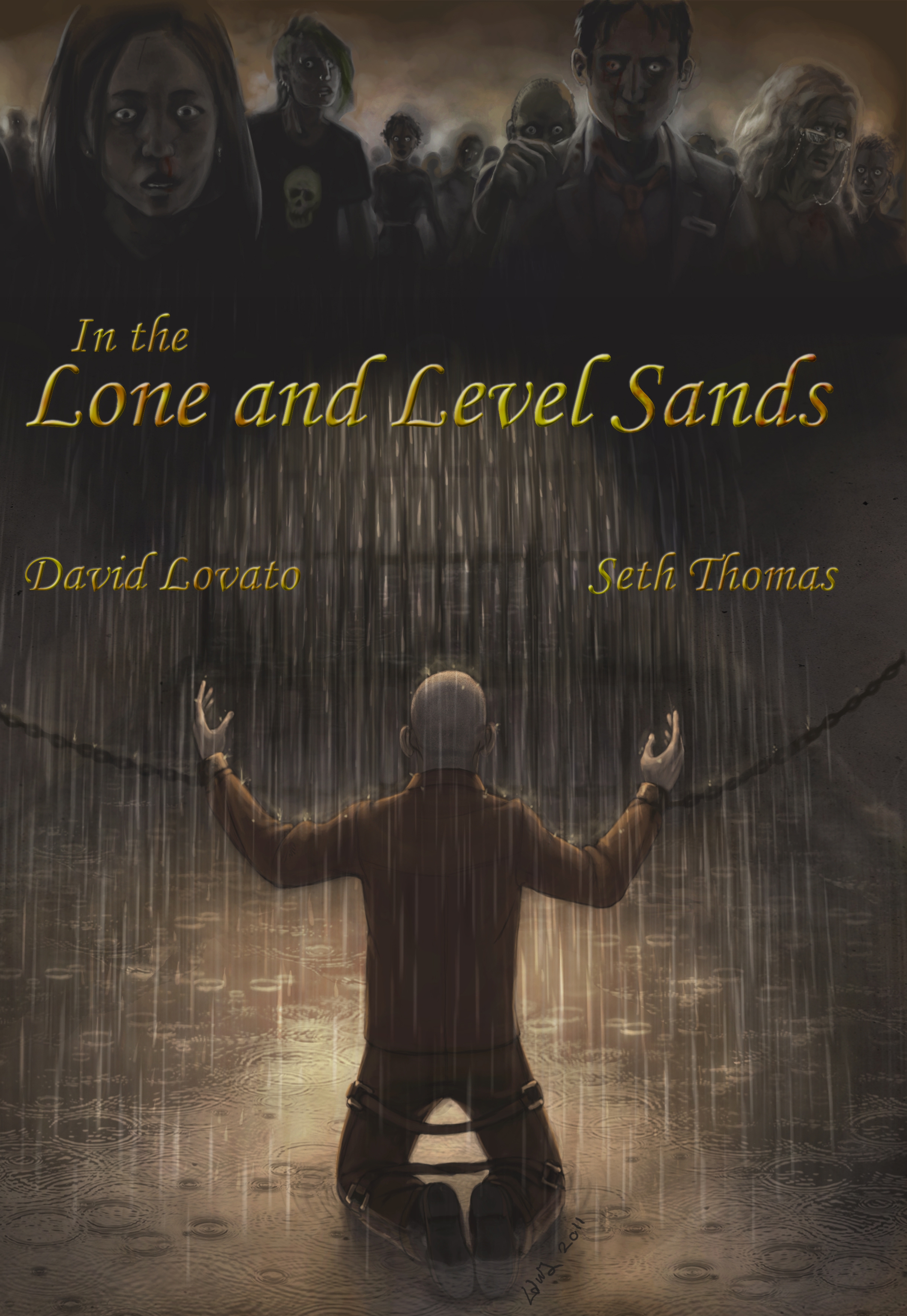
I’m glad to finally announce our book, titled In the Lone and Level Sands.

In the Lone and Level Sands

The story follows seven groups of people across America as they deal with the onset of the zombie apocalypse in different ways. When people around them begin killing and eating each other, unlikely allies band together for survival. But the creatures are evolving, and if the survivors want to live, they’ll have to do the same.

In the Lone and Level Sands is set in the same universe as our collection of short stories, After the Bite. We plan to release it in late November, but if you like the book’s Facebook page, you’ll have access to excerpts, a lengthy preview of the book, and a few surprises along the way.

Seth and I offer our thanks to everyone who has followed this book’s progress over the years, and any newcomers to it as well. We’d also like to thank Laura Soret for providing the gorgeous cover artwork.

Stay tuned. Good things are coming. To start them off, use the coupon code “DV23C” (without quotes) to get the e-book version of After the Bite free at Smashwords. The coupon expires on December 1st (subject to change, but only if I have to change it).

Thanks for everything.

Small Update, and a Review of 11/22/63

I found a healthy way to lengthen my scifi manuscript. It’s still on the short side, but I think it’s solid, story-wise. I’m working on querying, now.

My last post mentioned editing an older project for self-publishing, and that has gone very well. Hopefully I’ll have something substantial to post in the next two or three weeks. I’m pretty excited.

I have another review, this time of 11/22/63 by Stephen King.

11/22/63 is probably my favorite non-Dark Tower Stephen King novel. I say this loosely, as almost every one of his books ties into that series in some way, and this one is no exception. It’s not a horror novel, although the elements of it are there. It’s a gripping story, and a heavy one.

We live in a world that all too often demands a happy ending. I admire King’s ability to ignore this demand, but for the right reasons. It’s easy to write a tragedy for the sake of being contrary, but King doesn’t do this. Instead, his story is tragic, but hopeful, and shouldn’t it be? How often does life tie up all the loose ends, pack them into a gift-wrapped box, and send them to us on a sunny day, with all of the “good guys” alive and unscathed and all of the “bad guys” locked up or dead? More likely, the outcome of an event is apt to be a little good and a little bad (and usually a little more of one than the other), as are the people involved.

11/22/63 tells a fantastic tale that, because of the way it’s told, could just as easily be about real people and real events. Few authors do this as well as Stephen King, and while some of his craft decisions leave me scratching my head or even rolling my eyes, I always walk away grateful to have read the book and spent that time with his characters and stories. This one gets five stars from me.

As a side note, this is my first experience with an audio book. I think I prefer the print, but Craig Wasson’s reading was superb. Each character came to life in a unique but not over-the-top way. Sometimes he read things differently than I would have, but I could hardly call the different perspective a bad thing.

Check out more of my reading activity on my Goodreads page.

Small Update, and a Review of Three Hainish Novels

Since the last few posts have been reviews of other people’s work, and that isn’t what my blog is meant to be about, I thought I’d give a quick update before posting my latest review.

I’ve finished the second draft of my latest manuscript, a scifi/cyberpunk-ish novel called The Foreland. Thanks to the wonderful people at QueryTracker’s forums, I think my query letter is ready to go. I’m not querying agents yet (though I am making a list of them); I’m worried my manuscript might be a little too short. I’m currently exploring ways to lengthen the story without adding fluff or nonsense. I only need to add a few thousand words to get it to the “ideal word count” I’ve read about on so many other blogs, but if I can’t do it well, I won’t do it at all. I think I’d rather have a good story be a little short than have a fluffy story be the ideal length.

I am, as always, working on writing my next big project. I have a few ideas in the works, but few far enough along to talk about right now.

I’ve also picked up an older project for another round of editing, this one more likely to be self-published. Depending on how much of that I get done in the next few weeks, you’ll probably hear a lot more about it very soon.

On to the review:

Three Hainish Novels is, as the title suggests, a collection of three of Ursula K. Le Guin’s books, these ones set in her science fiction Hainish Cycle.

Rocannon’s World is Le Guin’s first novel, and the first in this collection. A lovely tale, science fiction at its finest, and wonderfully told. Some of the paragraphs run on a little long and the story begins to feel exhausted toward the end, but it doesn’t wear itself out and instead comes to a clean, beautiful close. 4/5 stars.

I’m not usually a fan of flowery prose, but in Planet of Exile it’s done so well and in such moderation that it only adds to the story. The story and the writing are both beautiful. Le Guin perfectly captures imagery and poetry in prose form, and this builds up to some moments later that gave me chills and could put most of the horror novels I’ve read to shame. The first few chapters were slow but very much enjoyable, and once I got to the last third or so of the book, I couldn’t put it down. 5/5

The final book, City of Illusions, is the longest, though still not a very long book. I had a little bit more trouble with this one; it’s very wordy, and I had to read over a few sentences a few times to get their meaning, especially when they were full of mythos and things from other Hainish Cycle books that weren’t immediately clear to me. Just as it begins to feel like it’s dragging on, the story takes a sharp turn, and all of that journey leading up to that point becomes clearer, more important. The moral dilemma faced by the main character, Falk, is astounding; page after page I dreaded what would become of him.

This is possibly the first of the three books in which it becomes clear that while the stories in the Hainish cycle take place billions of miles and hundreds of years apart, they are very much a part of one story. It was interesting to see a pebble cast by a character in one book lead to ripples the size of species in another, and there was a very strong thread of emotion connecting characters hundreds of years apart, never knowing each other or their stories, but somehow working toward the same end.

Each book in the Hainish Cycle is like a snapshot, a capture of one moment, one story, only a glimmer of the whole, expansive tale of mankind throughout the millenia. It excites me that there are more Hainish Cycle books to get to, and I can’t wait to see how they fit in. The series being written in one order and taking place in another means that once I’ve finished reading them in the order they were written, I can go back and read them in the order in which they take place, and start to see things new again.

Overall: 4/5 stars. Be sure to check out more reviews on my Goodreads page.

Review: Scott Pilgrim

When Edgar Wright’s Scott Pilgrim Vs. the World came out, I had never heard of the comics. I watched the film, being a huge fan of Shaun of the Dead, and I loved it. I took the next logical step and decided to read the comics, and I wasn’t sure what to expect.

This might sound strange coming from a writer, but I usually don’t have a problem with film adaptations of other media. Often I like them as much as or more than the source material. For the first volume or two of Scott Pilgrim, I didn’t think I’d like the comics as much as I liked the movie. Around Volume 3 I was proven wrong, and once I got to Volume 4 I couldn’t stop reading.

I still love the movie, but I love the comics in a different way. They’re a lot deeper and a lot more personal, and in retrospect I think the film would have been even better as a trilogy. But I tend to see film adaptations and their source material as separate entities, and I’m comfortable being in love with both.

There were moments in the graphic novels that made me laugh out loud, which doesn’t happen often when I’m reading. I appreciated the style and humor of the comics, the frantic and exciting imagery, and especially how straightforward it was. The biggest problem I have when reading comics is that I sometimes have to stare at a panel for a long time to figure out what’s going on. I was rarely confused this way when reading Scott Pilgrim, but I found myself staring at the panels anyway, taking in the minute details and pop culture references Bryan Lee O’Malley hid throughout. In some ways Scott Pilgrim does right what I thought the FLCL graphic novels did wrong: there is a distinct method to the madness that demands the reader visit the story again and again to pick up on the things they missed the first time through. Scott Pilgrim has the added bonus of lovable scenarios and characters worth revisiting.

The final panels of the final volume were breathtaking in their beauty and simplicity. I wasn’t sure how the comic was going to end, but I wasn’t disappointed.

Final rating: 5 out 5 stars.

For more book reviews, be sure to check out my Goodreads page.

Review: The Wind’s Twelve Quarters by Ursula K. Le Guin

In April I finished the first draft of my latest manuscript, and almost immediately after, a friend asked me to look over one he had recently finished, which I was happy to do, as I like to put some time between drafts of my work. After finishing his and starting on mine, I started to feel like reading something else. I don’t tend to read a lot while revising my own work, but I had spent too long away from the pile of books beside my bed. It was around that time I decided to pick up The Wind’s Twelve Quarters, thinking a short story collection might make for easier reading while I worked on my own writing. This proved to be a miscalculation, as I had trouble putting the book down.

Mentioning Le Guin’s work will most often draw to mind her fantasy, namely the Earthsea Cycle, which would pave the road for the likes of Neil Gaiman, Hayao Miyazaki, and J.K. Rowling. Perhaps less famous (but equally as influential, not to mention good) is her science fiction work, most of which falls under the Hainish Cycle. What most people won’t think of, however, is horror, which is a pity because she is perhaps the best writer at it. I’ve read books and found them disturbing, perhaps creepy, but never have I seen them as more than words on a page, which are not inherently horrific. Some of the stories in this book changed that for me. I would be hard-pressed to argue that the point of any story on the book is to be a work of horror, but there’s no doubt that Le Guin has managed to capture fear. I’m not talking about the gruesome and grisly, or the idea of some grotesque creature coming to “get” you, but the real horrors: Madness, isolation. The realization that you are not alone in a dark room, the comprehension of that which renders us infinitesimal.

“Semley’s Necklace” opens the collection. A short story on its own, it also happens to be the first chapter of Le Guin’s first novel, Rocannon’s World. Reading that novel was probably my first experience with the horror Le Guin is capable of writing: At first a mild science fiction work, it slowly works its way toward a terrifying realization. It was the perfect way to open both books.

“April in Paris” offers an immediate change of tone, being a more light-hearted fantasy work. “The Masters” presents the idea of persecution of the scientific, a theme that will recur in many of the author’s works, and contains one of my favorite passages in the book. “Darkness Box” is another fantasy piece, and one I enjoyed. Only a few pages long, it presents a world more rich than ones I’ve visited for entire novels.

“The Word of Unbinding” and “The Rule of Names” are both part of the Earthsea Cycle. The latter has elements of dark comedy, and in the last sentence returns the horror theme present throughout the collection. “Winter’s King” takes us back to the Hainish Cycle, and while a strong story, I thought it might have been better if it were extended into a full novel. Entire revolutions are passed over in a paragraph, which I assume is because they are perhaps not directly related to the central character’s internal story, but seeing years go by in a sentence was inescapably jarring.

“The Good Trip” provided a nice change of pace, being a short speculative work between two larger science fiction pieces. Following this is “Nine Lives”, one of my favorite stories in the collection. After this is “Things”, another short but very rich piece, and another favorite of mine. “A Trip to the Head” is a much less “conventional” story, being speculative through and through, and I appreciated the story it had to tell and the way it was told.

“Vaster Than Empires and More Slow” marks the point at which I couldn’t stay away from the book for more than a few hours. Another science fiction piece and part of the Hainish Cycle, this one stands perfectly well on its own. In this story were passages that gave me chills; perhaps for the first time, reading a book terrified me. Yet the story is not gloomy; it is beautiful even at its darkest, perhaps when it is darkest. This is not only my favorite in this collection, but easily one of my favorite short stories.

“The Stars Below” runs parallel to “The Masters” but is perhaps more enjoyable. “The Field of Vision” is one of the most terrifying stories I’ve ever read, and one of the most interesting. “Direction of the Road” offers a change of pace, another dark comedy and one of the most imaginative things I’ve read.

“The Ones Who Walk Away from Omelas” was the first of Le Guin’s works I read. After a few years, it holds all the power it did when I first read it, and I was glad to re-visit it. I could write at great length about this story, but for now I’ll just say that I hold this one close to my heart.

“The Day Before the Revolution” solidly closes the collection. It might make more sense to me once I read The Dispossessed, but I did enjoy the story.

Nearly every story left me wanting to start the same story again, so this is a collection I look forward to coming back to time and again. It only grows more relevant with time, and I hope to read it over every few years, noticing things I hadn’t before, taking away lessons that passed me by the previous time. I can tell already that it has a lot to teach.

For more book reviews, be sure to check out my Goodreads page.
WIBUT 6/23

Another edition of What I’ve Been Up To!

Editing

I finished looking over my friend’s manuscript a few weeks ago. Since then I’ve been going over my latest finished work, still tentatively titled The Foreland. I’m taking it pretty slowly at the moment, but I’m picking up steam on it, and I’m hoping to have it finished by August.

Reading

I’m currently reading The Wind’s Twelve Quarters by Ursula K. Le Guin. I’m enjoying most of the stories within, and you can expect a review on Goodreads when I’ve finished it. I’ll likely post my reviews here as well from now on.

Writing

I’m still writing for Nintendocon, and I’m doing minor work on various other projects. My main focus at the moment is revising The Foreland. I have an idea for a new project, so when I’m done revising, I’ll probably begin work on that, and continue work on a fantasy manuscript I keep putting on the backburner.

Publishing

I changed the cover of Six and Seven again. I wanted it to be more colorful, so I made a new cover based on one of the illustrations in the novella.

What I’ve Been Up To 5/16 Edition

Hey everyone! I haven’t posted here in a while, but I’m busier than ever! Here’s what I’ve been up to:

Editing!

I’ve been making some minor pre-edit adjustments to the novel I finished in April, which is tentatively titled The Foreland. I think these are pretty much finished, and now I’m going to let the manuscript sit for a few more weeks before I really get down to editing.

I’ve also been proofreading a manuscript by my good friend Seth Thomas. He printed a copy of it for me to write and draw all over, and I’ve been trying to do so every night.

Reading!

I just finished Mile 81, a novella by Stephen King. You can find my review of it on Goodreads. I’m still debating what to read next, but City of Illusions by Ursula K. Le Guin is pretty high up on my list.

Writing!

I’ve been taken on as a staff writer for a Nintendo fan website, Nintendocon. Be sure to follow it for the latest news, reviews, and analysis.

Publishing!

Laura, the wonderful artist who did the cover for After the Bite, has been kind enough to draft up a new version. This one has much better title text, is easier to see, and is (hopefully) much better-looking in print (I’ll know for sure as soon as my copies arrive).

The people behind /r/shutupandwrite’s Critiquecast have been kind enough to critique my microfiction piece “The Reaper Runs Faster”. If you don’t know what Critiquecast is, it’s a podcast in which a group of amateur writers critiques other amateur writers, with hilarious and probably not-safe-for-work results. It’s a lot of fun, and you should check the podcast out.

As always, I’m working to try to get short stories and novels published traditionally. I’ll be a lot more specific about this if and when I have anything specific to announce.

That’s the gist of what I’ve been up to. What about you?

Camp NaNoWriMo April 2013 Results

Hey guys! Thought I’d give a little update on my Camp NaNoWriMo progress.

If you follow my blog, you’ll probably notice that I participate in almost every NaNoWriMo and Camp NaNoWriMo, but usually I’m either too busy working on something else to finish it, or I end up writing a novella well under the 50,000 word goal.

This month was different. I reached my 50,000 word goal a few days ago, and I’m very happy with the work that has come out of it so far. It’s not finished yet, but I expect the final draft will be around 60,000 to 65,000 words. After that I’ll put it away for a while, then I’ll come back and edit it, which will likely make it end up around 58k to 60k. A little short for a science fiction epic, but again, I’m pretty proud of this story. I like it a lot.

I expect to finish the first draft within the next week or so.

The next session of Camp NaNoWriMo is in July. I’m not sure if I’ll participate in that one; I have a fantasy novel sitting at over 20,000 words and I should probably get back to that pretty soon. I have other ideas (I’m pretty much never short on that) but I’m not sure any of them are developed enough to begin working on.

For all my fellow campers out there, good luck! There’s still a week left, and writing something is better than writing nothing. Have fun!

Camp NaNoWriMo April 2013

Just a quick update here. For the April session of Camp NaNoWriMo, I’m making a second attempt at a novel I started years ago but wasn’t ready to write. It’s science fiction, which I haven’t written in a while, and it feels good to get back into the genre.

As always, some NaNo tips:

1. Have fun! Don’t take things too seriously. Missing your daily or even overall goal isn’t the end of the world, and writing something is better than writing nothing at all.

2. It may not matter what you write, just write. If you’re dead-set on reaching your goal but you have writer’s block, make a copy of your document and just go completely nuts. Write something off the wall that would never make it to your final draft. Chances are as long as you keep writing, the creative gears will keep turning, and you may just come up with a way past your block.

3. Put it away for a while. When I find myself stuck, I usually head for some menial task, like running on the treadmill or doing the dishes. Nine times out ten, a solution to whatever I’m stuck on pops into my head within a half hour.

4. And this one is for writing in general: Write down your ideas! I use the Notes app on my iPod Touch, and I write down everything. Every little thought, however incoherent. My recent novella Six and Seven started out this way. I was lying in bed, about to fall asleep, and one little thought popped into my head: Hell has seven chimneys. It took almost a year before I began fleshing that out into a story, but the result is one of my favorite works. And you never know when some little note or idea or sentence will be just what you need to get yourself moving again.

If you want to keep up with my camp progress, here’s my profile: http://www.campnanowrimo.org/campers/crackedthesky

Feel free to add yours in the comments. You might get a few views, and we might even be able to get a cabin going.