nowPlaying: Bioshock Infinite

Bioshock was one of the first Xbox 360 games I ever played. I bought the console from a friend, along with a few games, and that was the only one that looked interesting to me. (I had yet to go pick up my copy of Fallout 3, which was my reason for buying the console in the first place.) I remember being surprised at how much fun it was: Not your average first-person shooter, the game implements the use of biological powers called plasmids, which ultimately led to the fall of the game’s utopian underwater city, Rapture. The game introduced the Big Daddy, one of the most iconic video game characters to appear in recent time, and the story’s twist ending was something I hadn’t seen much in the world of video games.

I remember playing Bioshock 2 and finding it to be a little too familiar. It’s a solid game, but it didn’t offer much that the first game didn’t. Perhaps this is to be expected; the game is made by a different team.

The team behind the first Bioshock would later go on to make the third entry in the series, Bioshock Infinite. This one leaves the underwater city of Rapture in favor of the floating city of Columbia. It’s clear from the beginning that this isn’t going to be more of the same.
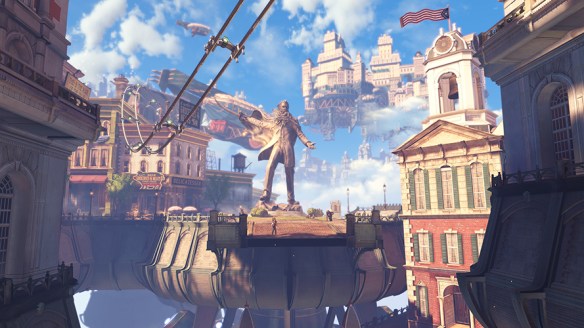
Welcome to Columbia.

The protagonist of Bioshock Infinite, Booker Dewitt, is much more present than in past games. In recent years, there’s been an influx of silent protagonists. This is something that isn’t always successful in terms of storytelling; when done correctly, the player will feel like they’re in the game, but if not, it tends to feel more like you’re playing as a wall that other characters keep asking to do things. It’s refreshing to see the concept of the pre-made, vocal protagonist is still around and can still be successful.

While you don’t control what Booker Dewitt says, several decisions are left up to you, the player. These range from trivial to very difficult, but great care has been taken to make sure they aren’t out of place. This is the downside to playing as a pre-made protagonist: Sometimes you, the player, make them do things that character would never do. Bioshock Infinite treads this line perfectly. Nothing Booker does is out of place, and he reacts to things the way you’d expect him to react.

Strong storytelling isn’t limited to Booker Dewitt. Bioshock Infinite is one of the strongest games I’ve seen in a long time, in terms of story. Booker’s journey begins on a boat trip to a lighthouse, and takes him into a floating city. His mission: Bring us the girl and wipe away the debt. “Whatever that means” will likely be your first thought, and this is intentional: Booker is the kind of guy who does things he needs to do and doesn’t ask questions. At least, that’s how he starts out.

Things in Columbia quickly take a dark turn, and Booker finds himself fighting for his life, trying to reach a distant statue so he might “find the girl”. It seems Booker is Columbia’s prophesied antichrist figure, recognizable by the “AD” carved into the back of his right hand. Columbia’s prophet, Zachary Comstock, has seen Booker coming, and wants him stopped at all costs.

Columbia is made up of floating islands, and to traverse them, Booker will use a device called the Sky-Hook to latch on to rails connecting the islands. This makes for an interesting mechanic: While sliding along these rails, called Sky-Lines, combat is still possible, and sometimes even required.
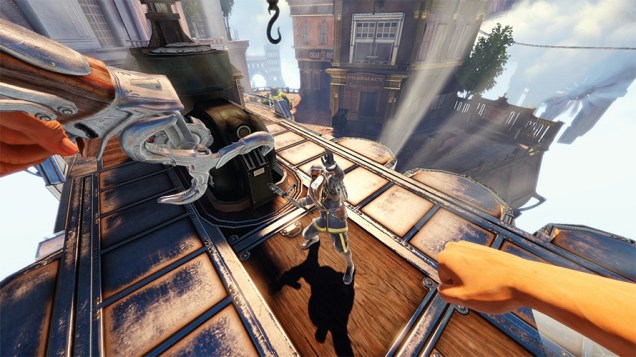
The Sky-Hook also makes for a powerful melee weapon.

While interesting, the Sky-Line and Sky-Hook system never realize their full potential. Whatever you do the first time you use them is probably going to be all you do with them throughout the game. Shooting from the Sky-Line is difficult, and you’ll most likely miss most of your targets. There also isn’t much complexity to be found: Most of the Sky-Lines in combat areas just take you in a circle around a platform your enemies will be shooting at you from. I couldn’t help but feel like a lot more could’ve been done with this system.

This brings me to my other main complaints about the game. Instead of the plasmids found in earlier games, Booker will use Vigors. The concept is the same: Your DNA is altered, allowing you to use biological attacks. If I had to summarize the game’s use of these, it would be “too much shock and not enough bio”. In most cases, you’ll just end up pulling the trigger of your regular old rifle until everyone else stops shooting at you. I found the Vigors to be mostly useless; one of them, called Devil’s Hand, was just about the only one I used, and it wasn’t particularly creative: Throw a ball of fire and it explodes. As far as first-person shooters go, they may as well have given you grenades.

The exception to the rule is a Vigor you acquire later in the game called Return to Sender. This one is easily my favorite, and the only one I found creative or even fun to use: Booker summons a ball of energy into his hand that allows him to catch incoming bullets and then throw them back at enemies. Doing this requires the use of Booker’s shield, so it isn’t unlimited, and timing is everything.
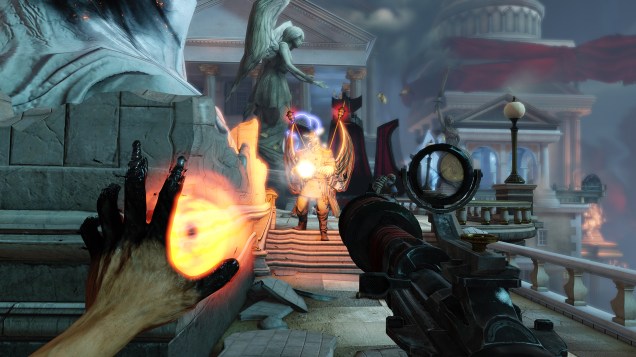
Return to Sender is particularly useful against Patriots, robotic renditions of the Founding Fathers equipped with machine guns.

Return to Sender aside, Bisohock Infinite is a pretty basic first-person shooter. There isn’t much variety in the enemies (the iconic Big Daddies are nowhere to be found, instead replaced with Handymen, which are far more annoying than frightening or formidable). Where the game surpasses your run-of-the-mill FPS is in its art direction. You’ll be using the same guns to fight the same enemies you’ll find in any FPS, but they’re going to look a lot more beautiful.

It takes more than looks to make a great game (which Bioshock Infinite is). With breathtaking visuals but standard gameplay and game time (a playthrough will take about 8-10 hours), where Infinite succeeds is its story, and this really takes off when you meet “the girl”, Elizabeth.

It’s difficult to meet Elizabeth and not be immediately reminded of a Disney character (Belle from Beauty and the Beast comes to mind). She’s a young, naive girl who’s spent her life alone in a tower with her books (and a certain guardian I won’t spoil for you). Sounds easy, right? Find the girl, protect the girl, get her to New York, wipe away the debt. Looks can be deceiving; Elizabeth is no sucker, and she’s not going to obey Booker as easily as Booker obeys the man who hired him. She has a mind of her own, and this lends to what is perhaps the game’s biggest charm.

The first time Booker meets Elizabeth, she attacks him with a book on quantum physics. and thus, a legend was born.

Elizabeth makes for an interesting character in so many ways. I said she has a mind of her own, and this extends to the gameplay itself: Elizabeth will be with you for most of the game. She’ll stay out of the way during combat, searching for ammo and health for Booker, sometimes finding money, lockpicks, and other useful items. The game’s AI is often mentioned, and with good reason. She’ll walk ahead of you toward your goal, sit down, chat with strangers, lean against walls, look through shelves; Elizabeth acts like a human being. She’ll talk with Booker about everything from his mission to her missing pinky finger. Her personality and programming make her one of the most likable video game characters I’ve ever met.

It’s hard to talk about the game’s story without ruining it. From the point you meet Elizabeth onward, Bioshock Infinite carries one of the strongest stories in video gaming. You’ll meet a lot of characters and factions with their own reasons and purposes, and the story carries what would otherwise be a decent game into greatness. Enemies become friends, motives change. Something as small as the tip of a pinky finger can have life-altering ramifications.

When the screen finally cut to black and the credits began to roll, my first thought was “That’s it?” This quickly gave rise to “What in the world did I just witness?” which was then followed by me sitting in silence for about a half hour playing back everything I’d just experienced in my head. What seems at first like a tangled, nonsensical web of plot holes becomes a complex, intricate, purposeful and meaningful series of events the more you pick at it, the further you unravel it, and I’m not convinced it’s possible to straighten everything out. There’s a reason the title contains the word “Infinite”.

Look up any list of the most mind-blowing endings in video game history, and you’ll probably see the first Bioshock on it. Bioshock Infinite puts it to shame. If I hadn’t rented the game, I would have popped it right back into my Xbox and played through it again to see what else I could see. I look forward to my next playthrough (but I’m aiming for PC next time; the Xbox 360 version suffers from an unfortunate amount of lag, especially during the last battle).

The game’s developer, Irrational Games, recently announced a massive scaling-down, as well as an intent to make no further Bioshock games. I have no doubt their publisher, 2K Games, will assign another team to make sequels, but it’ll be hard to see them as true Bioshock games. Bioshock ends with Infinite; you can’t take a story this well planned and executed and simply add on to it. It’s rare in the world of video games to see a complete story with a beginning, middle, and end. Bioshock and Bioshock Infinite create one of the exceptions to this rule, and I think I’d be happier if they remained that way.

All images taken from the official website and not owned by me.
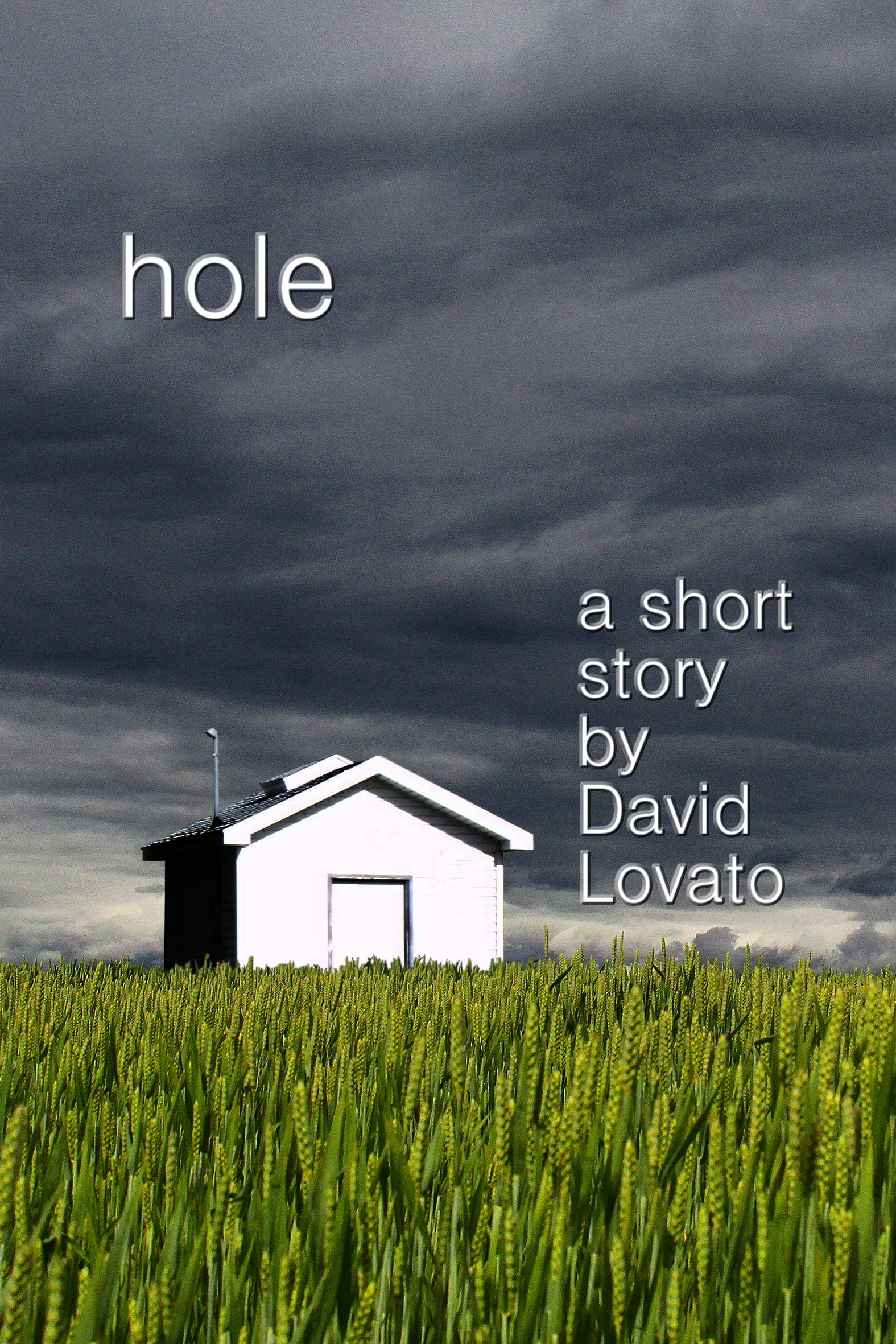
“Hole” Update

My first venture into self-publishing was through a free short story called “Hole“. For a long time the story appeared almost exactly as I’d written it. Sure, I’d edited it after first writing it, but beyond that, I didn’t do much to it.

I happened to catch a glimpse of the story recently, and realized that was something that needed to change. So, over the last few days, I prepared a new cover image for it (thanks in part to the contributors at Pixabay) and set to work editing the text itself. I’m a lot happier with the newer versions of both.

Cover by David Lovato

As I mention in the story’s new afterword, I’m considering making a side-by-side comparison of the 2010 version of the story and the 2014 version of it, to show a little bit of my editing process, and the thoughts that go into each change. Maybe it’ll help someone out there with their own editing. This probably won’t come until later; I’m pretty busy working on new, never-before-seen projects.

“Hole” is available for free from just about every ebook retailer, except for Amazon. (They tend to not allow permanently free ebooks.) You’ll find links to “Hole” at various ebook retailers here: https://davidjlovato.wordpress.com/works-2/#hole

nowListening: Wildlife by La Dispute

Recently I re-visited one of my favorite albums, Wildlife by La Dispute. Normally I walk on the treadmill for 20-30 minutes a day, but Wildlife clocks in at almost an hour. I had planned to stop at my normal time, but couldn’t bring myself to do it, and went the whole hour. This isn’t one you listen to just part of, it’s an album you commit to.

All lyrics and songs by La Dispute, not me. Obviously.

The interpretation of these songs as presented in this post, however, is mine. At no point should you feel like it’s the correct or only one; that’s the beauty of music.

I first heard of La Dispute in the summer of 2011, when the band released their entire discography for free on the internet. I happened to be browsing a post over at AbsolutePunk, and one of my friends on that site couldn’t recommend the band enough.

I downloaded their discography and gave a few of the releases (one LP and about seven EPs ranging from two to eight tracks) a try. I was at first put off by the vocals; at first listen, Jordan Dreyer’s voice can be intimidating, if not raw.

Even then, there were a few songs I could really get into. I think “The Surgeon and the Scientist” was first among them. One day, with my iPod on shuffle, a little tune called “Such Small Hands” came up. The first thing to catch my hear was the haunting, disembodied guitar intro. Then the vocals come in, and what hooked me were the lyrics.

I thought I heard the door open, oh
No, thought I heard the door open but I only heard it close
I thought I heard a plane crashing
Now I think it was your passion snapping

La Dispute, “Such Small Hands”

As it turns out, “Such Small Hands” is the first track on their first album, exhaustively titled Somewhere at the Bottom of the River Between Vega and Altair. That provided the foot in the door for the rest of the record. One listen to the following track, “Said the King to the River”, and I was sold on La Dispute.

La Dispute is a writer’s band. Vocalist Jordan Dreyer had reportedly never participated in music before being asked to join; he wrote short stories and poems instead. Literature is prominent in all of the band’s music. Two of their EPs (Hear, Hear. and Hear, Hear II) consist entirely of the band playing along to Dreyer reading, singing, and screaming famous poems, such as Poe’s “Annabel Lee”.

A fan-made lyric video for the song “Andria”, showcasing a few of the band’s common styles: A blend of spoken-word poetry and fast-paced punk vocals, Jordan Dreyer’s raw, honest-to-God voice and absolute control over his range, the bass coming in to foreshadow the intensity the song is about to escalate to, the lead guitar part forming a sort of “dueling guitars” melody to compliment the lead vocals. While it appears on their first release, this song is referenced many times on the album Wildlife.

For a lot of bands, you can hear the bands that influenced them in their music. With La Dispute, the keen listener will hear all of the writers that influenced the band instead.

It didn’t take long for La Dispute to cement themselves as one of my favorite bands. In October of 2011, they released a new album called Wildlife. I bought it immediately, and took my iPod out to the back deck to listen to it on the porch swing. It seemed fitting: That’s where I go to read books, and Wildlife is audible literature.

Still, I wasn’t prepared for what I was about to hear.

Wildlife by La Dispute

Wildlife is a concept album. Each song has a clear and complete narrative, but also fits into a larger one (think chapters in a book). The album opens with one of four letters the narrator is writing. The song is called “a Departure” and sets the stage for the story about to unfold.

Night fell on me writing this, and I ran out of paper
So I crossed the name out at the top of the page
Not sure why I’m even writing this, but I guess it feels right,
It sort of feels like I have to, like an exorcism.

I guess that makes me sound crazy, but that’s all right.
Lately I feel like I might be, not that I’ve heard any voices or anything
Just like that everyday kind, where you forget things you shouldn’t,
And you think too much about death.

La Dispute, “a Departure”

The album can be broken down into parts: A letter, three songs, the next letter, three songs, etc. Following “a Departure” is the fast-paced “Harder Harmonies”, which tells the story of an extraordinary piano player whose music is overtaken by the tones of the nearby city.

In all of the songs, it’s difficult to tell how much is literal vs. metaphorical, and how many of the stories are true. I’ve heard that most of them are things experienced by the band members or people they know. Part of me wants to never find out; not knowing contributes to the magnitude Wildlife carries. I can only hope these things didn’t all happen to the same person, but in terms of the story, I’ll say they do.

“Harder Harmonies” escalates into a sense of frustration conveyed not just by the lyrics, but by the music. The song ends on a message anybody could sympathize with: “There’s a melody in everything, I’m trying to find a harmony, but nothing seems to work, nothing seems to fit.” This is a recurring theme: Nothing seems to fit, and I think that’s where the story really picks up.

“St. Paul Missionary Baptist Church Blues” comes next. It tells the story of a church our narrator passes by every day, the once-beloved church now abandoned and falling apart, and the narrator thinks the same thing of some kind of relationship in his life, possibly the loss of his own faith.

Ten years now standing vacant
Ten years on empty, maybe more.
Once held the faith of hundreds,
Soon one more cell phone store.
For years they gathered here
Inside the building, sound and true
To sing their praises to a God that gave them hope
To carry on, to carry through.

La Dispute, “St. Paul Missionary Baptist Church Blues”

After this comes “Edit Your Hometown”, which sounds like a link you’d click on facebook, and that’s probably the point. The song tells the story of a young man who claimed his city with his friends, spending nights together and having fun, but as the years went on, his friends all moved away and carried on with their lives, leaving the narrator feeling alone with an empty city.

After this is our next letter, this one titled “a Letter”. The narrator looks at all of his anger and frustration and begins to wonder if it comes from within, and that maybe things aren’t working because he isn’t really trying to make them work.

Next up is a song in two parts: “Safer in the Forest/Love Song for Poor Michigan”. Both songs occupy the same track and are loosely related, but you can tell where one ends and one begins. “Safer in the Forest” is a relatively quiet, droning tune carried by guitars that never stop but don’t quite repeat themselves, moving up and down in tune with the vocals, until the song explodes into “Love Song for Poor Michigan”, a song about how a bad economy can break people down. In these you can hear references to previous songs; “Safer in the Forest” mentions the city’s song first suggested in “Harder Harmonies” as well as the desire to leave found in “Edit Your Hometown”, while “Love Song for Poor Michigan” hearkens all the way back to the song “Andria” off the band’s previous album, with the line “I will hold these old streets safely in my head, like her”. If you choose to interpret it as such, Wildlife can be seen as a sort of sequel concept to Somewhere at the Bottom… as this isn’t the only reference you’ll find to the band’s previous work.

“The Most Beautiful Bitter Fruit” carries tones of trying to forget pain through things like drugs and sex, but reflecting on how these releases are only temporary.

After this we get our third letter, titled “a Poem”. The narrator reflects on how the writing isn’t helping: “I had a reason for the writing, but trying to exorcise my demons didn’t work.” The narrator instead writes a poem to summarize his feelings and actions. This is reflected in the song as it slows to a crawl and transitions into a spoken-word poem.

The worry, the wonder, the shortness of days
The replacement for purpose
The things swept away
By the worry, the wonder, my slightness of frame
The replacements for feeling,
The casual lay.
And the worst of the wildlife wears clothes and can pray
And they worry and wonder for three meals a day.
Only death unimpeded, not slowing its pace
Brings that petty old worry and wonder away.

La Dispute, “a Poem”

After this comes a suite of three songs that I find hard to listen to, but I mean that in the best possible way. The next three songs are, without contest, the most emotionally exhausting suite of music I can think of. By the time I was through the first of them, “King Park”, I had stopped swinging on my porch swing, my shaking hands were pressed against my mouth. If you can think of a movie that brought you to the edge of your seat in anticipation, not in the exaggerated, metaphorical sense, but one of those moments that actually made you drop everything and just sit down and pay attention, this song is the audible equivalent of that. If you listen to nothing else from this record, listen to these three songs, in order, please. Something like this doesn’t come along often in any medium.

I don’t want to spoil the effect for you, so I’ll try not to go into too much detail about these three. Just grab a pair of headphones, sit down in a dark room, and listen. You might want to bring a box of tissues and find some ear bleach for when it’s over. These aren’t songs you just listen to; you’re probably going to want something to help you calm down afterward. I guess this all comes off as pretentious or exaggerated, but that’s not my intention. I’m serious, things are going to get intense.

“King Park” opens with a shooting: “Another shooting on the southeast side, this a drive-by, mid-day…Not far from the park, about a block from where the other shooting was last month. Or was it last week?”

The first two stanzas of the song are told in an omniscient, procedural tone, just the basic facts. There’s been a shooting, not far from where another one was recently. At the end of the second stanza, we hit the human element: “The target: a rival, but they didn’t hit the target this time. They hit a kid we think had nothing to do with it.”

From there, our narrator becomes a spectre, a spirit transcending time and space in an attempt to find a reason for the violence. His journey takes him “High and high up over King Park”, back through time, where he can visit the victims before they died, just “playing games and doing homework”, and visit their families, see their lives.

I want to write it all down, so I can always remember
If you could see it up close, how could you ever forget?
How senseless death, how precious life,
I want to be there when the bullet hit.

La Dispute, “King Park”

After this, our narrator moves forward in time to find the shooter, and from there an already dark and heavy song becomes almost too much to bear. I won’t even say anything about it. Just go listen for yourself.

After this is a song called “Edward Benz, 27 Times”. This one starts off on a much lighter tone than where “King Park” ends, and for that I’m grateful. We open with an old man, the titular Edward Benz, entering the narrator’s store and asking him to repair a window on a door.

Things take a drastic tone throughout the song as Ed tells our narrator his story. The song bounces back and forth between the narrator in the past, standing on Ed’s porch and listening to his story, and our narrator as he is currently, feeling alone and desperate and in pain. Slowly, our narrator realizes he’s writing a parallel to Ed’s story, so he revisits it in his head for comparison.

The underlying tone seems to be that the narrator finds the two situations incomparable: What the narrator is going through (suggested to be a breakup) is shallow compared to what Ed experienced, but that fact brings our narrator no solace; his pain is still pain.

And I sit in my apartment,
I’m getting no answers.
I’m finding no peace, no release from the anger.
I’ll leave it at arms length,
I’m keeping my distance
From hotels and Jesus and blood on the carpet.
I’m stomaching nothing,
I’m reaching for no one,
I’m leaving this city and I’m headed out to nowhere.

La Dispute, “Edward Benz, 27 Times”

Our trio rounds out with the song “I See Everything”. In this one, our narrator recalls a day in his junior year of high school, when he walks into the classroom a little late and finds a heavy atmosphere in the room. He takes his seat and finds his teacher handing out photocopies of a journal she kept in the 80’s, shortly after her seven-year-old son was diagnosed with cancer. Following the introduction, the middle of the song is presented directly as these journal entries, and the end finds our narrator alone many years later, reflecting on the teacher and her son, as well as his own life.

July 9
There’s a suffering when I look in his eyes
He’s been through so much.
We’ve all been through so much, but
What incredible resolve our little boy shows
Only seven, standing face-to-face with death
He said it’s easy to find people who have suffered worse than him
“Like Jesus suffered worse than anyone,”
He told me last night, when God abandoned him.

La Dispute, “I See Everything”

Once this suite ends, we’re given our last letter, “a Broken Jar”.  Our narrator has grown tired of writing down these stories in attempt to cope, they aren’t helping. In his frustration he turns over a table and a breaks a jar, which he then attempts to repair, but reflects that no matter what he does, the cracks will still be visible, and some things can’t be fully repaired.

After this letter, we’re presented with two songs to serve as falling action. The first is “all our bruised bodies and the whole heart shrinks”. Maybe I look too much into it, but I think the fact that the title is improperly formatted (using all lowercase letters) is a reflection of how the writer has become tired and apathetic, but he hasn’t given up, hence the title being so long.

In this song, our writer comes to a realization. He’s been writing down the suffering of other people to cope with his own, and rather than comparing them, he begins to collect them, to realize that other people have made it through their pain, so it’s possible that he will, too.

Tell me what your worst fears are
I bet they look a lot like mine
Tell me what you think about when you can’t fall asleep at night.
Tell me that you’re struggling, tell me that you’re scared
No, tell me that you’re terrified of life
Tell me that it’s difficult to not think of death sometimes.
Tell me how you lost, tell me how he left, tell me how she left
Tell me how you lost everything that you had,
Tell me it ain’t ever coming back.
Tell me about God, tell me about love,
Tell me that it’s all of the above.
Say you think of everything in fear,
I bet you’re not the only one who does.

La Dispute, “all our bruised bodies and the whole heart shrinks”

The album’s final track is “You and I in Unison”. In this song, the writer finally tells his own story, adding his own pain to the pages he’s been writing, and leaves them with the feeling that even if we suffer, we all suffer together. Our narrator isn’t alone and never has beenhe has a stack of pages that prove it.

There’s a certain feeling you get when you finish reading a good book, and Wildlife is probably the only album that’s ever given me that feeling. It’s painful but hopeful, it’s heavy but beautiful.

La Dispute is releasing their third album in March 2014, called Rooms of the House. I’m looking forward to it, and I hope I love it half as much as I love Wildlife.

La Dispute provides nearly all of their music for listening on their website here: http://www.ladisputemusic.com/music/

If you enjoy the music, please consider supporting the band. Pre-orders of their upcoming album Rooms of the House support various charities. More information can be found on the album’s pre-order pages here: http://hellomerch.com/collections/la-dispute

nowPlaying: Xenoblade Chronicles

You might remember how, for a few months, I was a staff writer for a Nintendo fan site. The site is gone now and the admin vanished, but my love for writing, video games, and writing about video games is stronger than ever, so I’m happy to continue doing it on my blog. I’ve also decided to extend my reviews/analyses outside of the gaming world (with music and films in mind), but for now, here’s the first in my nowPlaying series: Xenoblade Chronicles, developed by Monolith Soft, for the Nintendo Wii.

All images taken from the official site, not owned by me.

When you ask people about the greatest video games ever made, there are a few titles that’ll come up on almost every list: The Legend of Zelda: Ocarina of Time. Half-Life 2. Resident Evil 4. In a perfect world, Xenoblade Chronicles would be one of them. It’s near the top of mine.

Released for the Wii in 2010, this one took a while to leave Japan. It didn’t reach America for nearly two years, coming out shortly before the Wii’s successor, the Wii U. The game received a limited printing, so a copy is going to cost you anywhere between $60 and $80, but it’s worth it.

The word “epic” is overused these days, but it fits this game perfectly. The story opens with two titans fighting each other in an otherwise empty ocean. They strike fatal blows at the same time, but their lifeless bodies remain standing, and from these spring forth all living things.

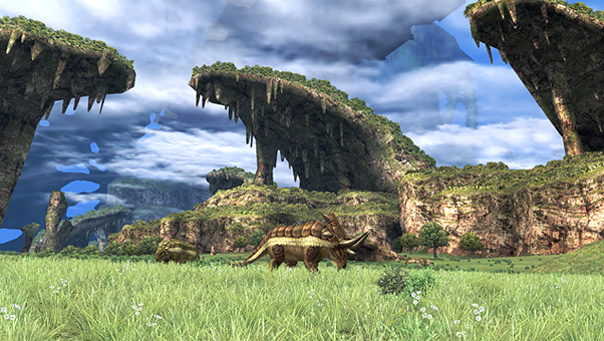
You play as Shulk, a young boy who grew up on one of the titan’s knees. Did I mention the game is epic? The whole world consists of the bodies of the titans. At any point you can look into the sky and see their arms, their heads, you can look across the ocean and see most of the other titan—all but the part that extends beyond the clouds.

An example of the view from one of the legs, complete with the torso of the titan in the distance.
An example of the view from one of the legs, complete with the torso of the titan in the distance, and its extended sword hovering above.

This game is huge. Everything about it is massive: Open-world areas in the same vein as Bethesda’s latest games, seamless combat (nearly all of the game’s loading screens are just there to load cinemas, only a few places require a loading screen transition), character customization; everything you’d expect from an action RPG, but bigger. My final play time, for example, was 75 hours. There were still dozens of side quests I hadn’t done, and I could have sunk another few hours in to level up and have an easier time with the final bosses (because a game this big can’t have just one).

The graphics are good, for the Wii. You can find screenshots, but they don’t do it much justice. The wind blowing through the grass, the people and creatures going about their lives, the ever-looming titans, you have to see it for yourself. It’s a Wii game, so by today’s standards it’s dated, but even as such it looks good.

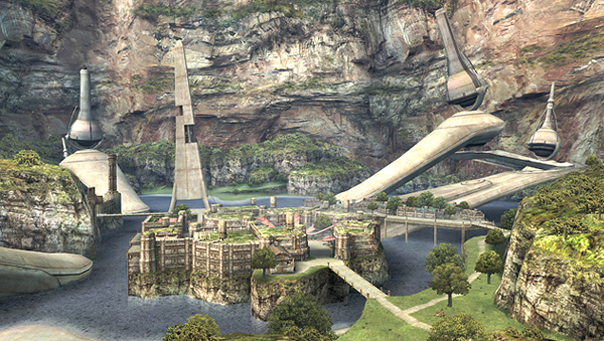
Colony 6, where the main characters grew up. From this viewpoint, you can travel all the way into the town and along its streets without loading screens.


The characters you face are, for the most part, lovable. Off the top of my head, only one enemy character comes to mind who I could describe as one-dimensional, and she’s not a major character. Everyone else is a well-acted, well-designed being, complete with their own motives and reasons, and this adds to one of the game’s running themes: Existentialism.

Your run-of-the-mill game can be pared down to “Find the bad guy and kill him”. You’ll be doing a lot of finding in this game, and you’ll be doing your fair share of killing, but you won’t want to. Instead of faceless “baddies” that only stand in your path, the game presents your adversaries as people who happen to be on the other side of the coin. Shulk, the main character, begins as a naive kid with a desire for vengeance, but transforms into a strong, noble man, one who tries to reason before ever lifting his sword, and who understands his enemies. I have a feeling the game’s director, Tetsuya Takahashi, might have been influenced by the works of Orson Scott Card and Ursula K. Le Guin: Before Shulk defeats his enemies, he has to know and love them, and he feels every loss along his path.

The game’s story goes on to tackle the idea of what it means to be part of a Universe in which you aren’t the only inhabitant. I don’t think I’ve ever seen a game do this before. There are often moments of depth, often strong characters that you feel for, but Xenoblade takes it to a new level. As big as the game is, it must also be described as “deep”.

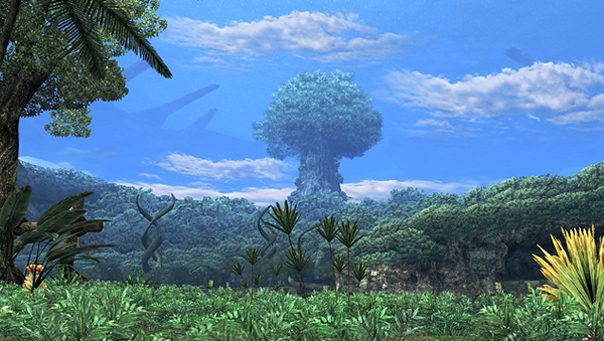
The tree in the background is just a texture from this distance, but you will eventually reach the top of it in-game.

Some of the plot points are trite, but most are unpredictable. The game threw a lot of curveballs. In most cases I had no idea what was coming until the second it happened. It does suffer from some overly-descriptive and repetitive dialogue (sometimes the characters just plain talk too much), but it’s nothing you won’t find in the average video game.

The gameplay itself is fun, but a lot of people seem to have trouble with the battle system. Unlike most games, you won’t be mashing the A button to obliterate everything in your path. Characters (there are several in your party, and you get 3 on-screen at a time and may play as any of them) auto-attack. Your job as the player is to choose where they go. Some attacks are more powerful from behind, some from the side, etc. You also have special attacks called “Arts” that you choose from, giving combat a layer of strategy comparable to that of a turn-based RPG, but the battles won’t wait for you, and timing is everything.

Another word I might use to describe the game is “exhausting”. The last ten hours or so started to wear me down. I did get a little tired of running around fighting random creatures and fetching items for NPCs. The game’s design is relentless, every new place you find is as large and as full of things to explore and do as the last, but by the time I reached the last handful of areas, I just wanted to skip them and go straight into the main quests. I never really wanted to stop playing, but if there had been another ten hours of main story, I might have.

The upsides far outweigh the downsides, and in the end I’m so glad to have played through this game. It’s one of the most original and unique stories I’ve ever encountered, especially in the world of video games.

In January 2013, Nintendo revealed a trailer for a game by the same company, Monolith Soft, that is very heavily implied to be a sequel to Xenoblade Chronicles. I can’t wait to see what’s in store this time around. The possibilities are limitless, and I’m looking forward to what will surely be one of the richest gaming experiences offered this generation.

Thank You!

Writing a book can be frightening. There are times I wonder if I’m capable of doing the story justice; there are places and characters and plots in my head, but what if I can’t translate those onto the page? What if I end up sharing a bastardized version of them with the world?

Then there’s the fear of losing someone. I think a lot of people who read can relate; even though a story or character is fictional, you’re devoting part of your life to spend time with them, and sometimes losing them hurts. I think it’s just as hard on the writer, especially if we didn’t see it coming, but we have to do what’s right for the story.

For me, possibly the most frightening part is releasing the book into the world, and not knowing how people will react. It’s like I’ve raised a bird since it was an egg, and now it’s time to set it free to fly, and I really hope someone doesn’t shoot it out of the sky as soon as it leaves my hands.

Obviously, not everyone is going to like my writing, and every writer gets negative reviews. That’s part of the process. People have different tastes, and you can’t expect a book to sit well with everyone. There’s so much I love about writing, I’d keep doing it if nobody liked my work. Still, that anxiety that accompanies releasing a book exists. I’m pretty sure by now it’s inescapable. I could release 99 books that each get a hundred five-star reviews, and I’ll still feel it just before I release book 100.

I’m not trying to complain. That anxiety is also accompanied by a sense of excitement, especially if I’m proud of the book I’ve written. It’s a double-sided coin, and I think if I wasn’t anxious, I might not be excited, either.

So far my books are being well-received. I’m thrilled to see the reviews come in, most of them very positive, and I can’t thank you enough. I have a few one- and two-star ratings, and I can’t complain. Theoretically, every rating is followed by a reading. Someone took time out of their life to read something I wrote. That is its own reward; someone twice my age, someone half my age, someone sitting in a country I’ll probably never see with my own eyes has read something I’ve created.

If you’re that someone, thank you. There are millions of books out there, billions of characters you could’ve spent your time with, and you chose mine. That’s an incredible honor. We’re on this earth for a limited time, and to have anyone spend theirs on me is a humbling experience.

I hope you enjoyed it. I’m sorry if you didn’t. Either way, I’m thankful you gave it a chance.

Something About Spring

There’s something about the spring that makes me want to visit other worlds.

I aim to always be reading something. Sometimes I’ll take a week or two off from reading, especially if I’m editing my writing; I need to give my eyes a break, after all. I’m editing something right now, but I’m not taking a break from reading (instead I’m reading a graphic novel, which is a little lighter on the eyes than a book is).

The other morning I stepped outside to let my dogs out, and for once it wasn’t freezing. It was actually nice; it was warm in the sunlight, and the wind was cold, but soft. It reminded me that spring is on the way, but more than that it reminded me of past springs and summers, when I’d sit on the porch swing reading books, only taking breaks to dream up my own.

Spring is almost like a refresh. Let’s reboot the planet, all the plants and the sun and the air. It gives me a feeling I can only describe as “new”. New year, new world. Maybe that’s what makes me want to visit other worlds, in reading and in writing, and it often continues through the summer.

We’re coming up on that time, and I’m excited. I’m not sure what I’ll be reading two months from now (probably either The Dispossessed or The Girl Who Circumnavigated Fairyland in a Ship of Her Own Making), and perhaps more importantly, I’m not sure what I’ll be writing two months from now. All I know is that I’m excited to get there.

It snowed last night, reminding me spring isn’t here yet. But oh, is it coming, and I can’t wait to meet you in another world.

On Titles

Over a year ago, I was browsing a magazine (I don’t remember which), and near the back was a review of a book I’d never heard of. The book is called The Girl Who Fell Beneath Fairyland and Led the Revels There. I didn’t read the review (I think they gave it five stars, I don’t recall), but I did add the book to my mental “to read” list immediately.

The title hit me like a freight train. It captured my attention, held it, and demanded I pick the book up.

I looked into it and discovered the book is a sequel to one with a title that’s almost as good: The Girl Who Circumnavigated Fairyland in a Ship of Her Own Making. It should be noted that I haven’t read either book yet (a misfortune I plan to remedy very, very soon), but regardless of how that goes for me, I think these are two of the best book titles I’ve ever seen in my life. (The author is Catherynne M. Valente, for those interested in looking these books up.)

When it comes to titles, I don’t know that I’d consider them among the most important parts of the writing process. A bad title probably won’t turn anyone away, but a good title can certainly turn a reader toward your book. For example, let’s look at two of my favorite books: The Silence of the Lambs by Thomas Harris is one. It’s a great title for several reasons. To start, it has a sort of mystical feel to it. You don’t immediately know what it’s about. There are two key words in the title: “silence”, which makes me think of darkness, death, suspense, and fear. The other is “lambs”, which conjures the idea of “innocence”. So now I have to know why innocence is being silenced, which means I have to read the book (or, at the very least, the back cover).

(In case you don’t know, the book is a horror/suspense novel about a young FBI agent hunting a serial killer. The title comes into full play toward the end of the book.)

Now a second of my favorite books: The Road by Cormac McCarthy. It’s simple, straight to the point, and honestly, tells me absolutely nothing about the story. That book could be about anything. I can guess that perhaps the titular road is symbolic and that there will be some kind of journey involved, either internal or external, but not much else. (It turns out it’s a bit of both; it’s a post-apocalyptic road novel.)

I wouldn’t say The Road is a bad title, but it’s no Silence of the Lambs. It doesn’t demand I drop what I’m doing to read the book (which is where the synopsis has to take over), but it certainly doesn’t make me turn away from the book, either.

With all of this in mind, when I choose a title for my work, more than anything else I try to find one that fits the story. Lately, I try to aim for the attention-getter, but sometimes I just can’t find one. In any case, I thought I’d give a few pointers in how to narrow down a good title, or at least a good place to start looking for one.

You’re going to want something that serves as a “bigger picture” summary of your story. (The Road nailed this one.) Bonus points if this is unique. George R.R. Martin’s A Game of Thrones is a good example. The book is, at its heart, about a struggle of succession to the throne, and how many of the people involved more or less game the system. It’s also very obvious just from the title that we’re probably talking historical fantasy, and the title isn’t readily reminiscent of any other title I can think of. So it’s unique, it hints at the genre, and it summarizes the story within.

A good way to find something like that in your own work is to look for a word or term or phrase within. (Another one A Game of Thrones nailed, as the term appears twice in the book, if memory serves.) An example of this is my own book, In the Lone and Level Sands. While it’s not immediately clear from the title that the book is about zombies (though those familiar with the Shelley poem the title alludes to might think “post-apocalyptic”), the title is, in my opinion, an attention-getter. It’s also taken directly from a conversation two characters have toward the end of the book, and relates to the story pretty clearly from that context.

So, long story short, you want something that summarizes your story, hints at the genre, grabs the attention, or does all of these. A good place to look is in the work itself, in a passage of writing, a bit of dialogue, or just in the general plot. Sometimes you can find it by looking elsewhere; for example, Cormac McCarthy’s No Country for Old Men does a good enough job of summarizing the story, even though the line is taken from a completely unrelated poem. (Again, my own In the Lone and Level Sands can relate.) Just make sure it’s related to your story in some way and falls under fair use; plagiarism doesn’t make for good titles.

I think a good combination to shoot for is this: Your cover should draw the reader in from afar. Your summary should make the reader have to read the book. But your title should make the reader have to read the summary. And, if your title is good enough, it just might cause a few readers to skip the summary and dive right in. Catherynne M. Valente’s titles did it for me, and I can only hope to be that good at coming up with titles in the future.

In closing, here’s a list of some of my favorite book titles and my own comments about them. Feel free to add yours in the replies.

The Left Hand of Darkness by Ursula K. Le Guin. The Word for World is Forest, also by Le Guin. (No idea what either of these books are about, but I’m pretty sure they’re both in her Hain series, which I’m about halfway through.)

The Lathe of Heaven by Ursula K. Le Guin.

Only Revolutions by Mark Z. Danielewski. (Sounds cool, and it’s a road novel, and there’s a lot of teenage anarchy involved, so it’s a perfect fit.)

John Dies at the End and its sequel This Book is Full of Spiders by David Wong. (I mean, you pretty much have to read a book with that title.)

The Drawing of the Three and The Wind Through the Keyhole by Stephen King. (Both of these are Dark Tower novels, and both have the sort of fantastical title that captures my attention. Most of the books in that series do.)

Something Wicked This Way Comes by Ray Bradbury. (You see the title and have a pretty good idea what the book is about.)

The Call of Cthulhu by H.P. Lovecraft. (The title is almost as creepy as the novella is. I could list almost everything Lovecraft ever wrote here, so you should probably just look up a list of his works.)

A Swiftly Tilting Planet by Madeleine L’Engle. (Another attention-grabber.)

Speaker for the Dead by Orson Scott Card. (Another perfect title. You can guess the genre as scifi/fantasy, it draws you in, and it does a wonderful job of capturing the heart of the story.)

The Devil and God are Raging Inside Me by Brand New. (This is an album and not a book, but it fits just as well.)

In the Lone and Level Sands

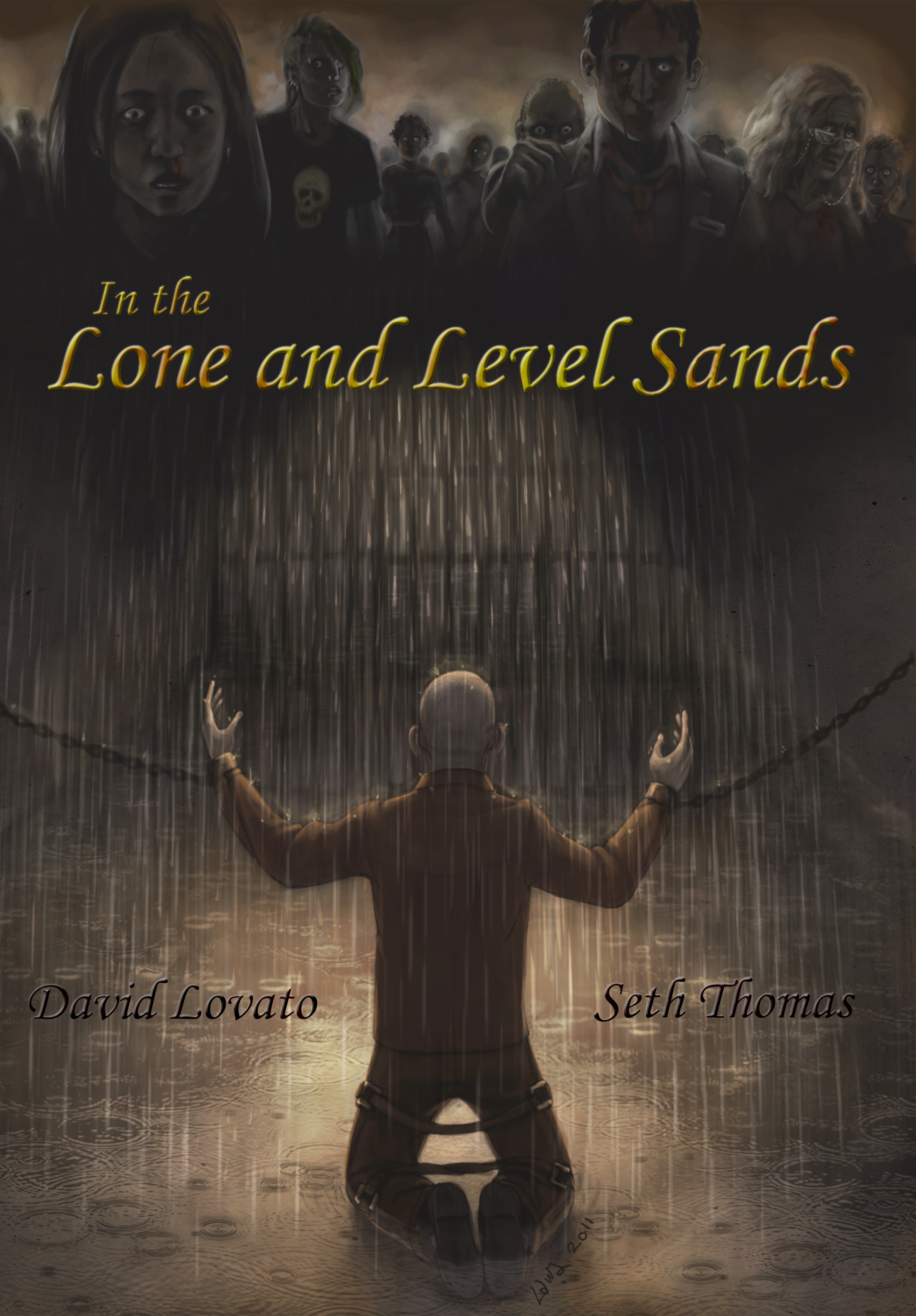
In the Lone and Level Sands cover

The wait is over! In the Lone and Level Sands is now available in ebook format (list price $3.99) through Smashwords, Amazon, Barnes & Noble, and iTunes (with Kobo and Sony editions coming soon). It’s also available in print (list price $12.99) through Createspace and Amazon (with Barnes & Noble coming soon).

In the Lone and Level Sands is the story of seven groups of people across America as they try to survive the zombie apocalypse.

You can read the first 19 chapters here: https://drive.google.com/file/d/0BzO8YJWnSng8SzRzcUtYeHpDM00/edit?usp=sharing

You can also see a longer preview at the various ebook retailer pages.

Seth and I want to thank everyone who reads this or any of our works, and everyone who will do so. You mean a lot to us.

In the Lone and Level Sands Trailer (And Other Things)

In the Lone and Level Sands comes out Tuesday, November 26th.

You can pre-order the ebook through Smashwords, Barnes & Noble, and iTunes.

The ebook will also be available through Amazon, Kobo, and Sony eBooks. A print edition will also be available soon.

Purchasing a new print edition through Amazon will allow you to download the Kindle eBook free of charge.

Just a reminder, you can read the first 19 chapters of the book under the “Samples” section of this blog. You can read a longer sample at the book’s Smashwords page.

Another reminder, the ebook edition of After the Bite is free for the month of November.

I’m very excited to release this novel next week. In the meantime, my NaNoWriMo progress has slowed considerably. I reached a point where it felt like forcing the story out would ruin it, so I’m more or less checking out of NaNoWriMo. I wrote a good 20,000 words and I absolutely plan to finish this novel, just not by the end of November.

I’ve also come up with a new title for one of the books I’m querying agents for. I’m not sure whether I want to change it yet, but I’m thinking I’ll do a blog post about titles pretty soon, as I have a few things to say on the subject.

Zombie Extravaganza

The tentative release date for my co-authored zombie apocalypse novel In the Lone and Level Sands is November 26th, 2013.

Leading up to its release, I’ve been posting a lot of fun zombie-related stuff on the book’s Facebook page. This blog post is meant to recap a lot of that. If you like zombie fiction, I hope you’ll check these out.

Free Norman Peters! – A blog maintained by one of the minor characters in In the Lone and Level Sands.

After the Bite – A collection of short stories and poems set during the same zombie apocalypse. Published in 2012, the e-book is free for the month of November if you download it through Smashwords, Barnes & Noble, Kobo, iTunes Books, or Sony.

Update: Amazon now also allows you to download the eBook free of charge.

This book is also enrolled in the Kindle Matchbook program, meaning if you buy a new copy of the paperback edition through Amazon, you can download the Kindle version free of charge.

In the Lone and Level Sands preview – The first two parts (about 16%) of In the Lone and Level Sands uploaded as a .doc to Google Docs for easy reading. This includes the first 19 chapters of the upcoming book, in their entirety.

I’ve been a huge fan of zombies for a long time, and In the Lone and Level Sands is the zombie epic I always wanted to write. I’m happy to finally be releasing my contribution to the zombie genre, and I hope you’ll stick around when it arrives later this month. I also hope you enjoy the rest of this stuff in the meantime. Have fun!